Work Visa vs Permanent Residency Pathways
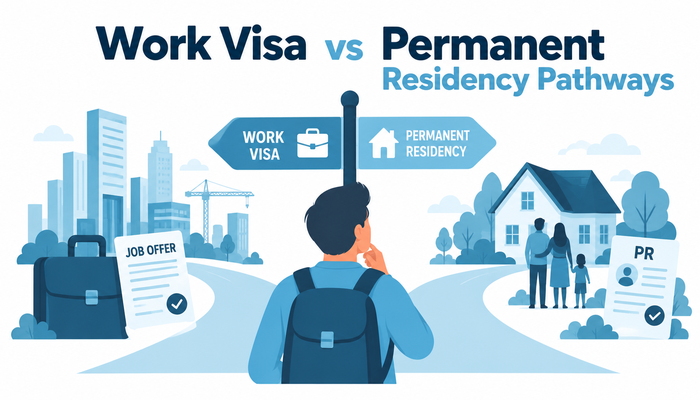
Work Visa vs Permanent Residency Pathways: Which Route Makes More Sense?
When I first started researching relocation options, I treated every immigration route as if the goal was the same:
Get permission to move abroad.
But once I looked more closely, I realized that a work visa and a permanent residency pathway can lead to very different lives, even if both allow you to live and work in the same country.
One may depend heavily on a specific employer.
Another may give you much more freedom but require a stronger profile or longer preparation.
One may get you into the country faster.
Another may offer more long-term stability.
So the useful question isn't:
“Which visa is better?”
It's:
“Which immigration structure gives me the right balance of speed, flexibility, career options and long-term security?”
That is a much more practical comparison.
First, Understand the Difference
The exact terminology varies by country, so always check the current official rules of the destination you're considering.
But broadly:
Work Visa
A work visa or work-based residence permit usually allows you to live and work in a country under certain conditions.
Those conditions may be connected to:
A specific employer
A specific occupation
A specific type of work
A salary threshold
A limited period of stay
Other immigration requirements
Permanent Residency
Permanent residency usually gives a person a more stable long-term right to reside in a country.
Depending on the country, it may offer greater freedom in employment and fewer immigration restrictions than a temporary work-based status.
But permanent residence is not the same as citizenship, and the rights attached to it vary by country.
The practical distinction is:
A work visa often gets you into the country under conditions.
Permanent residency often reduces how much your future depends on those conditions.
The Biggest Difference Is Dependency
This is the part that matters most in real life.
Imagine two people working in the same city.
Both have the same salary.
Both have similar apartments.
Both appear equally settled.
But one person's legal status is strongly tied to their employer.
The other has permanent residency.
Their lives can feel very different.
The first person may think carefully before:
Changing jobs.
Quitting.
Taking a career break.
Moving into another role.
Dealing with employer conflict.
Negotiating aggressively.
The second may have more room to make those decisions independently, depending on local rules.
So when comparing routes, don't look only at whether both allow you to work.
Ask:
“How much of my life depends on keeping the same immigration conditions?”
Work Visas Can Be Strategically Excellent
A work visa is not an inferior option.
For many people, it is the most realistic and efficient first step.
A good work-based route can give you:
Immediate employment.
Local professional experience.
Income from the beginning.
Employer support.
A way to test the country before making a long-term commitment.
A possible route toward permanent residency later.
If your goal is to enter a country, build local experience and decide later whether you want to stay permanently, a work visa can make a lot of sense.
Permanent Residency Can Change Your Decision-Making
Permanent residency can be valuable because it may reduce uncertainty.
Instead of asking:
“Can I change jobs without affecting my immigration status?”
you may have greater freedom to focus on:
Career growth.
Salary.
Work-life balance.
Industry changes.
Self-employment.
Family decisions.
Housing.
Long-term planning.
Again, the exact rights vary by country.
But psychologically, the difference can be significant.
Immigration status affects how comfortable you feel making ordinary career decisions.
Speed vs Stability
A useful way to compare the two is:
Work Visa
Often optimized for entry and employment.
Permanent Residency Pathway
Often optimized for long-term settlement and independence.
That can create a trade-off.
A work visa may be available relatively quickly if you have a qualifying job offer.
A direct permanent residency pathway may require:
A competitive profile.
More documentation.
Language results.
Points.
Specific experience.
Financial preparation.
Longer processing.
Neither is automatically better.
It depends on what you need now.
Practical Example: Daniel Has Two Options
Imagine Daniel is 30 and works in software.
He has:
Five years of experience.
Strong English.
A good degree.
No spouse or children.
He receives a job offer abroad.
At the same time, he appears potentially competitive for a permanent residency pathway in another country.
Option A: Work Visa
The job is strong.
Salary is good.
The employer is international.
The visa process is relatively straightforward.
Daniel can move sooner.
But his status is initially tied more closely to the employment arrangement.
Option B: Permanent Residency Pathway
The process is slower.
There is more uncertainty before approval.
But if successful, Daniel may enter with greater long-term flexibility.
Now the choice is not:
temporary = bad
and:
permanent = good
It's:
Do I value speed and a strong job opportunity more right now, or do I value legal independence and long-term flexibility more?
That is the real decision.
Ask How Easy It Is to Change Employers
This is one of the most important questions for any work visa.
Don't assume you can simply resign and start another job.
Depending on the country and permit, changing employers may require:
Notification.
Approval.
A new application.
A new sponsor.
A new permit.
Meeting new salary or occupation conditions.
Your timeline may also matter.
So when evaluating a work visa, research:
What happens if I lose my job?
How long can I remain?
Can I change employers?
Does the new employer need to sponsor me?
Does my new role need to meet certain conditions?
Those questions matter almost as much as the original job offer.
Your First Employer Has More Power on a Work Visa
This isn't always obvious before moving.
If your legal status is connected to your job, your first employer can indirectly influence more than your salary.
They may affect:
Your residence stability.
Your timing.
Your ability to leave.
Your willingness to negotiate.
Your tolerance for a bad work environment.
That doesn't mean employer-sponsored migration is dangerous by default.
It means you should evaluate the employer more carefully.
Don't only ask:
“Will they sponsor me?”
Ask:
“Would I still want to work for this company if immigration wasn't part of the offer?”
That's a very useful filter.
Permanent Residency Can Reduce Career Friction
With a more independent immigration status, you may be able to evaluate jobs more like a local worker.
You can focus on:
Role quality.
Career trajectory.
Salary.
Management.
Commute.
Company culture.
Remote work.
Promotion.
Instead of:
“Can this employer maintain my legal status?”
That additional freedom can improve long-term career decisions.
But you usually pay for that freedom through a harder or longer immigration process upfront.
Compare the Financial Cost
Work visa and permanent residency pathways can create very different financial requirements.
Work Visa Costs May Include
Documents.
Application fees.
Translations.
Travel.
Relocation.
Initial housing.
Employer-related costs depending on the structure.
Emergency fund.
Permanent Residency Pathway Costs May Include
Language tests.
Credential assessment.
Application fees.
Medical or background-related requirements where applicable.
Financial proof.
Documents.
Relocation.
A longer waiting period before earning locally.
The biggest difference may not be application fees.
It may be cash flow.
If a work visa comes with a confirmed job, you may start earning relatively quickly.
If a permanent residency process requires months of preparation without a job offer, you may need more financial runway before moving.
Don't Ignore the Cost of Dependency
There is also a less visible financial cost.
Suppose your employer-sponsored status makes you reluctant to leave a bad job for 12 months.
You may miss:
A better salary.
A better role.
A shorter commute.
A healthier company.
A stronger career opportunity.
That lost flexibility has value.
You can't easily put it into a spreadsheet, but it belongs in the comparison.
Can a Work Visa Lead to Permanent Residency?
In many countries, work-based residence can potentially contribute toward longer-term residence or permanent settlement, subject to current rules and individual circumstances.
But never assume:
Work visa → automatic permanent residency
The real path may depend on:
Years of residence.
Type of permit.
Employment continuity.
Language.
Income.
Integration requirements.
Tax or insurance history.
Other conditions.
Some temporary residence periods may be treated differently from others.
So before accepting a work visa as your long-term strategy, research the actual transition path.
Ask:
“If I stay on this route, what would I need to qualify for permanent residency later?”
Reverse-Engineer the Permanent Residency Path
This is one of the most useful exercises.
If your long-term goal is permanent settlement, start from that outcome and work backward.
For example:
Permanent residence in Year 5
Then ask:
What residence status do I need in Years 1–4?
Does this work permit count toward the required residence period?
Do I need a language level?
Do I need continuous employment?
Are income or contribution requirements relevant?
What happens if I switch employers?
What happens if I spend time outside the country?
What documents should I preserve from Day One?
Now your work visa becomes part of a roadmap rather than simply a ticket into the country.
Work Visa May Be Better If You Are Still Testing the Country
Permanent immigration is a significant commitment.
You may not yet know whether you actually want to stay.
You can research:
Weather.
Housing.
Language.
Culture.
Salaries.
Work-life balance.
But there are things you may only understand after living there.
A work visa can sometimes function as a real-life test.
You might spend two or three years learning:
Do I enjoy working here?
Can I build friendships?
Can I handle the language long term?
Do I want to raise a family here?
Does my career have enough room to grow?
If you decide the country isn't right for you, temporary status may have allowed you to gain valuable international experience without building your entire future around permanent settlement.
Permanent Residency May Be Better If You Already Know What You Want
Permanent residency becomes more attractive when:
You have a strong long-term commitment to the country.
You want to buy a home eventually.
Your family needs stability.
You want greater career flexibility.
You don't want your residence tied closely to one employer.
You want to plan many years ahead.
The more long-term your decisions become, the more valuable immigration stability may feel.
Family Changes the Calculation
For a single professional, employer dependency might be manageable.
For a family, it can feel much more serious.
Imagine one person's work status supports the family's ability to remain in the country.
Job loss may affect:
Housing.
Children's schooling.
Partner plans.
Savings.
Residence stability.
That doesn't automatically mean permanent residency is necessary before moving.
But families should ask more questions.
How does the partner's status work?
Can the partner work?
What happens if the main applicant changes jobs?
What happens after job loss?
How does the long-term residency path work for family members?
The downside risk becomes larger when several people's lives depend on one status.
Partner Career Freedom Matters Too
A relocation can look successful on paper because the main applicant has an excellent job.
But if the partner cannot work easily or has very limited career options, the household may become less satisfied over time.
So compare pathways at household level.
Don't only ask:
“Can I work?”
Ask:
“What can we both build under this immigration structure?”
Permanent Residency Does Not Mean Permanent Happiness
There is another mistake on the opposite side.
People sometimes treat permanent residency as the final objective.
They spend years chasing it.
Then they receive it and realize:
They don't love the city.
Their career has stalled.
Housing is expensive.
They want to return home.
Their priorities have changed.
Permanent residency is a legal status.
It isn't proof that the destination is still the right place for you.
Don't confuse immigration security with life fit.
Work Visa Does Not Mean Your Life Is Temporary
A temporary immigration status can create a very real life.
People build:
Friendships.
Careers.
Relationships.
Routines.
Communities.
Skills.
Savings.
A temporary legal label doesn't make those experiences temporary or meaningless.
You can take the move seriously while keeping long-term options open.
Practical Comparison
Factor | Work Visa | Permanent Residency |
Initial speed | Can be faster with qualifying employment | May require more preparation |
Employer dependency | Often higher | Usually lower |
Job flexibility | Can be restricted | Often greater |
Long-term security | Lower initially | Higher |
Upfront career certainty | Strong if job already secured | May vary |
Immigration flexibility | More limited | Usually greater |
Financial cash flow | Often better with immediate employment | May require more runway |
Best for testing country | Often useful | Bigger commitment |
Family stability | Depends heavily on route | Often stronger |
Long-term planning | More uncertainty | Usually easier |
This is a planning framework, not a universal legal comparison. Exact rights vary significantly by country and status.
Common Mistakes When Comparing the Two
Choosing the Fastest Route Without Looking Five Years Ahead
Speed matters, but so does the status you will have after arrival.
Assuming Employer Sponsorship Means Career Security
A sponsor helps with immigration. It doesn't guarantee a good workplace.
Assuming Permanent Residency Is Automatically the Best Goal
It only makes sense if the destination supports the life you actually want.
Ignoring Job-Loss Rules
Understand what happens before something goes wrong.
Ignoring Employer-Change Restrictions
Career flexibility can matter enormously after your first year.
Treating Work Visas as Automatically Temporary
Some can form part of a long-term settlement strategy.
Assuming a Work Visa Automatically Converts to PR
The transition usually has separate requirements.
Looking Only at Your Own Status
Partner and family rights can completely change the decision.
What Nobody Tells You About Employer-Linked Immigration
You may not realize how much immigration status affects your confidence until you're living under it.
An annoying manager can feel more powerful.
A bad job can become harder to leave.
An ordinary company restructuring can suddenly feel personal.
You may think twice before changing careers.
You may save more aggressively because you want a larger safety margin.
You may tolerate uncertainty differently.
This isn't necessarily a reason to reject employer-sponsored migration.
It's a reason to build options.
Before accepting a work visa, I would want to know:
How easily can I change employers?
What happens if I'm laid off?
How much emergency money do I need?
What would my path to permanent residency look like?
When could I become less dependent on one employer?
Speaking with someone who has already used the same route can be especially useful here.
Don't ask only:
“Was the visa easy?”
Ask:
“How did the status affect your job decisions after you arrived?”
“Were you afraid to change employers?”
“What happened when coworkers were laid off?”
“How long did it take before you felt immigration-independent?”
Those are the questions official immigration pages usually cannot answer.
A Simple Decision Framework
Work Visa May Fit Better If:
You already have a strong job offer
The role significantly improves your career
You want to move sooner
You are still testing the country
You understand employer-change rules
You have enough emergency savings for job disruption
The route can support your long-term goal if you decide to stay
Permanent Residency May Fit Better If:
You already have a competitive direct pathway
You value career flexibility highly
You want long-term settlement
Your family needs greater stability
You want less employer dependency
You can handle the longer preparation or waiting period
The destination clearly fits your five-year goals
Build Two Five-Year Scenarios
Before choosing, write both futures.
Scenario A: Work Visa
Year 1: Enter through employer, stabilize, learn the system.
Year 2: Build local experience and language.
Year 3: Change role or improve salary if possible.
Year 4: Meet more long-term residence conditions.
Year 5: Pursue permanent status or reconsider destination.
Scenario B: Permanent Residency
Year 1: Arrive with greater flexibility and establish career.
Year 2: Optimize employer, city and lifestyle.
Year 3: Build deeper professional and personal roots.
Year 4: Make larger long-term decisions.
Year 5: Evaluate citizenship or other future options where applicable.
Now compare the two lives.
Not just the applications.
Work Visa vs PR Checklist
Immigration Structure
Check exact status type
Check validity period
Understand renewal requirements
Understand employer dependency
Check employer-change process
Understand job-loss consequences
Research route to permanent residence
Career
Evaluate employer quality
Compare salary with local costs
Check alternative employers
Understand career progression
Research whether status restricts job changes
Think about your second job, not only the first
Financial
Calculate relocation costs
Build emergency fund
Estimate job-loss runway
Compare upfront costs
Compare earning start dates
Include family financial risk
Long-Term Fit
Define five-year goal
Consider partner's career
Consider children/family
Assess language expectations
Evaluate housing and lifestyle
Decide how important immigration independence is
Conclusion: Choose the Structure Behind the Visa
A work visa and a permanent residency pathway can both lead to successful international lives.
They simply solve different problems.
A work visa may give you:
Speed.
Employment.
Income.
Local experience.
A chance to test the country.
Permanent residency may give you:
Stability.
Flexibility.
Greater independence from one employer.
More confidence in long-term planning.
The best route depends on what you're optimizing for.
If you already have a career opportunity worth taking, a work visa may be an excellent first move.
If you already have a realistic permanent residency pathway and know you want to build a long-term life in the country, waiting for greater immigration independence may be worth it.
Whatever route you choose, verify the current rules through the responsible official immigration authority before making major decisions. Work rights, residence conditions, employer-change rules and permanent-residency requirements vary by country and can change.
And don't stop at:
“Can I move?”
Ask:
“What kind of freedom will I have after I move?”
That question often tells you much more about the life you're actually choosing.
FAQ
Is permanent residency better than a work visa?
Not universally. Permanent residency generally provides more long-term stability and may offer greater employment flexibility, while a work visa can be faster and more practical when you already have a strong job offer.
Can a work visa lead to permanent residency?
In many countries, some work-based residence pathways can contribute toward permanent residency, but the transition is not automatic. Requirements vary by country and status.
What happens if I lose my job on a work visa?
It depends on the specific country and permit. Your status may allow a period to find another employer, require a new application or be affected more immediately. Check the official rules before relying on a work-based route.
Can I change employers on a work visa?
Sometimes, but the process varies. You may need approval, notification, a new sponsor or a new permit. Do not assume employer changes are unrestricted.
Is it better to get permanent residency before moving?
It can be advantageous if you qualify directly and value long-term flexibility, but waiting may not make sense if you already have a strong employment opportunity and the work route supports your wider goals.
Should I accept employer sponsorship?
Evaluate both the immigration route and the employer itself. A strong sponsorship offer is most useful when the job, salary, company and long-term career path are also good.
What should I compare before choosing between a work visa and permanent residency?
Compare employer dependency, job-change rules, job-loss risk, total costs, processing timeline, family rights, long-term settlement requirements, career flexibility and how each route fits your five-year plan