How to Check Your Eligibility for Immigration Programs
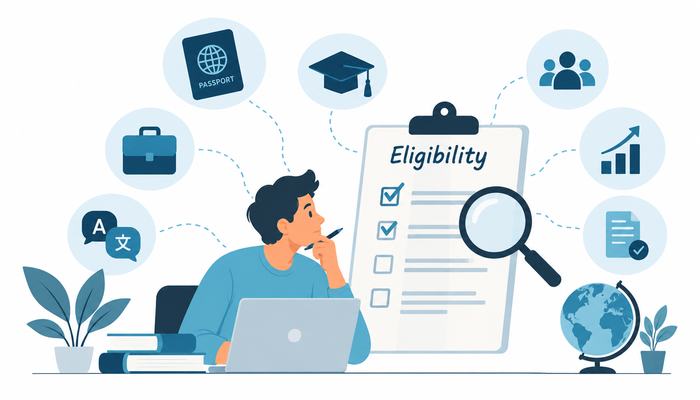
How to Check Your Eligibility for Immigration Programs Before You Apply
One of the easiest mistakes to make when planning a move abroad is starting with countries instead of eligibility.
You find a destination you like.
Then you discover a promising immigration program.
You read a few articles, watch videos and perhaps use an online calculator.
Everything looks possible.
So you begin imagining the move.
But there is a much more useful question to answer first:
“Based on my actual profile today, which immigration programs am I realistically eligible for?”
Immigration eligibility is rarely determined by one factor.
Your nationality, education, qualifications, work experience, profession, language ability, finances, job offer, family situation and purpose of relocation can all matter.
And different programs can evaluate the same person very differently.
The goal of an eligibility check isn't to predict whether your application will definitely be approved.
It's to identify which pathways are worth investigating seriously—and which ones currently have obvious gaps.
Eligibility Is Not the Same as Approval
This distinction matters.
Meeting the basic eligibility requirements for an immigration program does not necessarily mean your application will be approved.
Think of the process in three stages:
Potential fit → Eligibility → Application decision
First, a program appears relevant to your profile.
Second, you verify that you satisfy its requirements.
Third, the responsible authority evaluates your actual application and evidence.
Your goal during early research is primarily the first two stages.
Don't treat an online eligibility calculator, social-media video or even your own checklist as a visa decision.
Step 1: Define Why You're Moving
Before checking programs, define your purpose.
Are you moving to:
Work?
Study?
Search for work?
Join family?
Start a business?
Conduct research?
Build a long-term career?
Your purpose immediately narrows the relevant pathways.
For example, the EU Immigration Portal organizes information for longer stays around purposes such as work, study and family reunification, while individual countries make decisions on applications and may have their own national rules. (Migration and Home Affairs)
This is why searching for “best visa for Europe” isn't very useful.
Start with:
“What am I actually trying to do there?”
Step 2: Build Your Immigration Profile
Before comparing programs, create a simple profile of yourself.
Write down:
Nationality
Age
Highest education
Field of study
Professional qualifications
Years of relevant work experience
Current occupation
Language abilities
Current savings
Job offer status
Family situation
Previous international experience
Target countries
Intended length of stay
Don't evaluate anything yet.
Just collect the facts.
This becomes your baseline for comparing programs.
Step 3: Separate Your Qualification From Your Profession
This is one of the areas where people often become confused.
Your qualification is what you've formally studied or trained for.
Your profession is what you actually do.
They may overlap perfectly.
Or they may not.
For example:
You might have a degree in engineering but work in project management.
A business degree but several years of experience in technology.
Vocational training followed by specialized professional experience.
Different immigration pathways may care differently about formal qualifications and professional experience.
So when checking eligibility, don't simply write:
“I have a bachelor's degree.”
Record:
What is the degree?
Where was it awarded?
Is the institution recognized?
Is the qualification relevant to your intended work?
Could formal recognition or comparability be required?
That level of detail matters.
Step 4: Check Whether Qualification Recognition Matters
Recognition is particularly important for some professions and immigration pathways.
Don't assume that because your qualification is valid in your home country, it will automatically be treated the same way in your destination.
Germany's Opportunity Card is a useful example of why details matter.
Germany currently provides different routes to the Opportunity Card. One route applies to people considered skilled workers through qualifications obtained or fully recognized in Germany; another uses a points-based pathway for applicants meeting specified basic conditions. (Make it in Germany)
So the question isn't merely:
“Do I have a degree?”
It may be:
“How is this particular qualification treated under this particular pathway?”
That is much more precise.
Step 5: Calculate Relevant Work Experience Carefully
“Five years of work experience” sounds simple.
It may not be.
Programs can care about things such as:
Relevance.
Duration.
Timing.
Occupation.
Skill level.
Evidence.
Employment status.
Your CV saying you worked somewhere for four years isn't necessarily the same as having four years of experience that meets a particular program's criteria.
Create a work history table.
Period | Role | Employer | Relevant Experience | Evidence Available |
2021–2023 | Marketing Specialist | Company A | Yes | Contract + reference |
2023–2025 | Marketing Manager | Company B | Yes | Contract + reference |
2025–Present | Consultant | Self-employed | Possibly | Contracts + invoices |
The last column is important.
Eligibility isn't only about what is true.
Applications often require you to demonstrate it appropriately.
Step 6: Check Language Requirements Exactly
Don't write:
“My English is good.”
Immigration programs may require formal evidence or specific levels.
Record your language profile precisely:
English: B2? C1?
German: A1? B1?
Spanish: conversational?
Italian: beginner?
Do you already have an accepted test result?
When does it expire, if applicable?
Again, Germany's Opportunity Card demonstrates why precision matters. Under its points route, current official guidance includes minimum language conditions and then awards points for certain additional criteria. (Make it in Germany)
The important lesson isn't to memorize Germany's rules.
It's this:
Language ability and immigration-proof language ability aren't always the same thing.
Check what evidence the specific program accepts.
Step 7: Check the Financial Requirement
People often ask:
“How much money do I need to immigrate?”
That's too broad.
Different pathways can require different financial evidence.
A student may need to demonstrate resources.
A job-search pathway may require proof that you can support yourself.
A person arriving with employment may face different requirements.
Family circumstances can also change the calculation.
For example, Germany's official guidance for its Opportunity Card currently requires proof of sufficient financial resources; the amount and acceptable evidence should be checked against current official guidance when applying. (Make it in Germany)
Italy's student pathway likewise includes financial resources among the conditions listed for non-EU students, alongside requirements such as admission, health insurance and housing. (Migration and Home Affairs)
Don't assume your relocation budget automatically satisfies an immigration financial requirement.
Treat them separately.
Step 8: Determine Whether You Need a Job Offer
This single question can eliminate many irrelevant pathways.
Ask:
Do I need employment before applying?
Some routes are built around an existing job.
Others may allow qualified applicants to enter or remain for job-search purposes if they satisfy the relevant conditions.
Germany's Opportunity Card, for example, is specifically designed as a job-search pathway and does not simply require everyone to arrive with an existing job offer. (Make it in Germany)
The practical lesson is important.
If your target pathway requires a job offer and you don't have one, your immediate project isn't necessarily “apply for immigration.”
It may be:
become employable and secure the qualifying offer.
That's a completely different action plan.
Step 9: Check Whether Your Occupation Changes the Rules
Your profession can matter for reasons beyond employability.
Some occupations may involve:
Professional recognition.
Licensing.
Specific qualifications.
Regulatory requirements.
Different employment conditions.
So research both:
Immigration eligibility
and:
Professional eligibility
You don't want to discover after months of immigration planning that the real barrier is being able to legally or practically work in your profession.
Step 10: Check Study Pathways Properly
Studying abroad shouldn't be treated as a generic alternative when a work pathway looks difficult.
First ask whether studying actually supports your long-term goal.
Then verify the specific requirements.
For example, Spain's official migration information states that applicants for relevant study authorization must be admitted to an authorized educational institution for a qualifying full-time program. (Ministerio de Inclusión)
Italy also sets specific conditions for non-EU students, including admission-related requirements and the appropriate visa and residence process. (Migration and Home Affairs)
So don't simply ask:
“Can I get a student visa?”
Ask:
“Am I eligible for the specific study pathway, and does this education improve the career or life outcome I'm actually pursuing?”
Step 11: Create an Eligibility Matrix
Once you've collected your information, compare pathways in one place.
For example:
Requirement | Program A | Program B | Program C |
Education | Meets | Meets | Needs review |
Work experience | Meets | Missing 1 year | Meets |
Language | Meets | Test required | Needs improvement |
Job offer | Required | Not required | Required |
Qualification recognition | Required | Possibly | Not confirmed |
Financial proof | Meets | Needs more funds | Meets |
Overall status | Research further | Gap | Research further |
This prevents a common mistake:
Reading each immigration program separately and forgetting how they compare.
Use Three Categories: Green, Yellow and Red
For every requirement, mark it:
Green — I Can Verify That I Meet It
You have the requirement and appropriate evidence.
Yellow — Unclear or Fixable
Examples:
Need a language test.
Need qualification recognition.
Need additional savings.
Need better documentation.
Need more research.
Red — Currently Not Eligible
Examples:
Mandatory qualification missing.
Required professional experience missing.
Required job offer absent.
A condition you cannot currently satisfy.
This turns immigration research into an action plan.
Practical Example: Amir's Eligibility Check
Imagine Amir is 31.
He has:
A bachelor's degree in mechanical engineering.
Five years of professional experience.
Strong English.
Basic German.
€14,000 in savings.
No international job offer.
He is considering Germany.
Instead of asking:
“Can Amir immigrate to Germany?”
he should break the problem down.
Route 1: Employment-Based Pathway
Does he need a job offer?
Would his intended employment satisfy the relevant requirements?
How is his qualification treated?
What salary or employment conditions apply to the specific route?
Route 2: Opportunity Card
Does his qualification satisfy the relevant basic conditions?
Does he qualify directly as a recognized skilled worker or need the points route?
Does he meet the language condition where applicable?
Does he have sufficient financial resources?
How many points would his profile receive if using the points route?
Germany's official Make it in Germany service provides a self-check specifically for the Opportunity Card, which is much more useful than relying on an unofficial social-media calculator. (Make it in Germany)
Now Amir isn't asking one enormous question.
He's checking a series of verifiable conditions.
That's how eligibility research should work.
Don't Confuse “Not Eligible Yet” With “Impossible”
This mindset matters.
Suppose your eligibility matrix shows:
Language: insufficient.
Savings: insufficient.
Work experience: six months short.
That doesn't necessarily mean the pathway is impossible.
It may mean:
Not yet.
You can turn those gaps into milestones.
For example:
Next 6 Months
Improve language.
Next 9 Months
Complete required work experience.
Next 12 Months
Build financial reserves.
Then reassess.
Immigration planning becomes much less overwhelming when you convert eligibility gaps into projects.
But Some Gaps Should Change Your Strategy
Not every red box should become something you spend years trying to fix.
Imagine one pathway requires several major changes while another country or program fits your existing profile much better.
Ask:
“Am I improving my profile—or forcing myself into one specific pathway?”
There is a difference.
Sometimes the smartest decision is changing the route rather than changing yourself.
Common Mistakes When Checking Immigration Eligibility
Using Social Media as the Main Source
Use videos and communities to discover questions, not as final proof of current requirements.
Checking Only One Requirement
A degree alone doesn't establish eligibility.
Using Outdated Information
Immigration rules, thresholds and procedures can change.
Confusing Eligibility With Guaranteed Approval
Meeting basic criteria doesn't determine the authority's final decision.
Ignoring Documentation
Being able to prove experience or qualifications can matter as much as having them.
Assuming All EU Countries Use Identical Rules
EU frameworks exist, but individual countries make immigration decisions and national rules can differ. (European Union)
Checking the Visa but Not the Career
Being legally able to move somewhere doesn't guarantee a strong professional opportunity there.
Paying Someone Before Understanding the Basics Yourself
Even when you use professional assistance, understanding the official criteria helps you ask better questions.
What Nobody Tells You About Immigration Eligibility
The technically available pathway isn't always the strategically best pathway.
You might qualify for a program in Country A.
That doesn't automatically mean Country A is the best destination for your career.
You might qualify for study in Country B.
That doesn't automatically mean paying for another degree is your best move.
You might satisfy the conditions for a job-search route.
That doesn't guarantee your profession has a strong local market.
Immigration eligibility answers: “Can this pathway potentially work?”
It doesn't answer:
“Should I build my life around it?”
That's where lived experience becomes valuable.
Once you've identified two or three realistic pathways through official sources, speak with people who actually moved using similar routes.
Ask about:
Job searching.
Housing.
Language.
Costs.
Career progression.
The first year.
What happened after the immigration process ended.
Official sources tell you the rules.
Experienced expats can help you understand the life behind those rules.
You need both.
Immigration Eligibility Checklist
Personal Profile
Nationality recorded
Age checked where relevant
Family situation considered
Relocation purpose defined
Target countries identified
Education
Highest qualification recorded
Institution status checked where relevant
Qualification recognition researched
Professional licensing checked if applicable
Supporting documents available
Career
Relevant work experience calculated
Occupation requirements researched
Employment evidence available
Job-offer requirement checked
Local job market researched
Language
Required language identified
Required level identified
Accepted evidence checked
Current level assessed realistically
Test timeline planned if necessary
Financial
Official financial requirement checked
Relocation budget calculated separately
Emergency fund planned
Family costs included
Currency and timing considered
Verification
Current official government source checked
Information date checked
Embassy/consulate guidance checked where applicable
Unclear conditions identified
Professional advice considered for complex cases
A Simple Eligibility Workflow
If I were checking immigration options today, I would use this sequence:
1. Define the goal.
Work, study, job search, family or another purpose.
2. Build the profile.
Education, experience, language, finances and family situation.
3. Find relevant pathways.
Not every available visa—only routes that match the goal.
4. Read official requirements.
Use the responsible government or official immigration authority.
5. Build the matrix.
Compare each requirement against your actual profile.
6. Identify gaps.
Green, yellow or red.
7. Verify uncertainties.
Never guess about a condition that could determine eligibility.
8. Research real life.
Once a pathway looks realistic, investigate whether the destination actually supports your career and lifestyle.
That order saves enormous amounts of wasted research.
Conclusion: Check Eligibility Before You Fall in Love With the Plan
Immigration planning becomes much harder when you emotionally commit to a destination before understanding whether the pathway fits your profile.
Reverse the process.
Start with yourself.
Your education.
Your experience.
Your profession.
Your language.
Your finances.
Your family.
Your goals.
Then compare those facts with current official program requirements.
Use official self-check tools where available. Germany, for example, currently provides an official Opportunity Card self-check through its government-backed Make it in Germany portal. (Make it in Germany)
For EU destinations more broadly, the European Commission's EU Immigration Portal can help you navigate information by country and purpose, but individual countries remain responsible for immigration decisions. (Migration and Home Affairs)
And always verify the current rules before acting.
Eligibility criteria, financial thresholds, documentation requirements and procedures can change.
The goal isn't to find someone online who says:
“Yes, you can immigrate.”
The goal is to reach a point where you can say:
“I understand the pathway, I know which requirements I meet, I know which gaps remain, and I know what I need to verify next.”
That's when immigration stops being a vague dream and starts becoming a plan.
FAQ
How do I know if I'm eligible for an immigration program?
Compare your nationality, education, work experience, profession, language ability, finances, job-offer status and family situation against the current official requirements of the specific program.
Does meeting the eligibility criteria guarantee visa approval?
No. Meeting basic eligibility requirements means a pathway may be available to you, but the responsible authority still evaluates your application, documents and circumstances.
Where should I check immigration eligibility?
Start with the official immigration, government, embassy or consular resources for the destination. For EU countries, the EU Immigration Portal can also help identify relevant categories and country-specific information. (Migration and Home Affairs)
Can I check immigration eligibility without a lawyer?
Many people can perform an initial eligibility assessment themselves using official information and self-check tools. Complex cases or unclear legal circumstances may justify qualified professional advice.
What if I'm not eligible right now?
Identify why. Some gaps—such as language, savings, documentation or additional experience—may be addressable. Others may make a different pathway or destination more realistic.
Should I check eligibility before taking a language test?
Ideally, first identify the pathways you're considering and their accepted language requirements. That helps you choose the appropriate test and target level rather than preparing without a specific objective.
How often should I recheck immigration requirements?
Recheck before making important decisions and again before applying. Immigration rules, thresholds, documentation and procedures can change, so current official guidance should take priority over older articles or personal experiences.