cost of Living vs Salary Expectations
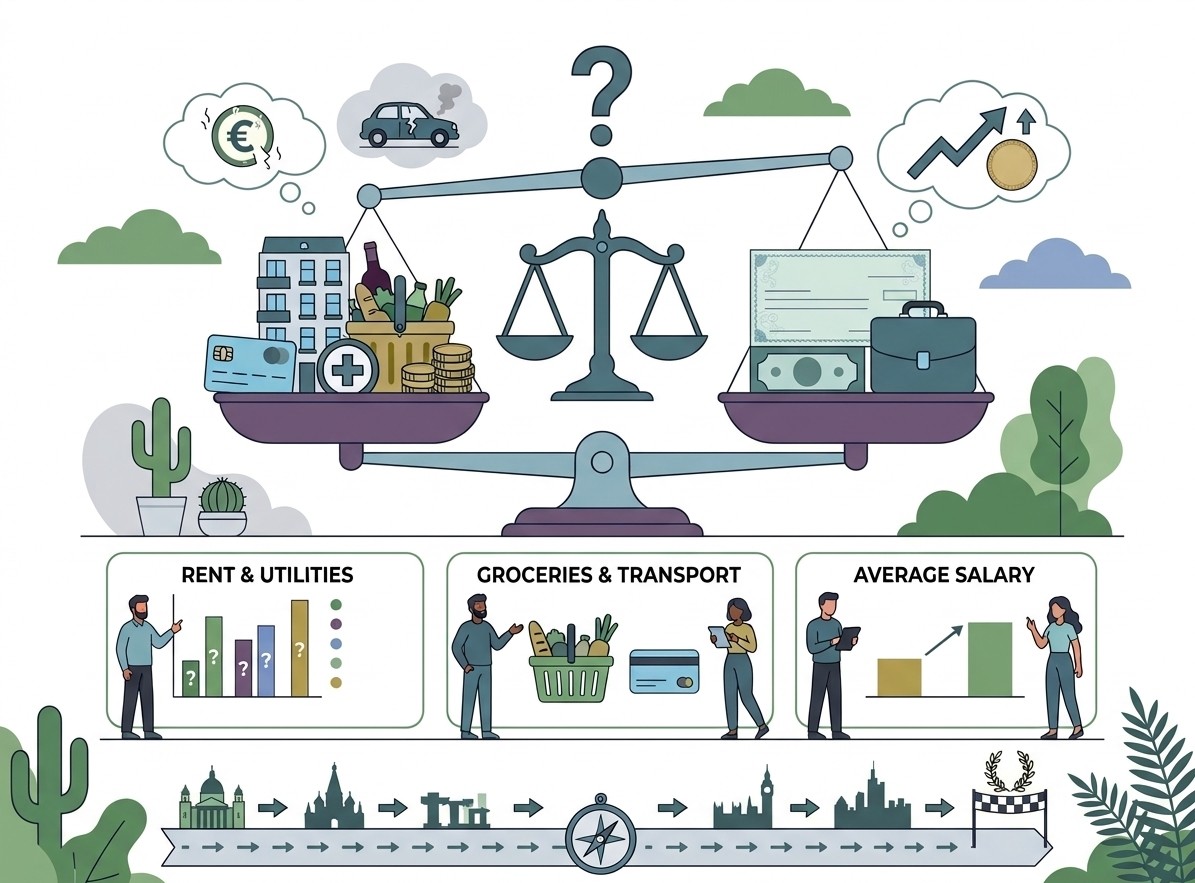
Cost of Living vs Salary Expectations: What Expats Should Really Expect in Europe
Introduction
When planning a move abroad, salary is usually one of the first things people research.
You might compare a €50,000 job offer with a €45,000 offer and immediately assume the first is better. But salary alone doesn't tell you how comfortable you'll actually be.
A higher income can come with higher rent, taxes, transportation costs, and everyday expenses. Meanwhile, a lower salary in a more affordable city may leave you with more money at the end of the month.
That's why cost of living vs salary expectations is a more useful comparison than salary alone.
The real question isn't:
"How much will I earn?"
It's:
"How much will I have left after paying for the life I want?"
This matters particularly when comparing Germany, Spain, and Italy. Salaries and living expenses vary between countries, but they can also vary dramatically between cities.
This guide explains how to compare income and expenses realistically before relocating.
Table of Contents
What Does Cost of Living vs Salary Mean?
Gross Salary vs Net Salary
Expenses to Include in Your Budget
Germany: Salary vs Living Costs
Spain: When a Lower Salary Can Still Work
Italy: Why Location Matters
Germany vs Spain vs Italy
Why City Choice Matters
How to Calculate Disposable Income
Salary Expectations by Career Stage
Common Mistakes
Lessons Learned
What Nobody Tells You
Relocation Budget Checklist
FAQ
Conclusion
What Does Cost of Living vs Salary Mean?
Cost of living vs salary describes the relationship between your income and the money you need to maintain your lifestyle.
Consider two hypothetical expats:
Person A | Person B | |
Monthly net salary | €3,500 | €2,700 |
Monthly expenses | €2,700 | €1,700 |
Money remaining | €800 | €1,000 |
Person A earns €800 more but has €200 less available after expenses.
This is why salary comparisons can be misleading.
Before relocating, consider:
Net monthly income
Rent and utilities
Groceries
Transportation
Healthcare and insurance
Taxes and social contributions
Lifestyle expenses
Travel
Unexpected costs
Potential savings
The number that matters most is what remains after your realistic expenses.
Disposable Income Is the More Useful Number
Disposable income is essentially the money you have available after relevant taxes and expenses.
A healthy relocation budget should leave room for:
Savings
Emergencies
Travel
Hobbies
Social activities
Long-term financial goals
A salary that covers basic bills but leaves nothing for savings or unexpected expenses may not provide the lifestyle you expected.
Gross Salary vs Net Salary
One of the biggest traps when comparing salary expectations in Europe is confusing gross income with take-home pay.
A job advertised at €50,000 generally refers to gross annual salary. Taxes and other mandatory contributions can reduce the amount that reaches your bank account.
Your final net income can also depend on personal circumstances.
Germany's Federal Ministry of Finance provides an official wage and income tax calculator that can be used as an estimation tool. The result is not a binding individual tax assessment. (bundesfinanzministerium.de)
Before comparing job offers, check:
Gross annual salary
Expected net monthly income
Bonuses
Employer benefits
Insurance contributions
Pension contributions
Other deductions
Your basic comparison should therefore be:
Net salary − realistic living expenses = money available for savings and lifestyle
That figure tells you much more than gross salary.
The Main Expenses Expats Need to Calculate
Housing
Housing is often the biggest expense.
Don't calculate only the advertised rent. Consider:
Utilities
Heating
Electricity
Internet
Building charges
Deposit
Furniture
Moving costs
Rental-related fees
Location is equally important.
An apartment that costs €200 less but requires an expensive daily commute may not actually save you much money.
Groceries
Food costs depend on your lifestyle.
Someone who cooks at home most days will have a different budget from someone who regularly eats out.
Look at your existing habits rather than using an unrealistic "minimum" food budget simply to make a relocation affordable.
Transportation
Your transport budget could include:
Public transportation
Fuel
Car insurance
Parking
Maintenance
Registration costs
Occasional taxis or ride-hailing
Living close to work and public transportation can sometimes make a car unnecessary.
Healthcare and Insurance
Healthcare arrangements differ between countries and individual circumstances.
Your budget may need to include insurance contributions, prescriptions, dental treatment, co-payments, or private healthcare.
Don't leave this category out simply because you're moving to a country with a public healthcare system.
Lifestyle
A realistic budget should include the things you actually enjoy:
Restaurants
Cafés
Gym
Hobbies
Entertainment
Shopping
Weekend trips
Holidays
Visits home
If your budget only works when you never go out or travel, it probably isn't realistic.
Germany: Salary Doesn't Tell the Whole Story
Germany attracts many international professionals because of its large economy and opportunities in areas such as technology, engineering, healthcare, finance, and other specialized professions.
But a strong salary doesn't automatically mean strong disposable income.
Housing can make a major difference.
Munich and Frankfurt, for example, can be expensive, while other German cities may offer a different balance between employment opportunities and housing costs.
Berlin also requires careful housing research.
Instead of asking whether Germany has good salaries, calculate:
Salary + city + housing + transportation + lifestyle
Before Accepting a German Job
Ask:
What will my estimated net income be?
Is there a bonus?
Which benefits are included?
Is relocation support available?
What does housing near the workplace cost?
How much will commuting cost?
You can also use the official German tax calculator for an initial estimate. For personal tax decisions, verify your circumstances through current official information.
Spain: When a Lower Salary Can Still Work
Spain can appear less attractive when you compare salary figures alone.
In some professions, local salaries may be lower than equivalent roles in Germany.
But lower income doesn't necessarily mean lower financial comfort.
Housing and everyday costs vary considerably between Spanish cities. Madrid and Barcelona, for example, require careful housing research, while smaller cities may offer a different balance.
Spain can also be interesting for people with:
Remote jobs
International employers
Specialized skills
Above-market salaries
Flexible location preferences
The useful question isn't whether Spain has "good" or "bad" salaries.
Ask:
Does my expected income support my lifestyle in the city where I want to live?
Italy: Why Location Matters
Italy presents another situation where national averages can hide important differences.
Milan has a very different employment and housing environment from many smaller Italian cities.
Your profession matters too. Someone working in technology or finance may have a very different earning potential from someone working in hospitality or another lower-paid sector.
So instead of asking:
"Is Italy cheaper than Germany?"
ask:
"What can I earn in my profession, what will I spend in this city, and how much can I save?"
For current tax information, the Italian Revenue Agency provides official information concerning personal income taxation and IRPEF. (infoprecompilata.agenziaentrate.gov.it)
Germany vs Spain vs Italy: Which Is Better Financially?
There is no universal winner.
Factor | Germany | Spain | Italy |
Salary potential | Strong in many skilled professions | Profession-dependent | Profession-dependent |
Major-city housing | Can be expensive | Can be expensive | Highly variable |
Smaller-city options | Worth considering | Worth considering | Worth considering |
Job market | Broad across skilled sectors | Stronger in selected sectors | Highly regional |
Importance of city | Very high | Very high | Extremely high |
Savings potential | Depends on income and housing | Depends on income and housing | Depends on income and housing |
These are broad patterns, not guarantees.
A software engineer, nurse, teacher, designer, researcher, or hospitality worker can have completely different financial outcomes in the same country.
Why City Choice Can Change Everything
One of the most important relocation lessons is:
Compare cities, not just countries.
"Is Germany expensive?" doesn't tell you whether your relocation will work.
Ask instead:
Can I afford Munich on my expected income?
What would housing cost in Frankfurt?
Would another German city give me more disposable income?
How much would commuting cost?
Would living outside the city center actually save money?
The same principle applies to Spain and Italy.
A Simple Example
Imagine:
Apartment A | Apartment B | |
Rent | €1,000 | €750 |
Transport | €50 | €250 |
Total | €1,050 | €1,000 |
Apartment B looks much cheaper initially.
But after transportation, the difference is only €50.
You also need to consider commuting time and quality of life.
The cheapest rent isn't always the cheapest overall choice.
How to Calculate Your Real Disposable Income
You can use a simple three-step calculation.
Step 1: Find Your Estimated Net Income
Start with expected monthly take-home pay rather than gross salary.
Step 2: Calculate Realistic Expenses
Include:
Housing + utilities + food + transportation + insurance + healthcare + lifestyle + other fixed costs
Step 3: Subtract Your Expenses
For example:
Monthly Item | Amount |
Net income | €3,200 |
Housing + utilities | €1,250 |
Groceries | €400 |
Transportation | €100 |
Healthcare/insurance | €150 |
Phone + internet | €60 |
Entertainment | €200 |
Other expenses | €240 |
Remaining | €800 |
Now imagine earning €2,800 in another location while spending €1,800.
You would have €1,000 remaining.
The lower salary produces €200 more disposable income.
Remember Annual Expenses
Some expenses don't appear every month.
Consider:
Flights home
Holidays
Dental care
Electronics
Clothing
Car maintenance
Professional certifications
Administrative expenses
Emergency costs
Estimate these annually and divide the total by 12 to include them in your monthly calculation.
Salary Expectations by Career Stage
Entry-Level Professionals
Don't automatically expect your first salary abroad to match someone with years of local experience.
You may still be adapting to:
Recruitment practices
Workplace culture
Language expectations
Professional standards
Networking
Industry-specific requirements
Your first job may be a starting point rather than your final earning level.
Mid-Career Professionals
Several years of experience can give you more negotiating power.
Technical skills, industry knowledge, achievements, management experience, language skills, and qualifications can all influence compensation.
Compare the complete package rather than base salary alone.
Senior Professionals
For senior roles, consider:
Bonuses
Equity
Pension contributions
Relocation assistance
Insurance
Paid leave
Professional development
Flexible working
An extra €5,000 in annual salary isn't necessarily better if another offer provides substantially better benefits or a cheaper living environment.
Common Mistakes Expats Make
Comparing Gross Salaries
A €60,000 gross salary isn't €60,000 of spending money.
Always estimate take-home income.
Trusting Generic Cost-of-Living Rankings
Online calculators can provide a useful starting point, but they can't predict your personal spending.
Your budget depends on your housing, lifestyle, transportation, family situation, and travel habits.
Ignoring Housing
Don't accept a salary offer before researching realistic rental costs in areas where you could actually live.
Assuming the Capital Is Always Better
Major cities often offer more jobs but can also have higher housing costs.
A smaller city may provide a better financial balance if suitable employment exists.
Forgetting Initial Relocation Costs
Your first months abroad may be much more expensive than normal.
You may need money for:
Deposits
Temporary accommodation
Furniture
Flights
Transportation
Documents
Household essentials
Keep a separate relocation fund rather than treating these costs as part of your normal monthly budget.
Lessons Learned From Real Relocations
People who have already moved abroad often discover that their original budget changes once real life begins.
Three categories cause frequent surprises.
Housing
The salary may look attractive until you discover what it costs to live somewhere practical for work.
One-Time Expenses
Deposits, furniture, moving costs, and setting up a new household can quickly add up.
Lifestyle
A strict pre-move budget might assume you'll never eat out, travel, socialize, or spend money on hobbies.
That rarely reflects real life.
A better budget makes room for both saving and living.
This is also where speaking with an experienced expat can be useful. Someone already living in your target city may help you identify everyday expenses and trade-offs that don't appear in salary calculators.
What Nobody Tells You About Salary Expectations
The salary that looks impressive before relocation can feel surprisingly ordinary after you move.
That's because your attention naturally goes to one large number:
"I'll earn €X per year."
Your actual financial experience is determined by many smaller numbers:
Rent. Groceries. Transportation. Insurance. Travel. Entertainment. Unexpected costs.
Then there are first-year expenses that may not repeat:
Moving costs
Deposits
Furniture
Language courses
Trips home
Building an emergency fund
So don't ask only:
Can I afford to live there?
Ask:
Can I live there, save money, and handle an unexpected expense?
If you're unsure how realistic a job offer is, speaking with someone who has already relocated can reduce a lot of trial and error. Their experience won't replace official financial or tax guidance, but it can provide practical context that a calculator can't.
Cost-of-Living Checklist
Before accepting a job abroad, calculate:
Gross annual salary
Estimated monthly net salary
Rent
Utilities and heating
Internet and phone
Groceries
Transportation
Healthcare and insurance
Restaurants and entertainment
Hobbies
Travel
Annual expenses
Emergency fund
Initial relocation costs
Expected monthly savings
Expected annual savings
Then ask:
"After paying for a realistic lifestyle, how much can I actually save?"
That number is often more useful than your salary.
FAQ
Is a high salary always better for expats?
No. Higher salaries can come with higher taxes and living costs. The amount remaining after realistic expenses is usually more useful than the salary figure alone.
Is Germany financially better than Spain?
Not automatically. Germany can offer strong salaries in several skilled professions, but housing and other expenses can also be significant. Your profession and city matter.
Is Italy cheaper than Germany?
It depends on the city and your lifestyle. Compare specific locations and your expected income rather than relying on national averages.
How much of my salary should go toward rent?
There is no universal percentage that works for everyone. Evaluate rent together with utilities, transportation, savings goals, and other expenses.
Should I choose a country based on salary?
No. Consider salary alongside housing, taxes, career opportunities, job security, healthcare, lifestyle, and savings potential.
Should I negotiate salary before moving abroad?
Yes. Research the market value of your role and experience before accepting an offer, and compare the entire compensation package.
Are smaller cities financially better for expats?
They can be, particularly when housing is cheaper. But lower living costs are only useful if suitable employment is available.
What is the most important number when comparing job offers?
For many expats, it is the amount remaining after taxes and realistic living expenses.
How can I estimate my salary after tax?
Use current official tax information and calculators for your destination country. For Germany, the Federal Ministry of Finance provides an official wage and income tax calculator. For Italy, consult the Italian Revenue Agency for current tax information.
Conclusion
Cost of living vs salary expectations should be one of the first financial comparisons you make before moving abroad.
A higher salary doesn't automatically mean a better financial situation. Likewise, a lower salary doesn't automatically make a country unaffordable.
The starting formula is simple:
Net salary − realistic living expenses = disposable income
But don't stop there.
Consider your savings goals, emergency fund, housing, commute, career progression, and the lifestyle you actually want.
If you're comparing Germany, Spain, Italy, or another European destination, don't ask only:
"Which country pays the most?"
Ask:
"Where do my career, income, lifestyle, and financial goals fit best?"
That's the comparison that gives you a much more realistic picture of what life abroad could look like.