The Mistake I Made When Evaluating My Immigration Chances
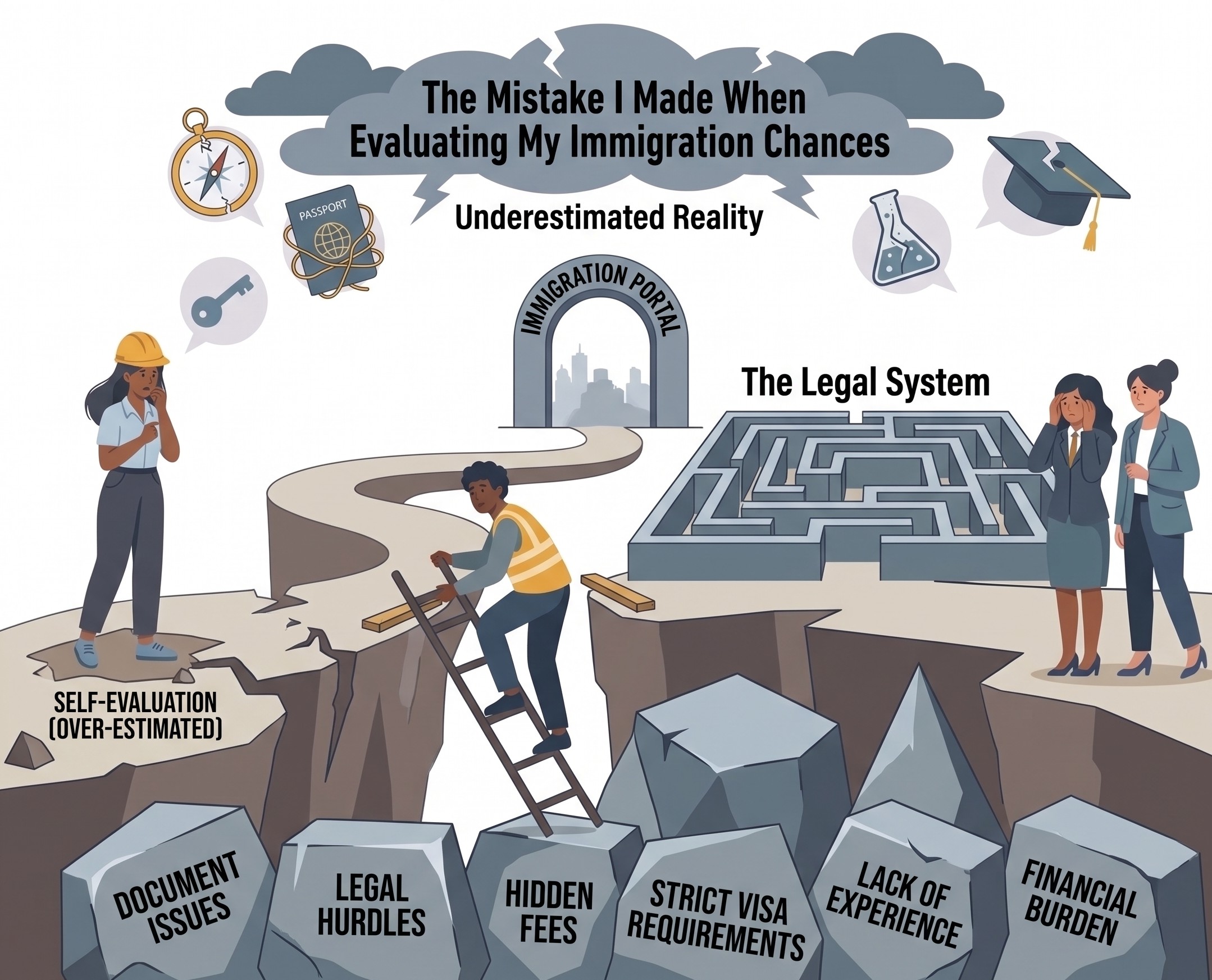
The Mistake I Made When Evaluating My Immigration Chances
When I first started evaluating my immigration chances, I thought I was doing everything right.
I looked at the obvious things first. I had a university degree. I had work experience. My English was good. I was still relatively young, and I had started saving money for a move abroad.
Then I compared myself with people who had already immigrated.
Some had backgrounds similar to mine. A few even seemed to have fewer qualifications or less experience. That made me feel confident.
So I reached a simple conclusion: my chances were probably good.
That was my mistake.
Not because optimism was wrong. The problem was that I had reduced my entire future to a list of qualifications.
I was asking:
“Is my profile good enough to immigrate?”
What I should have asked was:
“Given my education, work experience, finances, language skills, timeline, and expectations, which country and pathway actually make sense for me?”
Those questions are not the same.
A person can have a strong profile on paper and still choose a destination or pathway that does not fit their circumstances. Another person may have fewer obvious advantages but a more realistic plan, greater flexibility, and a better understanding of what comes after arrival.
That is why evaluating immigration chances is about more than age, degrees, work experience, or online eligibility tools.
It is about fit.
The Mistake: I Treated My Immigration Profile Like a Scorecard
My original approach was simple.
I made a mental list of my strengths:
I have a degree.
I have professional experience.
I speak English.
I have some savings.
I meet some of the general criteria I have read about.
The more boxes I could tick, the more confident I became.
But those factors did not exist separately.
My degree mattered differently depending on the country and career path I chose. My work experience could be valuable in one job market and less relevant in another. My language skills might be enough for daily conversations but not necessarily enough for the professional opportunities I expected.
My savings looked acceptable until I considered the full cost of relocation.
Travel was only the beginning. There could also be temporary accommodation, rental deposits, everyday expenses, document costs, and the possibility that finding work or settling in would take longer than planned.
Suddenly, “I have enough money to move” was not a useful conclusion.
The better question was:
Enough money for what—and for how long?
That was the shift I needed to make. Instead of evaluating my qualifications one by one, I needed to evaluate how my entire situation would work in real life.
A Strong Profile Does Not Automatically Mean Strong Immigration Chances
There is no universal definition of a perfect immigration profile.
Imagine someone with:
A master's degree
Five years of professional experience
Strong English skills
Moderate savings
Little knowledge of the local language
On paper, that person may look like a strong candidate.
But the real questions start after the basic profile.
What is their degree in?
What kind of work have they done?
Are their skills relevant to the jobs they want?
How transferable is their experience?
How important is the local language in their industry?
Can they support themselves if their job search takes longer than expected?
Would they accept a different role or location?
The answers can completely change the picture.
This is why evaluating immigration chances should not be about adding up positive qualifications.
Your profile only becomes meaningful when you put it into context.
Eligibility vs. Realistic Opportunity
One of the most important lessons I learned was the difference between being eligible and having a realistic opportunity.
Eligibility asks:
“Can I apply?”
Realistic opportunity asks:
“How well does this option fit my actual situation, and what would I realistically need to make it work?”
You may meet the general conditions to explore a particular work or study pathway. That can be an important starting point.
But eligibility alone does not answer questions like:
Can you realistically secure the job or admission you need?
Can you afford the full transition?
Does your professional background fit the opportunities available?
What happens if your original plan takes longer than expected?
Are you prepared for the practical realities of daily life after moving?
This matters when comparing destinations such as Germany, Spain, or Italy.
The right country is not automatically the most popular one. It is the one that makes sense for your skills, goals, finances, and expectations.
Getting into a country and building a sustainable life there are two different challenges.
The Five Factors I Should Have Evaluated Together
1. Education
A degree can be valuable, but it is only one part of your profile.
Ask yourself:
Does my education support the career I want?
Does it match my work experience?
Will I need additional training or adaptation?
Am I relying too heavily on my degree while ignoring practical skills?
A degree may open opportunities. It does not automatically create them.
2. Work Experience
“Five years of experience” sounds impressive, but the number of years does not tell the whole story.
You also need to consider:
Your industry
Your specific skills
Your level of responsibility
How transferable your experience is
The types of roles you could realistically pursue
Someone can be highly experienced in their home country and still need time to understand how their experience translates to another market.
That does not make the experience worthless. It means the strategy may need to change.
3. Language Ability
Language is another area where people often oversimplify their chances.
Being able to pass a test or hold a basic conversation is not necessarily the same as being comfortable enough to:
Handle a job interview
Follow workplace discussions
Build professional relationships
Deal with housing problems
Understand important documents
Manage unexpected situations
For some careers, English may be enough for certain opportunities. For others, local language ability can significantly affect the options available.
The key question is not simply, “Do I know the language?”
It is, “Is my current language level practical for the life and work I want?”
4. Financial Reality
I initially thought about money in the simplest possible way: Can I afford to move?
That was the wrong calculation.
A realistic budget may need to include:
Travel
Applications and documents
Translation or certification costs where relevant
Temporary accommodation
Rental deposits
Basic household expenses
Transportation
Ongoing living costs
A financial buffer for delays
The exact costs depend on the country, city, and personal situation. Current prices should always be researched before making financial decisions.
The important point is this:
Do not build your plan around everything going perfectly.
5. Flexibility
Flexibility is difficult to measure, but it can make a huge difference.
Ask yourself:
Would I consider more than one city?
Would I accept a different role temporarily?
Am I willing to improve my language skills before moving?
Can I adjust my timeline?
Would I reconsider my original plan if new information suggests a better option?
Sometimes the difference between an unrealistic plan and a workable one is not another qualification.
It is flexibility.
A Practical Example: Two Similar Applicants
Consider two fictional applicants.
Factor | Applicant A | Applicant B |
Education | Master's degree | Master's degree |
Work experience | 5 years | 5 years |
English | Strong | Strong |
Savings | Moderate | Moderate |
Local language | Beginner | Beginner |
At first glance, their immigration chances look almost identical.
But their plans are very different.
Applicant A wants to move to one specific city within three months. They expect the same job title, a similar salary, and are unwilling to consider alternative locations.
Applicant B has researched several cities. They are willing to spend more time improving their skills and language ability. They understand that their first job abroad may not look exactly like their previous role and have considered alternatives if their first plan does not work.
Who has better immigration chances?
There is no universal answer.
But Applicant B may have more realistic options because their plan has more room to adapt.
That is an important lesson: your chances are shaped not only by what you have, but also by what you are prepared to do.
Common Mistakes When Evaluating Immigration Chances
Comparing Yourself With One Successful Expat
You may find someone online who says they had a similar background and successfully moved abroad.
That can be useful and encouraging.
But you may not know their full story.
Their financial situation, professional network, timing, personal support, flexibility, or circumstances may have been completely different from yours.
Learn from other people's experiences, but do not use one success story as a prediction of your future.
Trusting Online Calculators Too Much
Online eligibility tools can be useful starting points.
They may help you understand general criteria or organize your information.
What they usually cannot measure is your:
Career flexibility
Financial resilience
Job-search strategy
Expectations
Ability to adapt
Personal priorities
Use calculators to start asking better questions—not to provide a final answer about your future.
Focusing Only on Getting There
Many people spend months researching how to enter a country and much less time thinking about what happens after arrival.
But relocation does not end when you arrive.
You may still need to deal with housing, work, language, administration, finances, and building a new routine.
A pathway that looks attractive at the beginning may not be the best fit once you consider the full experience.
What Nobody Tells You About Evaluating Immigration Chances
You do not need a perfect profile.
What you need is an honest understanding of your strengths and limitations.
Ask yourself:
What am I genuinely good at?
Where are the biggest gaps in my profile?
Which gaps can I improve?
Which problems require me to change my strategy?
What am I ignoring because I want this plan to work?
That last question can be uncomfortable.
When we want something badly, it is easy to pay more attention to information that confirms our preferred outcome.
I did exactly that.
I focused on the reasons my plan could work and gave less attention to the reasons it might require more time, money, or flexibility than I expected.
The goal of evaluating your immigration chances is not to get a simple yes-or-no answer.
The better question is:
“What would need to happen for this plan to become realistic?”
That question gives you something useful to work with.
How to Evaluate Your Immigration Chances More Realistically
Step 1: Define What You Actually Want
“I want to move abroad” is too broad.
Be specific.
Are you trying to:
Build an international career?
Study?
Change industries?
Improve your lifestyle?
Gain work experience abroad?
Build a long-term future in another country?
Your goal affects which options make sense.
Step 2: Build an Honest Profile
Write down your current situation without trying to make it sound impressive.
Include:
Education
Work experience
Industry and skills
Languages
Savings
Financial responsibilities
Preferred timeline
Career expectations
Lifestyle priorities
Countries you are considering
Accuracy is more useful than optimism here.
Step 3: Separate Fixed Constraints From Solvable Problems
Not every weakness is permanent.
Challenge | Possible Next Step |
Limited savings | Extend your preparation period |
Weak language skills | Create a structured learning plan |
Limited job options | Research related roles or locations |
Unrealistic deadline | Adjust the timeline |
Lack of local knowledge | Learn from people who have already moved |
The goal is not to eliminate every weakness.
It is to understand which weaknesses you can improve and which ones require a different plan.
Step 4: Compare Countries Based on Fit
Instead of asking:
“Which country is best?”
Ask:
“Which country is the best match for my current profile and goals?”
Germany may make sense for one person's professional background and career plans.
Spain or Italy may be a better fit for someone else with different priorities.
Popularity is not the same as suitability.
Step 5: Test Your Assumptions With Real Experience
Official information is essential for checking current requirements and procedures.
But official sources do not always explain what relocation feels like in practice.
They may not tell you what newcomers commonly underestimate about finding housing, adjusting to a different job market, or managing the first months after arrival.
This is where speaking with someone who has already gone through a similar relocation can be valuable.
An experienced expat cannot replace official information, but they may help you spot blind spots before you learn everything through trial and error.
A Realistic Immigration Assessment Checklist
Before committing significant time or money to a plan, ask yourself:
Do I understand the difference between eligibility and realistic opportunity?
Have I connected my education to a specific career goal?
Do I understand how transferable my work experience may be?
Have I evaluated my practical language ability?
Have I estimated the full cost of relocation?
Do I have a buffer for delays or unexpected expenses?
Have I researched realistic opportunities in my field?
Have I compared more than one suitable option?
Am I avoiding conclusions based only on another person's success story?
Have I identified the weakest parts of my plan?
Do I know which weaknesses I can realistically improve?
Have I considered how flexible I am about work, location, and timing?
Am I checking current official information relevant to my situation?
Have I tested my assumptions against real experiences from people who have already relocated?
If you cannot check every box, that does not mean your chances are poor.
It simply shows where you may need more research before making a bigger commitment.
The Lesson I Learned
The biggest lesson was that optimism was not the problem.
Selective optimism was.
I was looking for proof that my plan could work.
I should also have been looking for the reasons it might not work exactly as I imagined.
That does not mean becoming pessimistic.
It means challenging your own assumptions.
Ask:
What could delay this plan?
What am I underestimating?
What would I do if my first option failed?
What am I unwilling to compromise on?
What does success look like after arrival?
These questions may be uncomfortable.
They can also prevent expensive surprises.
Conclusion
The mistake I made when evaluating my immigration chances was assuming that a collection of good qualifications automatically created a good relocation plan.
It does not.
Your education, work experience, language skills, finances, age, and personal circumstances all matter. But they need to be evaluated together and in the context of a specific destination and realistic goal.
The purpose of an immigration assessment is not to predict your future with certainty.
No calculator or article can do that.
The purpose is to replace vague optimism—or unnecessary pessimism—with a clearer understanding of where you stand.
Identify your strengths.
Be honest about your gaps.
Improve the things you can improve.
And if the problem is not your profile but the fit between your profile and your plan, be willing to reconsider the country, timeline, or pathway.
Sometimes the smartest move is not becoming a completely different candidate.
Sometimes it is finding a plan that fits the candidate you already are.
If you are stuck between what looks possible on paper and what feels realistic in practice, speaking with someone who has already gone through a similar move can help you see the parts of the process you may be missing.
That kind of conversation will not guarantee an outcome. But it can help you make a better-informed decision before you invest more time, money, and energy.
FAQ
How can I evaluate my immigration chances realistically?
Look at your complete situation rather than focusing only on age, education, or work experience. Consider your skills, career goals, language ability, finances, flexibility, timeline, and the realities of your target destination.
Does having a degree improve my immigration chances?
A degree can strengthen your profile, but its value depends on your field, experience, career goals, and the opportunities connected to the country or pathway you are exploring.
Is being eligible the same as having a good chance of immigrating?
Not necessarily. Meeting general eligibility criteria can mean an option is available to explore, while practical factors such as finances, employment opportunities, timing, and personal circumstances may affect how realistic that option is for you.
Can an online immigration calculator predict my chances?
Online calculators can help you understand general criteria or organize your information. However, they cannot fully assess practical factors such as career opportunities, financial resilience, flexibility, or how well a plan fits your goals.
Should I compare my profile with someone who has already immigrated?
You can learn from their experience, but do not treat their outcome as a prediction of yours. Two people with similar qualifications may have very different finances, timing, expectations, support systems, and opportunities.
Can I improve my immigration chances before applying?
Depending on your circumstances, you may be able to strengthen relevant skills, improve your language ability, gain experience, increase your financial preparation, or adjust your timeline and options.
What is the biggest mistake people make when evaluating immigration chances?
One of the most common mistakes is evaluating qualifications separately instead of looking at how the entire profile fits a specific country, pathway, job market, and personal situation.
How do I know whether Germany is a good fit for my profile?
Consider how your education, professional background, language ability, finances, career goals, and lifestyle expectations align with the opportunities you are exploring. Verify current requirements through relevant official sources, as procedures and requirements can change.
Should I speak with someone who has already immigrated?
It can be useful when you want to understand the practical side of relocation. An experienced expat may help you identify assumptions, unexpected challenges, and day-to-day realities that are not obvious from general guides or eligibility tools. Their experience should complement—not replace—current official information.