Intensive German Courses vs Long-Term Learning
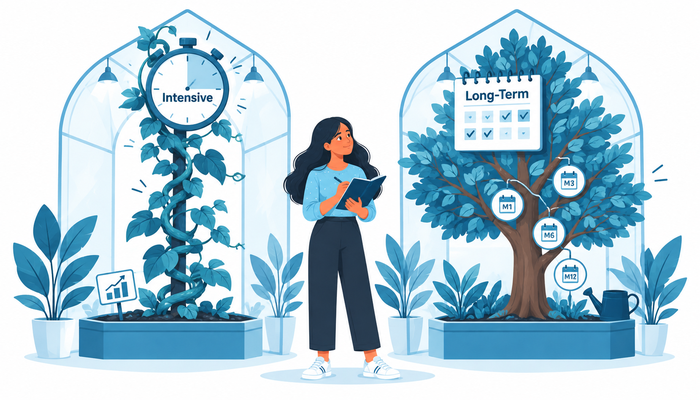
Intensive German Courses vs Long-Term Learning: Which Approach Works Better?
If you need German for an upcoming move, university application, job, or examination, an intensive course can sound like the obvious solution.
Study several hours every day.
Finish a level quickly.
Move on.
Compared with studying twice per week for months, intensive learning feels dramatically faster.
And in the right circumstances, it can be.
But completing material quickly and retaining usable German are not exactly the same thing.
Long-term learning gives vocabulary and grammar more opportunities to reappear. You have time to forget, retrieve, practice, make mistakes, and encounter the same structures in different contexts.
The real comparison is therefore not fast versus slow.
It is concentrated learning versus distributed learning.
Each can be effective, and the strongest choice depends on your starting level, deadline, daily schedule, learning stamina, and what you need to do with German afterward.
What Is an Intensive German Course?
An intensive course compresses a substantial amount of instruction into a short period.
Instead of attending one or two lessons each week, students may study on several or all weekdays and complete additional work outside class.
The exact number of hours and course length varies by provider.
That variation matters.
Do not choose a course simply because the word “intensive” appears in its name.
Check instructional hours, expected homework, class size, level progression, and what students are expected to accomplish.
What Is Long-Term Learning?
Long-term learning distributes German across a longer period.
You might attend classes twice per week, work with a tutor weekly, or follow an independent study schedule over many months.
Progress appears slower on a calendar.
However, the language repeatedly leaves and returns to your attention.
That repeated retrieval can strengthen retention.
You also have more time to integrate German into ordinary life through media, reading, conversations, and personal interests.
Long-term learning does not necessarily mean casual learning.
A learner studying ninety minutes every day for a year is following a long-term strategy while still accumulating substantial practice.
The defining feature is that progress is distributed rather than compressed.
Why Intensive Courses Can Work
Intensity creates momentum.
When you study German every day, yesterday's material is still fresh when today's lesson begins.
You spend less time mentally returning to the language after long gaps.
This can be particularly useful at beginner levels.
Vocabulary, basic grammar, pronunciation, and common sentence patterns accumulate quickly.
Intensive courses also create routine.
For several weeks, German becomes a major part of your day rather than something squeezed between other commitments.
If you have a deadline, that concentration may be necessary.
Someone preparing for an upcoming move or examination may not have a year available for gradual progress.
The Problem With Speed
Fast exposure does not guarantee long-term retention.
You can understand a grammar point on Monday, complete exercises correctly on Tuesday, and struggle to use it spontaneously three weeks later.
Intensive courses move because the schedule requires them to move.
Your brain may need more repetition than the timetable provides.
This creates an important distinction between “covering” a CEFR level and genuinely controlling the skills associated with it.
Finishing a course does not automatically mean that every skill has reached the target level.
Your reading may develop faster than speaking.
Your grammar exercises may be stronger than listening.
Use performance, not course completion alone, to judge progress.
The Burnout Risk
Intensity requires cognitive energy.
German is not the only thing happening in your life.
If you work full time and add several hours of German every evening, an intensive plan may become unsustainable.
The first week can feel exciting.
By Week Four, concentration may fall.
Homework accumulates.
You begin attending class without reviewing.
Eventually, the schedule that was supposed to accelerate learning reduces the quality of your practice.
Before choosing intensity, calculate the real workload.
Include class time, homework, vocabulary review, commuting if relevant, and independent practice.
Then compare that total with the time you genuinely have.
Why Long-Term Learning Can Work
Long-term learning creates space for consolidation.
You encounter a structure, forget part of it, retrieve it later, and meet it again in another context.
This process can feel slower, but it builds connections.
You also have more time to develop all language skills.
One week you may focus heavily on listening. Another week exposes a speaking weakness. You can adjust without feeling that an entire course level is racing ahead.
Long-term learning can also fit more naturally around employment, university, and family responsibilities.
A sustainable routine matters because reaching advanced German is a long project.
The Risk of Learning Too Slowly
Long-term learning has its own danger: insufficient intensity.
One ninety-minute lesson per week with no German between classes creates long gaps.
You may spend the beginning of every lesson remembering what happened previously.
Progress becomes frustratingly slow.
This is not necessarily a problem with long-term learning.
It is a problem with low exposure.
A sustainable long-term plan should still include German several times each week.
Short vocabulary review, listening, reading, writing, and conversation can maintain momentum between formal lessons.
Long-term does not have to mean occasional.
Which Is Better for Beginners?
Intensive learning can be highly effective for beginners who have enough time and energy.
Early German contains many foundational elements that support everything later: common verbs, sentence structure, pronunciation, articles, cases, numbers, questions, and high-frequency vocabulary.
Frequent contact helps these elements become familiar.
However, beginners should protect review time.
Do not respond to a fast course by simply studying new material faster.
Schedule repetition deliberately.
Otherwise, you may reach the end of A1 having seen everything but controlling very little.
Which Is Better for Intermediate Learners?
Intermediate learners face different challenges.
At B1 and B2, progress involves more than accumulating new grammar.
You need faster comprehension, broader vocabulary, spontaneous speaking, more precise writing, and the ability to handle increasingly complex topics.
These abilities benefit from repeated exposure over time.
An intensive course can still provide a powerful boost, particularly before an exam or relocation, but it should not replace sustained language use afterward.
Think of intensity as acceleration.
Long-term practice keeps the vehicle moving after the acceleration ends.
Intensive Courses for Exam Preparation
A short intensive period can be extremely useful before Goethe, TestDaF, or another language examination when your underlying German is already near the required level.
You can focus on task formats, timing, recurring weaknesses, and realistic simulations.
But intensive exam preparation cannot magically replace missing language proficiency.
If your German is substantially below the required level, learning exam strategies faster will not solve the fundamental problem.
Separate two questions:
Do I understand the exam?
Is my German strong enough for the exam?
Your preparation plan needs to address both.
Intensive Learning Before Relocation
A relocation deadline can justify temporary intensity.
If you are moving in eight weeks, studying more frequently now may produce practical benefits immediately after arrival.
Prioritize high-value communication.
Learn introductions, housing, transportation, shopping, appointments, work-related language, numbers, dates, and clarification strategies.
Practice listening.
Speak.
Do not spend your entire intensive period completing grammar worksheets because they feel measurable.
Your first weeks after relocation will require communication under imperfect conditions.
Prepare for that reality.
The Strongest Option: Combine Both
You do not necessarily need to choose between intensive and long-term learning.
A strong strategy can alternate between them.
You might begin with a six-week intensive period to build momentum, then move into a sustainable daily routine.
Later, you might use another intensive block before an examination.
Afterward, return to long-term exposure.
This creates periods of acceleration without expecting maximum intensity to continue forever.
Athletes do not train at maximum intensity every day of the year.
Language learners should not assume they must either.
Common Mistakes
The first mistake is believing that finishing a course level means mastering it.
The second is choosing an intensive program without calculating the workload.
Another mistake is allowing long-term study to become so relaxed that German appears only once per week.
Some learners repeatedly buy intensive courses because they enjoy the feeling of rapid progress but stop using German afterward.
Others spend years studying gradually without ever creating periods of focused speaking or listening practice.
Both patterns can create plateaus.
Match intensity to a purpose.
Lessons Learned
Speed and sustainability are not enemies.
They solve different problems.
Intensity is valuable when you need momentum, have sufficient time, or face a real deadline.
Long-term learning is valuable for retention, deeper skill development, and making German part of your life.
The important question is not how quickly you can finish the next course.
It is whether the German you learn remains available when you need to use it.
What Nobody Tells You About Intensive Learning
Rapid progress can create unrealistic expectations.
During an intensive course, German surrounds your schedule.
You improve noticeably.
Then the course ends.
If your exposure suddenly drops from several hours per day to almost nothing, your performance may decline.
This can feel like failure.
It is usually a maintenance problem.
Plan what happens after the course before the course finishes.
Decide how you will continue listening, speaking, reading, reviewing vocabulary, and receiving feedback.
The transition matters.
Choosing Based on Your Situation
Choose intensive learning when you have a deadline, enough daily time, strong motivation, and the ability to recover outside study hours.
Choose long-term learning when you need German to coexist with work or education and want a sustainable routine.
Combine them when possible.
A period of intensive learning followed by months of consistent practice can provide both momentum and retention.
Practical Checklist
Before choosing an intensive course, ask how many instructional hours it includes, how much homework is expected, whether you can realistically protect that time, and what happens if you miss lessons.
Ask how much speaking occurs.
Check whether the course prepares you for your actual goal.
For long-term learning, define minimum weekly exposure.
Do not rely on motivation.
Schedule German.
Include listening and speaking, not only lessons.
Review progress every few months and increase intensity temporarily when a weakness or deadline requires it.
Conclusion
Intensive German courses can accelerate learning, but speed alone does not guarantee durable proficiency.
Long-term learning can produce deep, sustainable progress, but only when “long-term” still includes regular contact with German.
The strongest strategy often combines both.
Use intensive periods when you need momentum, focused preparation, or rapid improvement before a meaningful deadline.
Use long-term routines to consolidate what you learned and continue building communication skills.
If you are preparing to move to Germany, remember that the end of a course is not the end of language learning.
German will continue developing through conversations, work, study, mistakes, media, relationships, and daily problems.
Choose a learning schedule that gets you ready for the next stage without leaving you too exhausted to continue once you reach it.
FAQ
Are intensive German courses worth it?
They can be highly valuable when you have enough time and energy to participate fully. They are particularly useful for building momentum, preparing before relocation, or focusing before an exam. Results still depend on review and continued practice.
Can I complete a German level in a few weeks?
Some intensive courses cover the curriculum associated with a level within a short period. However, completing a course does not guarantee equal mastery of listening, speaking, reading, and writing. Evaluate your actual abilities rather than relying only on course completion.
Is long-term learning better for remembering German?
Distributed learning creates more opportunities for retrieval and repeated exposure over time, which can support retention. However, long-term study must still be frequent enough to maintain momentum.
Can an intensive course take me from beginner to fluent German?
One short course cannot realistically replace the substantial learning and practice required for advanced proficiency. Intensive programs can accelerate particular stages, but developing broad, flexible German requires continued exposure and use.
Should I take an intensive German course before moving?
It can be useful if your schedule allows it. Focus not only on grammar but also on practical listening, speaking, and everyday vocabulary that will help after arrival.
What should I do after an intensive course?
Create a maintenance plan immediately. Continue vocabulary review, listening, reading, speaking, and targeted grammar practice. If you stop using German after the course, some newly learned material will become harder to retrieve.
Which approach is best for reaching B2 or C1?
Both can contribute. Intensive courses can accelerate progress, while long-term learning provides time for vocabulary, listening, writing, and spontaneous communication to mature. For many learners, alternating focused intensive periods with sustained practice is more realistic than relying exclusively on either approach.