Learning German in Your Home Country vs Germany
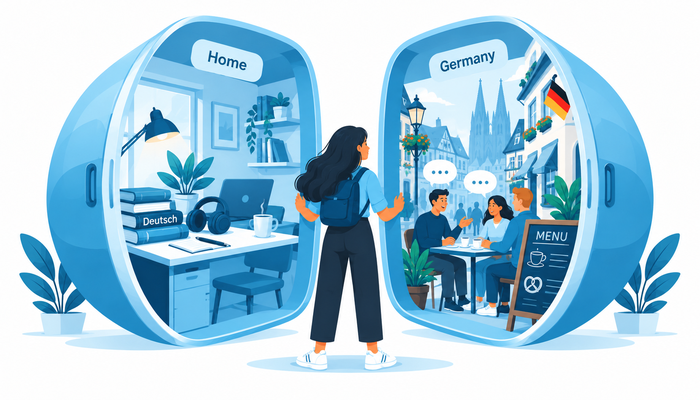
Learning German in Your Home Country vs Germany: Where Will You Learn Faster?
Many people planning to move to Germany tell themselves the same thing: “I will learn German properly after I arrive.”
The logic seems reasonable.
Germany is full of German. You will hear it in stores, on trains, at work, in advertisements, and during everyday conversations. Surely living there will make learning faster.
Immersion can help enormously.
But arriving in Germany without a foundation can also make the first months unnecessarily difficult.
You may be surrounded by German while understanding very little of it. Everyday tasks become stressful precisely when you are also adapting to a new country.
The better question is not where German can theoretically be learned faster.
It is how learning before and after relocation serve different purposes.
Learning in Your Home Country Gives You Preparation Time
Before relocation, German is usually one goal among many.
You may be working, studying, saving money, preparing documents, or planning your move.
The advantage is that mistakes have relatively low consequences.
You can struggle through a listening exercise without also worrying about missing an appointment.
You can practice a housing conversation before you actually need to solve a housing problem.
That makes pre-move learning a protected training period.
Use it.
Even basic German can make arrival less overwhelming.
Learning in Germany Creates Constant Exposure
Once you live in Germany, the language becomes part of your environment.
You see vocabulary on signs, receipts, menus, websites, transportation systems, letters, and products.
You hear different voices.
You discover which words people actually use repeatedly.
This provides context that is difficult to reproduce completely from abroad.
A word learned during a real situation often becomes memorable because it is connected to a need.
The environment can therefore accelerate learning.
But exposure is not the same as acquisition.
The Immersion Myth
Living in Germany does not automatically make someone fluent.
It is entirely possible to live in another country for years while functioning largely in your first language or English.
Your workplace may operate in English.
Your friends may speak your native language.
You may use translation apps for administrative tasks.
You may order food through apps instead of speaking.
Modern life makes avoiding difficult communication surprisingly easy.
Immersion works when you interact with it.
You need to notice language, ask questions, tolerate mistakes, review unfamiliar expressions, and deliberately expand the situations where you use German.
Germany gives you opportunities.
It does not force you to learn from them.
Why Learning Before Moving Helps
A foundation changes what immersion can do for you.
If you arrive knowing almost nothing, natural conversations may sound like continuous noise.
If you already have A2 or B1-level foundations, you can begin recognizing structures and vocabulary in the environment.
That makes everyday exposure more educational.
Instead of learning everything from zero, you connect classroom knowledge with reality.
You hear a phrase you studied and suddenly understand how it is actually pronounced.
You see grammar in a real email.
You discover informal alternatives to textbook expressions.
Pre-move study therefore makes later immersion more usable.
What Becomes Easier in Germany?
Listening can improve rapidly because you encounter many speakers and contexts.
Practical vocabulary becomes easier to prioritize because your life tells you what you need.
If you repeatedly visit supermarkets, transportation offices, workplaces, universities, or apartment viewings, relevant vocabulary appears naturally.
Speaking opportunities also increase.
You can ask questions instead of switching immediately to English.
You can speak briefly with neighbors.
You can participate in activities where German is used.
But this requires intentional behavior.
If every difficult interaction immediately moves to English, the learning opportunity disappears.
What Can Be Harder After Moving?
Relocation consumes mental energy.
You may be dealing with housing, finances, employment, university registration, transportation, paperwork, homesickness, and unfamiliar social norms simultaneously.
This is not always the ideal moment to begin learning basic sentence structure from zero.
Language problems also carry real consequences.
Misunderstanding a practice recording is harmless.
Misunderstanding an appointment time is different.
That additional pressure can make beginners avoid German precisely when they need practice.
Building a foundation beforehand reduces cognitive load.
The Social Side of Immersion
One of the strongest advantages of learning in Germany is social context.
Language is not merely grammar and vocabulary. It includes timing, politeness, humor, register, cultural references, and expectations about how people communicate.
These details become easier to observe when you live among speakers.
You learn how conversations begin and end.
You notice which textbook phrases sound overly formal.
You hear regional differences.
You experience the language as part of relationships rather than only as study material.
This is difficult to reproduce completely abroad.
Can You Create Immersion at Home?
You cannot perfectly reproduce living in Germany, but you can create substantial exposure.
Listen to German every day.
Watch German media.
Follow German creators.
Read news or simple articles.
Change selected devices or applications to German.
Join conversation groups.
Work with tutors.
Write notes and searches in German.
The goal is to make German something you encounter repeatedly rather than a subject that exists only during lessons.
You can also simulate practical situations.
Practice explaining an apartment problem, scheduling an appointment, introducing yourself professionally, or asking for clarification.
The more realistic your pre-move learning becomes, the smaller the gap after arrival.
Cost Matters
Learning in Germany can involve expenses that do not exist at home.
Relocation itself is expensive.
If you are moving primarily to learn German, accommodation, insurance, transportation, food, course fees, and other living costs can make immersion financially demanding.
Your home country may allow you to study while maintaining existing housing and employment.
This does not mean staying home is always cheaper once every factor is considered.
It means language learning should not be separated from your broader relocation budget.
If your move is already planned for work, study, or family reasons, the calculation is different from moving solely for language immersion.
Which Environment Is Better for Beginners?
Beginners often benefit greatly from starting before relocation.
At A1, basic vocabulary and sentence patterns require repetition wherever you live.
You do not need to be physically in Germany to learn numbers, introductions, common verbs, question forms, or fundamental grammar.
Building these basics beforehand allows you to use Germany for application rather than initial exposure.
That is a much better use of immersion.
Which Environment Is Better for Intermediate Learners?
Intermediate learners can benefit enormously from Germany because they already possess enough language to interact with the environment.
At B1 or B2, real-life exposure can reveal gaps quickly.
You may understand lessons but struggle with phone calls.
You may write accurately but find group conversations difficult.
You may know formal vocabulary but not everyday expressions.
These gaps become visible because real life tests your German constantly.
That feedback can accelerate progress if you respond to it deliberately.
A Better Strategy: Learn Before and After Moving
Treat relocation as a transition between two learning phases.
Before moving, build structure.
Develop core grammar, high-frequency vocabulary, listening habits, basic speaking confidence, and practical phrases.
After moving, use the environment aggressively.
Continue formal study if needed, but add daily interaction.
Record unfamiliar words from real situations.
Review letters you receive.
Notice recurring expressions.
Practice conversations you know you will need again.
Your learning becomes connected to your life.
This is stronger than waiting for Germany to teach you automatically.
Common Mistakes
The biggest mistake is postponing all German until arrival.
Another is assuming that moving automatically creates immersion.
A third mistake is becoming embarrassed by imperfect German and switching to English immediately.
Some learners also abandon structured study after moving because they believe everyday exposure is enough.
Natural exposure is valuable, but grammar, writing, academic language, and exam preparation may still require deliberate study.
Finally, avoid comparing your progress with other immigrants.
Their work environment, native language, social circle, previous language experience, and daily exposure may be completely different.
Lessons Learned
Pre-move learning and immersion are not competitors.
They reinforce each other.
Studying at home gives you foundations.
Germany gives those foundations context.
The stronger your starting point, the more you can extract from daily exposure.
The more you interact after arrival, the more clearly you can see what your formal study needs to improve.
This creates a powerful cycle.
What Nobody Tells You
Immersion can initially make you feel worse at German.
Before moving, you may feel confident because you understand your teacher and course recordings.
Then you arrive and hear fast speech, regional accents, incomplete sentences, background noise, and unfamiliar vocabulary.
It can feel as though your German disappeared.
It did not.
The environment simply became harder.
This stage is useful because it exposes the difference between controlled learning and spontaneous communication.
Give yourself time to adapt while continuing deliberate practice.
Talking with someone who has already relocated can also help you anticipate these gaps. Lived experience can show where German became unexpectedly important, while official requirements should always be verified separately.
Practical Pre-Move Checklist
Before relocating, try to become comfortable with introductions, numbers, dates, time, transportation, shopping, directions, basic housing vocabulary, appointments, and clarification phrases.
Practice listening regularly.
Speak before you feel completely ready.
Learn to say that you did not understand.
Learn to ask someone to speak more slowly.
Learn to confirm important information.
These abilities can be more valuable during your first weeks than memorizing unusual vocabulary.
Conclusion
Germany can be an exceptional environment for improving German, but location alone does not create proficiency.
The strongest strategy is usually to begin before you move.
Build enough German in your home country that you can interact with the environment after arrival.
Then use Germany as an enormous extension of your classroom.
Listen.
Ask questions.
Speak imperfectly.
Record what you do not understand.
Continue structured study where necessary.
Your home country gives you preparation.
Germany gives you context.
You do not need to choose between them.
Use each stage for what it does best.
FAQ
Will I learn German automatically if I move to Germany?
No. You will have greater exposure, but progress still requires interaction and deliberate learning. It is possible to live largely through English or another language, especially in international environments.
Should I learn German before moving?
Starting beforehand is usually useful. Even basic German can make transportation, shopping, introductions, appointments, and everyday problem-solving easier while making later immersion more productive.
What German level should I reach before moving?
There is no universal answer. Your practical target depends on work, study, family, and daily needs. Any formal requirement connected to a visa, university, employer, or regulated profession should be checked directly with the relevant organization.
Is immersion faster than classroom learning?
Immersion can accelerate listening, vocabulary, cultural understanding, and spontaneous communication, but structured learning remains useful. The strongest results often come from combining deliberate study with real-world exposure.
Can I create German immersion without living in Germany?
You can create substantial exposure through German media, conversation partners, tutors, reading, podcasts, online communities, and German-language routines. It will not reproduce every aspect of living in Germany, but it can prepare you effectively.
Why does German feel harder after arriving in Germany?
Real communication includes natural speed, accents, noise, interruptions, unfamiliar vocabulary, and social pressure. Classroom materials usually control these variables. The difficulty reflects a more demanding environment, not necessarily a loss of ability.
Should I continue taking German classes after moving?
That depends on your level and goals. Classes can remain valuable for structured progression, writing, grammar, exam preparation, and feedback, while daily life provides additional practical exposure.