Self-Study vs Private Tutors
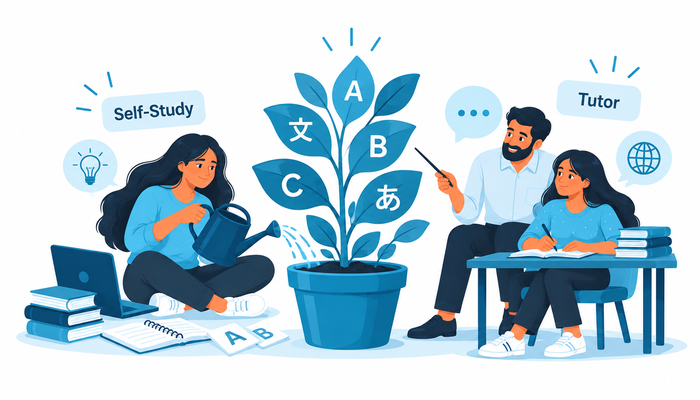
Self-Study vs Private Tutors: What Is the Better Way to Learn German?
Learning German by yourself can be remarkably effective. You can choose your resources, study whenever you want, repeat difficult material, and spend almost nothing if you use free resources wisely.
Then you try to have a real conversation.
Suddenly, vocabulary you recognized yesterday disappears. Word order becomes uncertain. You realize that you have been pronouncing something incorrectly for months, or that a sentence you confidently use sounds unnatural.
This is where private tutors become attractive.
A good tutor can identify weaknesses you cannot see yourself, correct recurring mistakes, create accountability, and force passive knowledge into active communication.
But private tutoring has limitations too. It costs more, depends heavily on teacher quality, and can become inefficient if the learner expects the tutor to do all the work.
The real question is therefore not whether self-study or private tutoring is universally superior.
It is which parts of German you can develop efficiently alone and which problems become easier to solve with another person.
Self-Study Gives You Control
The greatest advantage of self-study is control.
You decide when to study, what to review, how quickly to move, and which resources fit your goals.
If German cases are causing problems, you can spend three days concentrating on them. If the lesson is easy, you do not have to wait for the rest of a class.
This can make self-study extremely efficient.
There are also more high-quality resources available than most learners could ever finish. Official German-learning platforms, textbooks, podcasts, graded readers, videos, flashcard systems, and practice exercises can support learners from beginner through advanced levels.
The problem is no longer access to information.
The problem is selecting and using it consistently.
The Hidden Weakness of Self-Study
Independent learners control their learning environment so completely that they can unconsciously avoid uncomfortable skills.
If you enjoy reading, you read.
If grammar exercises make you feel productive, you complete grammar exercises.
If speaking makes you uncomfortable, you tell yourself you will start speaking after learning more vocabulary.
Months can pass.
This creates uneven ability.
You may understand a B1 text while struggling to produce an A2-level answer spontaneously.
Self-study also makes feedback difficult.
An exercise can tell you whether an answer is wrong, but it may not explain why you repeatedly make the same type of mistake when speaking.
You need mechanisms for discovering what you cannot see yourself.
What a Good Private Tutor Changes
A private tutor personalizes attention.
In a group class, a teacher divides attention among several students. In a private lesson, your weaknesses can determine the entire session.
That can accelerate correction.
Suppose you consistently place verbs incorrectly when speaking. A tutor can hear the pattern, stop you, explain it, and create exercises around your exact problem.
A tutor also creates spontaneous interaction.
You cannot control every question another person asks. That unpredictability is valuable because real communication works the same way.
For future expats, private sessions can be designed around practical situations such as apartment problems, workplace conversations, appointments, introductions, or phone calls.
That makes tutoring especially useful when your goal is functional communication rather than simply completing a curriculum.
The Limitations of Private Tutoring
Hiring a tutor does not guarantee progress.
Teacher quality varies, and compatibility matters.
A tutor may be excellent for exam preparation but less effective for conversation. Another may create enjoyable discussions without systematically correcting recurring weaknesses.
Cost is another limitation.
If you depend on a tutor for every aspect of learning, reaching an advanced level can become expensive.
There is also a danger of outsourcing responsibility.
Some students attend two private lessons each week and do almost nothing between sessions.
Two hours of tutoring cannot replace regular exposure, vocabulary review, reading, listening, and independent practice.
A tutor should multiply the value of your independent learning, not replace it.
Which Is Better for Beginners?
Beginners can benefit from both approaches.
Self-study works well when you have a clear structured course and can follow it consistently. At A1, much of your work involves building basic vocabulary, understanding common sentence patterns, developing pronunciation awareness, and learning fundamental grammar.
You do not need a private teacher beside you while completing every vocabulary exercise.
However, early feedback can prevent bad habits.
Occasional tutoring can help with pronunciation, sentence construction, and speaking confidence before errors become deeply established.
A useful beginner strategy is therefore structured self-study combined with targeted teacher sessions.
You learn independently, then use tutoring to practice, correct, and clarify.
Which Is Better for Intermediate Learners?
At intermediate levels, tutoring can become increasingly valuable because your mistakes become less obvious.
You can communicate.
People understand you.
That success can hide recurring problems.
Perhaps your vocabulary is broad but imprecise. Maybe your sentences remain simple because you avoid structures you do not trust. You may understand podcasts but freeze during spontaneous discussion.
A tutor can identify these patterns.
Intermediate learners also benefit from conversation that moves beyond predictable beginner topics.
Discussing work, education, technology, culture, or social issues forces you to organize more complex ideas in German.
Self-study remains essential, but targeted human feedback can help break plateaus.
Which Is Better for Speaking?
Private tutoring usually has a clear advantage for spontaneous speaking because another person creates interaction.
However, the quality of that interaction matters.
A lesson where the tutor talks for forty minutes is not effective speaking practice.
You should be producing language, receiving selective correction, and trying again.
Ask your tutor to record recurring errors rather than interrupting every sentence. Constant interruption can destroy fluency, while no correction allows mistakes to continue.
Outside tutoring, record yourself.
Summarize articles.
Describe your day.
Respond to imaginary questions.
Self-directed speaking practice is valuable, but combine it with real interaction so you cannot always control the conversation.
Which Is Better for Grammar and Vocabulary?
Self-study often wins for repetition.
You do not need to pay someone to watch you review twenty flashcards or complete routine grammar exercises.
Use independent study for learning and repetition.
Use tutoring for application.
Bring difficult grammar into conversation. Ask the tutor to create situations where you naturally need the structure.
If you have studied subordinate clauses, practice explaining reasons and conditions.
If you have learned workplace vocabulary, discuss a realistic professional situation.
This division makes tutoring more efficient.
Cost: Where Should Your Money Go?
If your budget is limited, do not assume you need frequent tutoring.
One focused session per week combined with consistent self-study can be more valuable than several unfocused lessons.
Before each session, identify what you want to practice.
Afterward, turn corrections into your study plan.
If a tutor corrects the same error every week and you never review it between lessons, you are paying repeatedly for the same feedback.
Use your money for things that are difficult to create alone: personalized correction, spontaneous conversation, pronunciation feedback, exam evaluation, and accountability.
Use free or inexpensive resources for repetition.
The Best Hybrid System
For many learners, the strongest approach is not self-study versus tutoring.
It is self-study plus tutoring.
Your main curriculum can remain independent.
Study grammar, vocabulary, reading, and listening throughout the week. Keep a notebook of questions and recurring difficulties.
Then bring those problems to your tutor.
Use lesson time actively.
Speak.
Ask questions.
Practice difficult situations.
Review corrections afterward.
This creates a feedback loop: independent learning reveals problems, tutoring clarifies them, and independent practice reinforces the correction.
That is far more efficient than expecting a tutor to teach everything from zero.
Common Mistakes
One common self-study mistake is constantly changing resources.
Another is postponing speaking.
Private students make different mistakes. Some arrive without preparation and expect the tutor to create motivation for them.
Others choose a teacher based only on price.
Another mistake is asking for correction of every tiny error during conversation. This can make speaking unnatural and stressful.
Prioritize errors that affect meaning or appear repeatedly.
Finally, do not confuse comfort with progress.
A tutor you enjoy can be valuable, but your lessons should still challenge you.
Lessons Learned
Self-study develops independence.
Tutoring develops feedback.
You need both qualities eventually, even if you do not use both methods formally.
A learner who depends completely on a teacher may struggle to continue learning independently after a course ends.
A learner who refuses all feedback may repeat the same mistakes for years.
The goal is to become capable of directing your own learning while knowing when outside help would save time.
That principle becomes particularly important after relocation, when German learning continues outside formal lessons.
What Nobody Tells You
A private tutor cannot make you fluent.
They can guide, correct, challenge, and accelerate your learning, but they cannot perform the repetitions for you.
Likewise, self-study is not automatically slower.
A disciplined learner with a good system can progress rapidly.
The real difference often appears when you become stuck.
If you spend three weeks trying to understand why your speaking sounds unnatural, a good teacher may identify the issue in ten minutes.
That is where tutoring can provide exceptional value.
Use human expertise where it removes bottlenecks.
Checklist
Self-study may suit you if you can follow a schedule independently, enjoy finding answers, have a limited budget, and already know how to organize learning.
Private tutoring may suit you if speaking is your weakness, you need accountability, you repeatedly make errors you cannot diagnose, or you have a specific deadline.
A hybrid approach may be strongest if you want efficiency without paying for every study hour.
Conclusion
Self-study and private tutoring solve different problems.
Independent learning provides flexibility, repetition, control, and affordability. Private tutors provide interaction, correction, accountability, and personalized guidance.
You do not need to choose one forever.
Build as much as you can independently.
Use a tutor when feedback, conversation, or expert diagnosis would accelerate progress.
Then take what you learn back into your daily routine.
The best German learning system is not the one with the most teaching hours. It is the one that repeatedly turns weaknesses into specific practice and passive knowledge into usable communication.
FAQ
Can I learn German completely by myself?
Yes, substantial progress is possible through structured self-study. However, speaking and personalized correction are harder to reproduce alone, so many independent learners benefit from occasional conversation partners, tutors, or teachers.
How often should I meet a German tutor?
There is no universal schedule. One or two focused sessions per week can be effective when combined with regular independent study. Your level, budget, deadline, and speaking needs should determine frequency.
Is a private tutor worth the money?
A good tutor can be particularly valuable for speaking, pronunciation, personalized correction, exam preparation, and identifying recurring mistakes. The value falls when lessons simply duplicate exercises you could complete independently.
Should beginners hire a tutor?
It is optional. Beginners can learn fundamental German independently through structured resources, but early feedback can help with pronunciation and prevent recurring errors.
Can a tutor help me prepare for moving to Germany?
Yes. Ask for practical role-play around housing, appointments, work, shopping, transportation, phone calls, and problem-solving. Formal immigration or language requirements should still be verified with the relevant official authority.
What is the cheapest effective approach?
Use free or inexpensive structured resources for most study and pay selectively for conversation or feedback. This gives you human guidance without requiring paid instruction for every learning hour.
Which option is faster?
Neither is automatically faster. Consistent self-study can outperform irregular tutoring, while a skilled tutor can resolve problems that would take an independent learner much longer to identify. Combining disciplined self-study with targeted tutoring is often highly efficient.