Best Resources for Learning German Fast
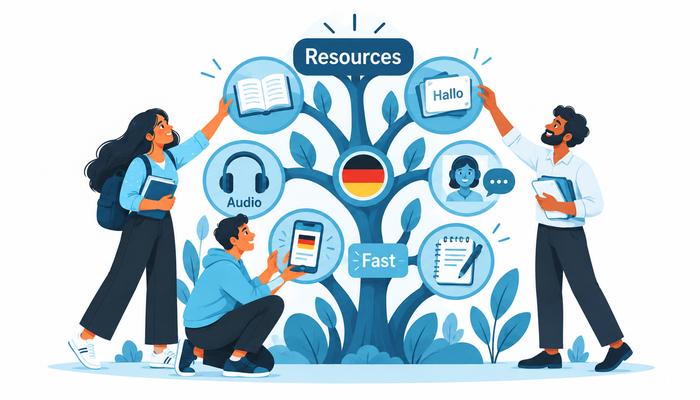
Best Resources for Learning German Fast
Learning German fast is not about collecting every app, course, podcast, and textbook. A faster strategy gives each resource a specific job.
Choose one course for progression, then add targeted practice for listening, vocabulary, speaking, and German. In 2026, learners can combine free resources from institutions such as the Goethe-Institut and vhs-Lernportal with conversation practice and authentic media.
The best combination depends on your level, purpose, and weakest skill.
Table of Contents
Start With a Structured Learning Path
Goethe-Institut: Best Official All-Level Resource
vhs-Lernportal: Best Free Structured Course
Easy German: Best for Real Spoken German
Language Exchange and Tutors: Best for Speaking
How to Combine Resources Without Wasting Time
A Fast German Learning Routine
What Nobody Tells You About Learning German Fast
Conclusion
FAQ
Start With a Structured Learning Path
The fastest learners are not necessarily the people using the largest number of resources. They are often the people who know what they are studying next.
A structured course gives your learning sequence. It introduces grammar, vocabulary, reading, listening, and communication in an order designed to become progressively more difficult. Without that structure, self-study can become random. You might spend three days learning adjective endings, watch an advanced podcast, memorize restaurant vocabulary, and then realize you still cannot form basic questions comfortably.
Choose one main curriculum.
If you are a beginner, work through lessons sequentially instead of jumping toward whatever topic appears interesting online. If you already have German experience, take a placement test or evaluate yourself against CEFR descriptions before selecting material.
Your main resource should answer, “What should I study today?”
Supplementary resources should answer more specific questions, such as, “How can I improve listening?” or “How can I practice speaking?”
That distinction prevents resource overload.
Goethe-Institut: Best Official All-Level Resource
The Goethe-Institut is one of the most useful starting points because its learning materials are connected to the CEFR levels used throughout German language education.
Its Deutsch für dich platform currently provides free exercises from A1 through C2. Learners can practice grammar, vocabulary, reading, and listening, and the platform also includes materials relevant to everyday German, work, study, and exam preparation.
This makes it especially useful when you want exercises that correspond to a recognizable proficiency level.
Goethe also offers free videos, podcasts, games, and other learning media. If you are preparing for a Goethe-Zertifikat, its official exam preparation materials become particularly important because they show the actual task types and expectations of the examination.
Do not use Goethe resources only for exam preparation.
A future expat can use them to strengthen everyday language before moving, while an advanced learner can target academic or professional weaknesses.
The major advantage is reliability. When you need information about Goethe examinations or official practice material, start with Goethe rather than relying on old social media explanations.
Use third-party explanations for additional help, but keep the official source as your reference point.
vhs-Lernportal: Best Free Structured Course
The vhs-Lernportal is one of the strongest free options for learners who want more structure than a collection of individual exercises.
It is operated by the German Adult Education Association and currently provides German learning options from A1 through C1, including general language and workplace-focused courses.
Its learner catalog includes A1, A2, and B1 German courses, as well as vocational courses at higher levels. The platform uses interactive exercises, audio, video, and structured lessons. Its A1 course, for example, is designed around basic everyday communication, while later courses progressively expand grammar and vocabulary.
This resource is particularly useful for adults preparing to live in Germany because much of the content is connected to everyday and professional situations.
If you struggle with self-study because you never know what to do next, a structured platform like this can reduce decision fatigue.
Instead of searching for a new lesson every day, follow the course and use other resources only to strengthen weaknesses.
That is often faster than building an entire curriculum yourself from random internet content.
Easy German: Best for Real Spoken German
Structured courses teach German systematically, but real people rarely speak like textbook dialogues.
That is where authentic or semi-authentic content becomes useful.
Easy German is well known for videos and podcasts built around real German, including street interviews and conversations about everyday topics. The format exposes learners to different speakers, natural pacing, common expressions, and the unpredictability of real answers.
This is valuable once textbook audio begins feeling too comfortable.
Use authentic content according to your level. Beginners do not need to understand an entire street interview. Listen for familiar words, the main topic, and repeated phrases. Intermediate learners can work more intensively with subtitles or transcripts. Advanced learners can focus on idioms, register, pronunciation, and how speakers organize spontaneous ideas.
Avoid turning every video into a vocabulary mining project.
Choose a few expressions worth learning and keep listening.
The purpose is partly to train tolerance for incomplete understanding.
That skill becomes extremely important after moving to a German-speaking environment, where conversations will not pause because one word is unfamiliar.
Language Exchange and Tutors: Best for Speaking
Speaking is difficult to improve through passive resources because retrieval has to happen in real time.
A tutor can provide structured conversation, correction, pronunciation feedback, and accountability. A language exchange can provide frequent informal practice at lower cost or no cost, although the quality and consistency will vary.
Whichever option you choose, arrive with a purpose.
Do not spend every session making the same comfortable small talk.
Ask to practice situations connected to your goals: introducing yourself professionally, making appointments, explaining a problem, discussing housing, participating in a meeting, or defending an opinion.
Keep a speaking error log.
After each session, write down recurring vocabulary gaps, grammar problems, and situations where you could not express your idea. Turn those problems into material for the following week.
Speaking sessions become far more valuable when they influence your study plan.
If you are moving to Germany, consider practicing repair strategies too: asking someone to repeat themselves, requesting clarification, paraphrasing a missing word, and confirming that you understood information correctly.
Real communication depends on these skills constantly.
How to Combine Resources Without Wasting Time
A useful German learning system needs roles, not a giant resource list.
Choose one main course.
Choose one vocabulary review method.
Choose one regular listening source.
Choose one way to speak with another person.
Then add exam-specific material only if you are preparing for certification.
For example, an A2 learner might use the vhs-Lernportal as the main course, Deutsch für dich for additional grammar practice, Anki for vocabulary, Easy German for listening, and one weekly conversation session for speaking.
That is enough.
Using five grammar websites rarely makes grammar improve five times faster.
The same principle applies to apps. Downloading several beginner apps often creates repeated exposure to the same easy material while more difficult weaknesses remain untouched.
Every resource should have a job.
If two resources perform exactly the same job, choose the one you actually enjoy and use consistently.
The fastest system is often the one with the least unnecessary switching.
A Fast German Learning Routine
If you can study around ninety minutes on a typical day, divide the time between structured learning and active use.
Spend roughly thirty minutes on your main course. Use another fifteen minutes reviewing vocabulary. Dedicate twenty minutes to listening or reading. Use the remaining time for speaking, writing, shadowing, or reviewing mistakes.
The exact percentages should change according to your weaknesses.
Someone who reads well but cannot understand spoken German should increase listening. Someone preparing for a written examination may need more writing and feedback.
Create longer speaking sessions several times per week if possible.
Also integrate German into ordinary life.
Write your shopping list in German. Describe what you are doing. Change selected interfaces to German. Search simple questions in German instead of immediately using English. Follow German creators connected to interests you already have.
These small exposures should supplement focused study, not replace it.
Consistency matters more than occasional marathon sessions.
A realistic daily routine maintained for months will usually outperform an extreme schedule that disappears after ten days.
What Nobody Tells You About Learning German Fast
“Fast” is relative.
A complete beginner preparing for basic everyday communication has a different target from someone trying to reach C1 for university study.
The CEFR levels represent increasingly complex abilities, and progress does not remain equally visible at every stage.
At A1, learning fifty useful phrases can transform your daily communication. At B2 or C1, improvement may involve nuance, precision, academic listening, register, and spontaneous control that develops more slowly.
Your life also matters.
Two learners following the same course can progress differently because one practices daily, speaks regularly, and receives feedback while the other studies only on weekends.
Moving to Germany does not automatically solve this.
Immersion creates opportunities, but you still need to notice language, interact, review mistakes, and deliberately expand beyond the English-speaking environments you may find.
Someone who has already relocated can provide valuable perspective about which German skills became unexpectedly important after arrival. That lived experience can help you prioritize practical learning, while official sources remain essential for formal language and certification requirements.
Conclusion
The best resources for learning German fast are not necessarily the most entertaining, expensive, or technologically impressive.
They are the resources that form a coherent system.
Use a structured course to guide progression. Use reliable Goethe-Institut or vhs-Lernportal materials for level-appropriate practice. Add authentic listening so textbook German does not become your only model. Use spaced repetition to retain vocabulary. Speak regularly so passive knowledge becomes available in real time. Gradually introduce German media as your comprehension improves.
Then keep the system small enough to maintain.
If you spend more time choosing resources than using German, simplify.
If you constantly understand lessons but cannot speak, add retrieval and conversation.
If you speak comfortably but make the same grammar mistakes, add focused correction.
If you understand textbooks but not people, increase natural listening.
Fast learning is not one resource.
It is the process of identifying the next barrier, choosing a tool that addresses it, practicing consistently, and moving forward when that barrier becomes manageable.
FAQ
What is the best free resource for learning German?
There is no single best resource for every learner. Goethe-Institut's Deutsch für dich provides free exercises from A1 to C2 covering grammar, vocabulary, reading, and listening. The vhs-Lernportal provides structured free German courses and is especially useful for learners who want a guided progression.
Is the vhs-Lernportal really free?
Yes. The vhs-Lernportal describes itself as a free digital learning platform operated by the German Adult Education Association. Its current offerings include German as a second language from A1 through C1, alongside vocational and other adult-learning courses.
Can I learn German quickly using only apps?
Apps can support vocabulary, grammar, and regular practice, but relying on one app may leave gaps in listening, spontaneous speaking, writing, and real-world comprehension. Use apps as components of a broader system that includes structured learning, authentic input, and active communication.
How many resources should I use at once?
For most learners, a small system is enough: one main course, one vocabulary method, one regular listening source, and one way to practice speaking. Add specialized resources when a clear weakness or examination requires them. More resources do not automatically create faster progress.
How can I improve German listening faster?
Listen frequently to material you can mostly follow, then gradually increase difficulty. Replay short sections, use transcripts after attempting comprehension, notice recurring pronunciation patterns, and summarize what you heard. Combine learner-oriented audio with increasingly natural German rather than jumping directly into content that is overwhelmingly difficult.
Should I use English subtitles while learning German?
They can help beginners understand context, but relying on them constantly can shift attention away from German. As your level improves, experiment with German subtitles, transcripts, or no subtitles. The objective is gradually to process meaning through German rather than translating every sentence.
What is the fastest realistic way to learn German before moving?
Build a daily routine combining a structured course, high-frequency practical vocabulary, listening, and active speaking. Prioritize situations you will face after arrival, such as housing, transportation, shopping, appointments, work, and introductions. Verify any formal language requirement separately, because practical communication goals and official certification requirements are not always the same.
Fix the incomplete German sentence Turn short fragments into full paragraphs