TestDaF Preparation Guide
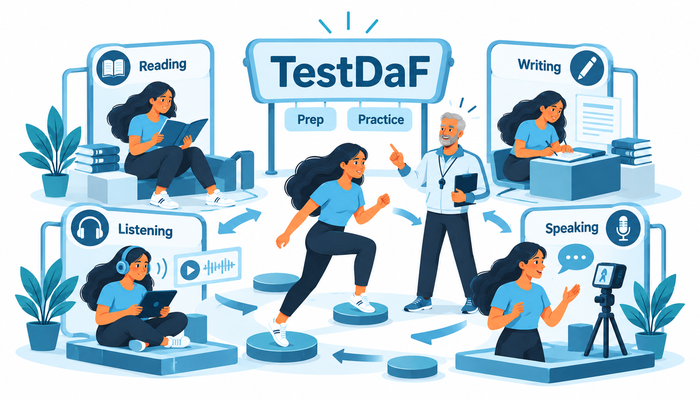
TestDaF Preparation Guide: How to Prepare for the Exam Strategically
Preparing for TestDaF is different from simply improving your German. You need strong enough language skills for university study, but you also need to understand how TestDaF transforms those skills into specific reading, listening, writing, and speaking tasks.
That distinction matters.
A learner can have good conversational German and still struggle with academic texts, structured arguments, lecture notes, or time pressure. Another learner may understand the test format perfectly but lack the language range required to perform consistently.
Effective TestDaF preparation has to address both problems.
TestDaF is designed primarily for people who need to demonstrate German proficiency for studying in Germany. The examination assesses four skills separately: Reading, Listening, Writing, and Speaking. Results are reported for each skill at TestDaF levels TDN 3, TDN 4, or TDN 5 rather than as one combined overall score.
The official TestDaF website currently provides preparation materials for both digital and paper-based versions. Because the formats differ, your first preparation decision should be simple: identify which version you will take, then practice specifically for that version.
Table of Contents
Understand What TestDaF Measures
Know Your Required Result
Choose the Correct Preparation Materials
Establish Your Starting Level
Prepare for Reading
Prepare for Listening
Prepare for Writing
Prepare for Speaking
Build Academic Vocabulary
Practice Integrated Skills
Use Mock Tests Properly
Create an Eight-Week Study Plan
Common TestDaF Preparation Mistakes
What Nobody Tells You About TestDaF
Final TestDaF Checklist
FAQ
Understand What TestDaF Measures
TestDaF is not designed around tourist German or casual conversation. Its tasks reflect communication that students may need in German higher education.
That includes understanding academic texts, following lectures and discussions, processing information, expressing ideas in writing, presenting arguments, and responding orally in study-related situations. Official TestDaF teaching guidance specifically describes tasks such as following lectures, taking notes, participating in seminars, responding to discussions, and producing study-related written texts.
This academic orientation should influence your preparation from the beginning.
If most of your German exposure comes from everyday conversations, entertainment, or general language courses, start adding university-related content. Read explanatory texts. Listen to lectures and interviews. Practice summarizing information. Explain graphs, arguments, processes, and contrasting viewpoints.
The digital TestDaF is completed at a test center on a computer. Candidates work through Reading, Listening, Writing, and Speaking. In Speaking, prompts and simulated interlocutors are delivered through headphones and responses are recorded.
That can feel very different from speaking to an examiner face to face.
Knowing this before test day matters because unfamiliar technology or interaction patterns should not consume attention you need for German.
Know Your Required Result
Before preparing for any language test, determine what result you actually need.
TestDaF reports each of the four skills separately. According to current official information, candidates receive a TestDaF level of TDN 3, TDN 4, or TDN 5 for each examination section. There is no single overall TestDaF result.
This means your score profile matters.
Do not rely on a friend’s requirement, an old forum discussion, or a general statement that a particular TestDaF level is “good enough.”
Check the current admission requirements for your intended university and program.
Universities determine the language evidence they accept for their programs, and requirements can depend on the course of study or other circumstances.
Write the requirement down before creating your preparation plan.
Your goal should not be “pass TestDaF.”
It should be a specific result profile that satisfies the organization receiving your certificate.
That clarity changes how you allocate preparation time, especially if one skill consistently performs below the others.
Choose the Correct Preparation Materials
One of the easiest TestDaF mistakes to avoid is practicing for the wrong format.
The official TestDaF website currently provides information and preparation sections for both digital and paper-based TestDaF. Both assess Reading, Listening, Writing, and Speaking, but their task formats and test procedures are not identical.
Use materials created for the version you booked.
For digital TestDaF, the TestDaF Institute provides official sample tasks, tutorials, audio and video materials, transcripts, solutions, and preparation guidance. Registered candidates also have access to free model tests through the participant portal.
The TestDaF site announced a new digital model test in February 2026, which makes checking current official materials particularly important.
Paper-based candidates should use the official model tests and guidance designed for that format.
Third-party books and courses can supplement your preparation, but official materials should anchor it because they show the examination you are actually preparing to take.
Establish Your Starting Level
Do not begin by guessing your weakest skill.
Test it.
Complete representative official tasks under realistic conditions. Avoid dictionaries, translation tools, unlimited pauses, or extra writing time.
Then analyze the results.
For Reading and Listening, identify both incorrect answers and the reasons behind them. For Writing and Speaking, compare your performance with official task expectations and seek informed feedback when possible.
Create a diagnostic table with four columns: skill, recurring problem, probable cause, and next action.
For example, a Listening problem might be losing track after one unfamiliar term. The next action would not simply be “practice more Listening.” You might specifically practice recovering immediately instead of mentally translating the missed word.
A Writing problem might involve presenting relevant ideas without developing them sufficiently. The next action could focus on building explanations and evidence.
Specific diagnosis turns preparation into training rather than repetition.
Prepare for Reading
TestDaF Reading requires more than understanding individual German sentences.
You need to process study-related texts efficiently, identify relevant information, understand relationships between ideas, and make decisions while time continues moving.
Start by reducing your dependence on translation.
Before analyzing details, identify the text type, topic, purpose, and structure. Notice headings, paragraph functions, examples, contrasts, causes, and conclusions.
When answering questions, return to evidence in the text rather than relying on memory.
After practice, investigate every error.
Did vocabulary prevent comprehension?
Did you misunderstand the question?
Did two similar statements confuse you?
Did you read too slowly?
Did you infer something that the text did not actually establish?
These causes require different solutions.
Also read beyond exam tasks. Use university websites, science communication, education articles, and other nonfiction German appropriate for your level.
The goal is not to understand every word.
The goal is to extract accurate meaning efficiently enough to complete academic reading tasks under examination conditions.
Prepare for Listening
Academic listening becomes difficult because information disappears immediately after you hear it.
You cannot reread a lecture sentence the way you can reread a paragraph.
That makes recovery essential.
If one unfamiliar expression appears, do not spend the next twenty seconds mentally translating it. Continue listening for the broader argument, examples, transitions, and important details.
Practice note-taking, but avoid trying to transcribe everything.
Useful notes capture structure.
Record keywords, relationships, numbers, examples, contrasts, and conclusions. Develop abbreviations that you can recognize quickly.
Digital TestDaF includes several audio and video task types, so use the official sample materials to understand what each task demands.
After completing a listening activity, use available transcripts strategically.
First answer under test conditions. Then listen again. Finally, examine the transcript to determine whether you lacked vocabulary, failed to recognize familiar language in speech, lost concentration, or misunderstood the task.
Listening improves faster when mistakes become specific.
Prepare for Writing
TestDaF Writing requires you to communicate clearly in study-related contexts.
For digital TestDaF, candidates currently complete two Writing tasks during a 60-minute section. The tasks require connected, clearly structured responses on socially relevant topics or questions.
Do not prepare by memorizing entire essays.
Develop a repeatable writing process instead.
Read the task carefully. Identify what information you must use and what position, explanation, or argument the prompt requires. Spend a short period organizing your response before typing.
During practice, evaluate structure and language separately.
First ask whether your response actually fulfills the task. Then examine paragraph organization, development of ideas, vocabulary precision, sentence variety, grammar, and spelling.
Learn to revise efficiently.
You will not have unlimited time to rebuild paragraphs during the examination, so practice spotting high-impact problems quickly.
Typing speed matters for digital candidates too. If German keyboard input feels slow or error-prone, practice composing timed responses on a computer rather than writing everything by hand.
Prepare for Speaking
Digital TestDaF Speaking can surprise candidates who have prepared mainly through face-to-face conversation.
You respond to prompts through the computer, listen through headphones, and record your answers. The digital examination currently includes seven Speaking tasks and takes approximately 35 minutes.
Practice in the same psychological format.
Use a timer, headphones, and recording device. Read or hear the prompt, prepare only within the permitted time, then respond without restarting.
Your goal is not perfect speech.
Your goal is organized, understandable, appropriate communication.
Practice common academic functions: explaining information, giving an opinion, comparing alternatives, making suggestions, summarizing a position, responding to another viewpoint, and contributing to study-related discussions.
Record yourself and review the result.
Do you answer the task directly?
Are your ideas organized?
Do pauses interrupt meaning?
Can you paraphrase when vocabulary disappears?
Does pronunciation remain understandable?
Speaking improves when you stop judging whether you “sound good” and start identifying observable communication problems.
Build Academic Vocabulary
TestDaF preparation requires vocabulary that extends beyond everyday German.
However, memorizing enormous academic word lists is not enough.
Learn vocabulary through functions and contexts.
Collect language for describing change, comparing information, explaining causes, discussing consequences, presenting advantages and disadvantages, expressing uncertainty, referring to evidence, and connecting arguments.
Also develop vocabulary around common study-related and social topics.
Learn words as combinations rather than isolated translations. Record useful collocations, prepositions, word families, and example sentences.
Then activate them.
Use new vocabulary in short summaries, spoken explanations, and Writing tasks. Recognition is only the first stage. TestDaF requires you to retrieve language while processing other information simultaneously.
Do not force sophisticated vocabulary into every response.
Accuracy and clarity matter.
If you can express an idea precisely with a familiar word, that is more useful than choosing an impressive term whose meaning or grammar you cannot control.
Practice Integrated Skills
University communication rarely separates language skills neatly.
You listen while taking notes. You read material and discuss it. You process information before writing. You respond to another person’s argument while developing your own.
Digital TestDaF reflects this study-oriented reality through tasks designed around communicative situations relevant to higher education.
Your preparation should therefore include integrated practice.
Read a short article and summarize it orally.
Watch a university-style presentation and write a brief summary.
Read two contrasting viewpoints and explain which argument you find stronger.
Listen to an explanation while taking notes, then reconstruct its main structure without replaying the recording.
These exercises train language and academic processing together.
They also reveal weaknesses that isolated grammar exercises hide.
You may know the vocabulary but struggle to retrieve it quickly. You may understand a lecture but take unusable notes. You may understand two arguments individually but struggle to compare them coherently.
Those are exactly the kinds of problems targeted practice should uncover before test day.
Use Mock Tests Properly
Official model tests are among the most valuable TestDaF preparation resources, but only when you use them deliberately.
Begin with a diagnostic attempt.
Later, use individual tasks for focused training.
Closer to the examination, complete realistic simulations to test pacing, concentration, and consistency.
After every simulation, create a review session.
Do not merely calculate how many answers were correct.
Classify errors.
For productive tasks, identify repeated language and organization problems. For receptive tasks, determine why each incorrect decision occurred.
Registered digital TestDaF candidates currently receive two free model tests in the participant portal, and the TestDaF Institute also provides public sample tasks and tutorials.
Protect these resources from careless use.
If you repeatedly complete official material without reviewing it, familiarity can inflate your confidence without fixing underlying weaknesses.
A mock test should generate your next preparation priorities.
If it does not change what you practice, you have mostly measured yourself again.
Create an Eight-Week Study Plan
During Weeks One and Two, establish your baseline and learn the format. Complete representative tasks from all four sections and identify your weakest areas.
During Weeks Three and Four, prioritize targeted repair. Spend more time on the skills and task types creating the largest risk. Continue maintaining stronger skills without dividing time equally by habit.
During Weeks Five and Six, increase integrated and timed practice. Combine academic reading, listening, note-taking, writing, and speaking. Complete individual sections under realistic limits.
During Week Seven, complete a serious simulation and analyze it thoroughly. Use the results to identify the final problems that still appear under pressure.
During Week Eight, consolidate.
Review your error log, maintain vocabulary, complete selected timed tasks, and practice the procedures you will use on examination day.
Avoid collecting new strategies during the final days.
Your exact timeline may need to be longer than eight weeks. A learner whose German is already near the required level has a different task from someone still building fundamental B2 or C1 language skills.
Let your diagnostic performance determine whether the schedule is realistic.
Common TestDaF Preparation Mistakes
The first mistake is confusing general German study with TestDaF preparation.
Both matter, but they serve different purposes.
The second mistake is using materials for the wrong TestDaF version. Digital and paper-based formats should be prepared separately.
Another mistake is taking mock tests continuously without targeted correction.
Candidates also underestimate academic communication. Everyday conversation does not automatically prepare you to summarize lectures, process structured arguments, or produce university-related responses.
Some learners memorize Writing templates or Speaking scripts too rigidly. Structure can help, but the language must adapt to the actual task.
Another common problem is ignoring computer-based practice before digital TestDaF. Typing, reading on screen, using headphones, and recording spoken responses should feel familiar before test day.
Finally, candidates sometimes choose a target result without checking the university.
TestDaF is part of a larger admissions process.
Always connect your preparation to the actual requirement your intended institution publishes.
What Nobody Tells You About TestDaF
TestDaF preparation can teach you more than how to pass a language examination.
The academic skills behind the test resemble challenges you may encounter after admission.
Following lectures, taking useful notes, processing complex texts, presenting ideas, responding to other viewpoints, and writing structured German do not disappear after you receive your certificate.
In many ways, the examination is only the beginning.
This is why studying exclusively for points can be shortsighted.
When you practice listening, ask whether your notes would help you understand a real lecture later. When you practice speaking, ask whether you could use the same skills during a seminar. When you read, practice extracting arguments rather than simply finding answers.
Someone who has already studied in Germany can provide useful lived context about this transition. They may explain where exam preparation helped and where university communication still felt unexpectedly difficult.
That experience should complement official TestDaF and university information, never replace formal admissions requirements.
Final TestDaF Checklist
Before test day, confirm that you have:
checked your university’s current language requirement;
identified whether you are taking digital or paper-based TestDaF;
studied the current format for that version;
used official TestDaF preparation materials;
completed realistic diagnostic tasks;
created an error log;
practiced academic Reading without translating everything;
trained Listening recovery and note-taking;
completed timed Writing tasks;
practiced typing German for digital TestDaF;
recorded timed Speaking responses;
practiced Speaking without restarting;
built academic vocabulary in context;
trained paraphrasing;
practiced summarizing information;
completed timed sections;
analyzed mock tests rather than only scoring them;
reviewed examination-day rules;
prepared the identification and materials required by your test center;
checked your application timeline.
Readiness is not the number of hours you studied.
It is your ability to perform consistently when the tasks, timing, technology, and pressure appear together.
Conclusion
A strong TestDaF preparation plan combines German proficiency, academic communication, test familiarity, and realistic practice.
Start by verifying what result your university requires.
Then identify the TestDaF version you will take and use materials designed for that format. Establish your baseline across Reading, Listening, Writing, and Speaking. Diagnose weaknesses precisely. Train those weaknesses individually before testing them again under time pressure.
Use official materials strategically.
For digital TestDaF, become comfortable reading and typing on a computer, listening through headphones, and recording spoken responses. For every version, develop the ability to process study-related German rather than relying only on everyday conversation.
Most importantly, remember what the examination represents.
TestDaF is not the final destination. For many candidates, it is evidence that they are linguistically prepared to begin the next stage: studying in German.
Prepare to earn the result you need, but also prepare for the lectures, discussions, texts, presentations, and academic decisions that come after it.
That makes your preparation useful long after test day.
FAQ
What is TestDaF used for?
TestDaF is a German language examination designed particularly for people who need to demonstrate the language skills required for studying in Germany. The official TestDaF site states that the certificate is recognized by German universities. Applicants should still check the exact language requirement published by their intended institution.
How is TestDaF scored?
Reading, Listening, Writing, and Speaking are evaluated separately. Candidates receive a TestDaF level of TDN 3, TDN 4, or TDN 5 for each section. There is no single combined overall TestDaF score, so your result is a four-part profile rather than one number.
Is TestDaF a B2 or C1 examination?
TestDaF operates in the upper-intermediate to advanced range relevant to university study, and official preparation offerings describe digital TestDaF training at B2/C1. Your readiness should be evaluated through actual TestDaF tasks rather than assuming that completion of a general B2 or C1 course automatically guarantees a particular TDN result.
Is digital TestDaF different from paper-based TestDaF?
Yes. Both versions assess Reading, Listening, Writing, and Speaking, but their task formats and procedures differ. The digital test is completed on a computer at a test center, and spoken responses are recorded. Prepare specifically with official materials for the version you have booked.
Where can I find official TestDaF practice materials?
The TestDaF Institute provides official sample tasks, tutorials, solutions, transcripts, audio and video materials, and preparation information on its website. Registered candidates for digital TestDaF also have access to free model tests in the participant portal.
How long should I prepare for TestDaF?
There is no universal preparation period. It depends on your current German level, required result, familiarity with academic German, and performance on TestDaF tasks. If your underlying German is below the level needed for the examination, you may need substantial language development before intensive format training becomes effective.
What is the most important TestDaF preparation strategy?
Use diagnosis rather than repetition. Complete realistic tasks, identify exactly why performance falls short, practice those weaknesses deliberately, and then test them again under examination conditions. Combine this process with official TestDaF materials and current university requirements so that your preparation remains aligned with both the examination and your actual admissions goal.