How to Pass the Goethe Exam
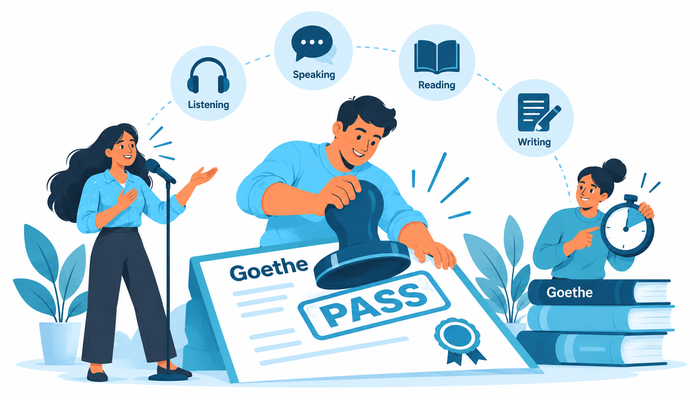
How to Pass the Goethe Exam: A Practical Preparation Guide
Passing a Goethe exam is not simply about knowing German. You need enough German for your target CEFR level, but you also need to understand how the exam works, what each module asks you to do, how quickly you must work, and how to demonstrate your ability under pressure.
That distinction matters because many learners spend months improving their German without practicing the actual exam tasks. Others make the opposite mistake: they memorize templates and strategies while their underlying language level remains below what the examination expects.
Neither approach is reliable.
A better preparation plan combines language development with exam specific practice. You should understand your target level, identify your weakest module, learn the task formats, practice under realistic conditions, analyze mistakes, and gradually make your performance more consistent.
The Goethe-Institut currently offers German examinations from A1 through C2. At B1, B2, C1, and C2, the examinations are modular. For these levels, each module can earn a maximum of 100 points and is passed with at least 60 points, or 60 percent.
The exact preparation strategy depends on your level, but the principles behind successful preparation are surprisingly similar.
Table of Contents
Know Which Goethe Exam You Actually Need
Understand the Exam Before Studying for It
Start With a Realistic Diagnostic Test
Prepare Reading Strategically
Train Listening Without Depending on Every Word
Make Writing Predictable
Practice Speaking as Communication
Learn Vocabulary for Your Target Level
Use Grammar to Communicate More Precisely
Practice With Official Materials
Turn Mock Exams Into a Learning Tool
Build a Four Week Final Preparation Plan
Common Goethe Exam Mistakes
What Nobody Tells You About the Goethe Exam
Final Preparation Checklist
FAQ
Know Which Goethe Exam You Actually Need
Before preparing, confirm the exact certificate and level required for your purpose.
This sounds obvious, but learners sometimes choose a level because a friend took it, because an online forum recommends it, or because they assume one certificate is universally accepted.
Your situation may be different.
A university, employer, authority, or professional organization may specify a particular level or accepted certificate. Goethe certificates themselves do not expire, but the Goethe-Institut notes that some institutions and employers expect a certificate issued within the previous two years.
That is why your first step should be verification.
Check the organization that will receive your certificate. Confirm the required level, accepted examination, and any rules about how recent the certificate must be.
Do this before paying for preparation or booking an exam.
The goal is not merely to pass a German test. It is to obtain evidence that actually satisfies the requirement behind your application.
Understand the Exam Before Studying for It
Once you know the correct level, learn the structure of that specific examination.
Do not assume that every Goethe exam works identically.
At the higher modular levels, Reading, Listening, Writing, and Speaking are assessed as separate modules. Goethe currently classifies B1 through C2 as modular examinations, and individual modules can be retaken.
Understanding the structure changes your preparation.
You should know what kinds of texts appear in Reading, how Listening tasks are presented, what Writing requires, and what happens during Speaking.
This is not cheating or learning tricks.
Exam familiarity allows your German ability to appear without unnecessary confusion.
Imagine having enough German to answer a task but losing time because you spend several minutes understanding the instructions. That is an exam preparation problem, not necessarily a language problem.
Before intensive study begins, you should be able to explain the structure of your examination to someone else.
If you cannot, learn that first.
Start With a Realistic Diagnostic Test
Many learners begin preparation by opening Chapter One of a course book.
A better starting point is diagnosis.
Use an official practice set for your target level and complete as much as possible under realistic conditions. Do not use a dictionary. Do not pause the audio whenever something becomes difficult. Respect the stated timing.
The result may be uncomfortable, but it gives you useful information.
Perhaps Reading is already strong while Listening collapses when speakers talk quickly. Maybe Writing contains enough vocabulary but lacks organization. Perhaps Speaking is understandable but full of hesitation because you rarely practice spontaneously.
Record those patterns.
Create an error log with four categories: Reading, Listening, Writing, and Speaking.
Under each category, describe the actual problem.
“Bad at Listening” is not useful.
“Misses details after an unfamiliar word and stops following the recording” is useful.
The second description suggests a training method.
Your preparation becomes much more efficient when every weakness is translated into a behavior you can practice.
Prepare Reading Strategically
Reading preparation should not become an endless attempt to translate German texts word by word.
At examination level, you need to extract meaning efficiently.
Practice identifying the purpose of a text before becoming trapped in individual vocabulary. Ask who wrote it, who it is intended for, and what the writer is trying to communicate.
Then work on locating evidence for individual questions.
When an answer is wrong, do not simply record the correct option. Find the exact part of the text that proves it. Then determine why you chose incorrectly.
Did one unfamiliar word distract you?
Did you confuse two similar statements?
Did you understand the sentence but misread the question?
Did you spend too much time on one item and rush later?
This type of analysis matters more than the number of practice texts you complete.
Reading also improves through regular exposure outside exam materials. Read German news appropriate for your level, short articles, emails, public information, and texts connected to your interests.
The objective is to become comfortable extracting meaning without requiring perfect comprehension.
Train Listening Without Depending on Every Word
Listening becomes difficult when learners believe they must understand everything.
Real German does not wait while you translate.
If you hear an unfamiliar word and continue thinking about it, the recording keeps moving. You may lose several sentences while mentally trying to solve one missing piece.
Train yourself to recover.
During practice, listen for the main topic, speaker intention, important details, numbers, opinions, contrasts, and changes of direction.
After completing a task, listen again and investigate mistakes.
Was the language genuinely unfamiliar?
Did you know the vocabulary but fail to recognize it when spoken?
Did you miss a negative expression?
Did you choose an answer before the speaker finished the idea?
Use transcripts when available, but only after attempting the listening task properly. A transcript should help you diagnose what your ears missed, not replace listening.
Regular exposure matters too.
Podcasts, interviews, videos, and German media can gradually make different voices and natural speech patterns less intimidating.
The goal is not perfect comprehension.
It is reliable comprehension at the level your examination expects.
Make Writing Predictable
Writing becomes much less frightening when you stop treating every task as a completely new problem.
You need flexible language, but you can develop a reliable process.
First, understand the task before writing.
Identify the purpose, audience, required points, and appropriate register. A message to a friend should not sound like a formal complaint. An argumentative task requires different organization from a short personal message.
Then plan.
Even a brief plan can prevent repetition and missing content.
During practice, separate your problems into categories: task completion, organization, vocabulary, grammar, and register.
Do not simply write another complete response whenever something goes wrong.
If your introductions are weak, practice introductions.
If your arguments lack development, practice explaining reasons and examples.
If word order repeatedly breaks in subordinate clauses, isolate that grammar pattern.
This approach turns Writing into smaller trainable skills.
Templates can help you remember structure, but avoid memorizing complete passages. You need language that can adapt to the actual prompt.
Practice Speaking as Communication
Many learners prepare for Speaking by memorizing possible answers.
That creates confidence until the examiner asks something unexpected.
Instead, practice communicative functions.
Learn how to express an opinion, agree politely, disagree, suggest an alternative, explain a reason, compare options, ask for clarification, and respond when another speaker challenges your idea.
These skills transfer across topics.
Record yourself regularly.
Listen for long pauses, repeated vocabulary, unclear pronunciation, unfinished sentences, and grammar mistakes that appear when you speak quickly.
Then practice one problem at a time.
If you hesitate because you search for perfect vocabulary, practice paraphrasing. Explain the word you cannot remember using simpler German.
If you struggle to develop ideas, practice giving an opinion followed by a reason and example.
If the examination includes interaction with another candidate, do not treat your partner as an obstacle. Listen to what they say and respond meaningfully.
Speaking is communication, not a memorized speech delivered beside another person.
Learn Vocabulary for Your Target Level
Vocabulary preparation should focus on usability rather than impressive lists.
Learn words in context.
When you record a new noun, include its article and useful combinations. When you learn a verb, notice the prepositions and cases that commonly accompany it. When you learn an adjective, collect a sentence that demonstrates natural usage.
Organize vocabulary around recurring themes relevant to your level.
Topics may include education, work, housing, transportation, technology, health, environment, relationships, media, travel, and social issues.
But do not memorize one essay for each topic.
Build a flexible vocabulary network.
Active recall is essential. Recognizing a word while reading is easier than producing it during Writing or Speaking.
Test yourself in both directions.
Can you understand the word?
Can you use it accurately without looking?
Can you paraphrase if you forget it?
That last ability is particularly useful during an exam because communication should not collapse when one word disappears.
Use Grammar to Communicate More Precisely
Grammar study becomes inefficient when you try to review every German rule before the exam.
Start with your recurring errors.
If case endings repeatedly cause problems, review them. If subordinate clause word order becomes unstable when you speak, practice that pattern. If you avoid past tense structures because you lack confidence, target them directly.
The goal is not to display grammar for its own sake.
Grammar allows you to express relationships between ideas accurately.
At higher levels, variety becomes increasingly important because you need to explain causes, conditions, contrasts, possibilities, and complex opinions.
However, complexity without control can damage clarity.
Use structures you understand, then gradually expand your range.
A useful exercise is rewriting.
Take a simple paragraph and express the same ideas using more varied sentence structures. Combine sentences, add subordinate clauses, change connectors, and compare how meaning shifts.
Grammar becomes much more memorable when it solves communication problems instead of existing only as a worksheet.
Practice With Official Materials
Official Goethe materials should be central to your exam preparation.
The Goethe-Institut provides practice and information materials for its examination levels, including downloadable materials that candidates can use free of charge.
Use them early, not only during your final week.
Official materials show you how tasks are structured and what level of language the examination expects.
Complete one set diagnostically.
Study individual task types.
Then return to complete sets under timed conditions later.
Do not assume unofficial resources are useless. Teachers, courses, books, videos, and online platforms can provide excellent explanations and additional practice.
But when unofficial advice conflicts with current official information about exam structure or rules, verify the claim with Goethe.
Exam formats and administrative details can change.
Your preparation should be based on the examination you will actually take, not somebody's memory of an older version.
Turn Mock Exams Into a Learning Tool
Taking ten mock exams does not automatically make you better prepared than someone who takes three.
The difference is what happens afterward.
Every mock should produce a diagnosis.
For Reading and Listening, calculate your result and classify mistakes.
For Writing, review whether you completed every requirement, organized the response logically, used appropriate language, and controlled recurring grammar problems.
For Speaking, use recordings whenever possible.
Then create the next week's study priorities from those results.
If the same mistake appears across several mocks, stop testing it repeatedly and train it directly.
Mocks become more useful as exam day approaches because they test whether separate skills remain reliable under pressure.
They also teach pacing.
You learn when you tend to slow down, where concentration drops, and which tasks create unnecessary panic.
A mock exam is valuable when it changes what you practice afterward.
Otherwise, it is mostly another measurement.
Build a Four Week Final Preparation Plan
During the final month, your preparation should become increasingly specific.
In Week One, complete a diagnostic exam and identify your largest weaknesses. Review the official format and create a prioritized error list.
In Week Two, spend most of your time on targeted repair. Work on difficult Reading tasks, Listening problems, Writing weaknesses, or Speaking behaviors individually.
In Week Three, combine targeted practice with more timed modules. Check whether the improvements survive when the clock is running.
In Week Four, prioritize consistency.
Complete realistic simulations, review recurring errors, maintain vocabulary, and continue speaking regularly. Avoid suddenly changing your entire strategy because of a new video or study method you discovered online.
Your final days should reduce uncertainty, not introduce more of it.
Sleep and routine matter too.
Exhausting yourself with a late study marathon is unlikely to compensate for months of inconsistent preparation.
Arrive knowing the format and trusting the methods you practiced.
Common Goethe Exam Mistakes
The first mistake is booking an exam because your course ended rather than because your performance is ready.
Finishing a B2 course does not automatically guarantee B2 examination performance.
Another mistake is studying all modules equally when one clearly needs more attention.
Learners also memorize Writing and Speaking scripts. Prepared structures can help, but rigid memorization makes adaptation difficult.
Ignoring timing is another major problem.
A response that succeeds with unlimited time may fail under examination conditions.
Some candidates also rely heavily on translation. They mentally build a sentence in their first language and then convert it into German. This becomes slow and unreliable during spontaneous tasks.
Finally, learners sometimes chase new resources instead of reviewing mistakes.
The closer you get to the exam, the more valuable your personal error history becomes.
Your mistakes tell you what generic study plans cannot: where your own performance is most likely to break.
What Nobody Tells You About the Goethe Exam
Passing can feel different from speaking German comfortably in daily life.
An exam samples particular skills through structured tasks. Real life is less predictable.
You may pass B1 and still struggle during a fast phone call. You may have B2 and feel lost when coworkers use regional expressions. You may perform well academically but find casual group conversations surprisingly difficult.
That does not make the certificate meaningless.
It means certification and lived communication are related but not identical.
If you are taking Goethe because you plan to relocate, keep developing practical German alongside exam preparation.
Talk to people. Listen to unscripted German. Practice phone conversations. Read real messages and notices. Learn how to ask for clarification.
Someone who has already moved to a German speaking environment can also offer useful lived perspective about where classroom German felt sufficient and where reality was harder.
That experience should complement official information, not replace it.
Final Preparation Checklist
Before exam day, make sure you have:
verified the exact certificate required;
studied the current format for your level;
completed official practice materials;
identified your weakest module;
created an error log;
practiced Reading under time limits;
practiced Listening without pausing;
reviewed Listening mistakes with transcripts when available;
written multiple timed responses;
received useful Writing feedback when possible;
practiced Speaking with unfamiliar topics;
recorded and reviewed your speech;
practiced paraphrasing;
reviewed recurring grammar errors;
learned vocabulary in context;
completed realistic mock examinations;
developed a pacing strategy;
checked the rules and instructions from your exam center;
prepared everything required for test day.
Do not judge readiness only by how much material you have studied.
Judge it by whether you can perform consistently under realistic conditions.
Conclusion
The best way to pass the Goethe exam is not to search for a secret shortcut.
Build the language ability expected at your target CEFR level, understand the examination, and practice demonstrating that ability under its conditions.
Start with diagnosis.
Identify where your performance currently falls short. Use official Goethe materials to understand the real task formats. Prioritize weaknesses. Analyze errors instead of simply collecting scores. Practice Reading for efficient comprehension, Listening for recovery and meaning, Writing for clear task completion, and Speaking for flexible communication.
As the exam approaches, make practice increasingly realistic.
A certificate can be important for study, work, relocation, or personal goals, but remember why you are learning German beyond the test.
Passing proves something valuable about your language ability at a particular level.
Using German confidently afterward requires continuing to turn that ability into real communication.
FAQ
What score do I need to pass a Goethe exam?
The rule depends on the examination. For Goethe-Zertifikat B1, B2, C1, and C2, each module has a maximum of 100 points and is passed with at least 60 points, or 60 percent. A1 and A2 have different examination structures and should be checked separately.
Can I retake a Goethe exam if I fail?
Yes. Goethe states that examinations can be retaken. For the modular B1 through C2 examinations, individual modules can also be taken again. Always check the current exam regulations and availability at your testing location before planning a retake.
Do Goethe certificates expire?
Goethe states that certificates from A1 through C2 do not expire. However, institutions and employers may have their own rules about how recent a certificate must be, and Goethe notes that many expect certificates to be no more than two years old. Verify this directly with the organization receiving your certificate.
Are official Goethe practice tests free?
Goethe provides practice and information materials for its exam levels, including materials that can be downloaded free of charge. Use the materials for your specific certificate and level because task formats differ between examinations.
Is memorizing German exam templates a good strategy?
Learning flexible structures can help with organization, but memorizing complete answers is risky. The actual task may require different content, register, or interaction. Build adaptable phrases and practice responding to unfamiliar prompts instead of relying on scripts.
How do I know when I am ready for the Goethe exam?
Use repeated performance rather than confidence alone. Complete official practice tasks under realistic timing and examine results across all required modules. You should understand the format, manage the available time, and perform near or above your target consistently rather than depending on one unusually strong mock result.
Is passing Goethe enough to communicate comfortably in Germany?
A Goethe certificate provides evidence of German proficiency at a CEFR level, but real life can introduce accents, informal language, specialized vocabulary, noise, and unexpected situations that structured examinations cannot reproduce completely. Continue practicing practical communication even after you pass.