A1 to C1 German Levels Explained
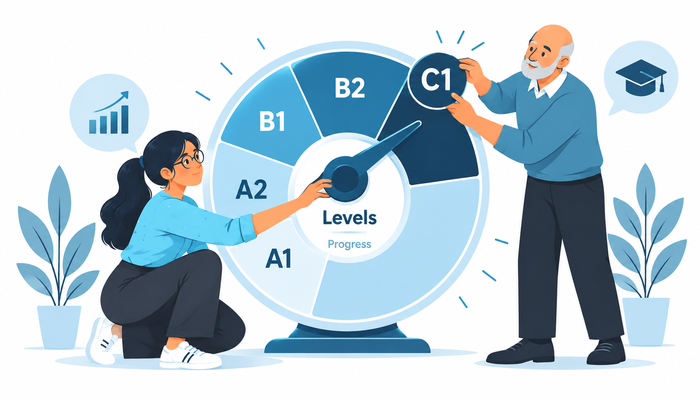
A1 to C1 German Levels Explained: What Each Level Actually Means
The levels come from the Common European Framework of Reference for Languages, usually called the CEFR. The framework has six main levels, from A1 to C2, and describes proficiency through practical “can do” abilities rather than a simple vocabulary count. A1 and A2 are Basic User levels, B1 and B2 are Independent User levels, and C1 and C2 are Proficient User levels.
For someone planning a move, the useful question is not simply, “What level am I?” It is, “What can I realistically do at this level, and is that enough for the situation I am entering?”
This guide explains A1 through C1 for life in Germany, studying, working, and building independence after relocation.
Table of Contents
What the CEFR Levels Actually Measure
A1 German: Building a Survival Foundation
A2 German: Managing Familiar Daily Situations
B1 German: Becoming an Independent User
B2 German: Communicating With Real Flexibility
C1 German: Functioning at an Advanced Level
How the Levels Compare in Real Life
Which German Level Do You Need Before Moving?
Why Your Skills May Be at Different Levels
How Long Does It Take to Move Between Levels?
Common Mistakes When Choosing a Target Level
What Nobody Tells You About CEFR Levels
German Level Checklist
FAQ
What the CEFR Levels Actually Measure
The CEFR is not a German-only system. The Council of Europe created it as a common framework for describing language proficiency across languages. Its six main levels run from A1 through C2, and the descriptors cover what learners can accomplish through listening, reading, speaking, writing, interaction, and other communicative activities.
This matters because a CEFR level is not supposed to mean that you memorized a particular number of words or completed a particular textbook.
It describes functional ability.
At lower levels, communication depends heavily on familiar situations, simple language, repetition, and support from the other person. As learners progress, they become able to understand more complex material, communicate more spontaneously, develop detailed arguments, and adapt language to academic, professional, and social contexts.
The Goethe-Institut aligns its German courses and examinations with the CEFR and offers certificates across A1 through C2.
For relocation planning, these levels are useful reference points, but they should not replace checking the exact requirement set by the university, employer, authority, or professional organization evaluating you.
A1 German: Building a Survival Foundation
A1 is the first main CEFR level and represents a basic user.
At this stage, you can understand and use familiar everyday expressions and very basic phrases connected to concrete needs. You can introduce yourself, ask and answer simple personal questions, and interact when the other person speaks slowly, clearly, and is prepared to help.
In real life, that might mean saying your name, nationality, address, or occupation. You may be able to order something simple, ask the price, understand basic numbers and times, or ask where a place is.
A1 is useful, but it is limited.
A conversation can become difficult as soon as the other person moves away from familiar vocabulary or speaks naturally at normal speed. Phone calls can be especially challenging because you lose facial expressions, gestures, and environmental clues.
For someone moving to Germany, A1 can reduce the feeling of complete dependence during basic interactions. You can recognize common signs, exchange simple information, and use clarification phrases.
However, A1 should not be confused with conversational fluency.
You are building the foundation that later independence depends on.
A2 German: Managing Familiar Daily Situations
At A2, everyday communication becomes broader.
The CEFR describes an A2 learner as someone who can understand frequently used expressions related to areas of immediate relevance, such as personal information, family, shopping, local geography, and employment. The learner can handle simple routine exchanges and describe aspects of their background and immediate environment.
That difference from A1 can feel substantial.
Instead of only producing isolated survival phrases, you can begin connecting information. You might explain what you do for work, describe your apartment, discuss your routine, talk about simple past experiences, or make straightforward arrangements.
After moving, A2 can help with predictable interactions in stores, restaurants, transportation, and familiar workplace or neighborhood situations.
But unpredictability remains difficult.
If a conversation suddenly becomes detailed, abstract, fast, or highly formal, you may lose the thread. Administrative letters can contain vocabulary and structures well beyond what you encounter in beginner materials.
A2 therefore creates useful everyday functionality without providing complete independence.
It is an important stage because German starts feeling less like a collection of memorized phrases and more like a language you can actively assemble.
B1 German: Becoming an Independent User
B1 marks an important transition because the CEFR categorizes B1 and B2 as Independent User levels.
According to the CEFR global scale, a B1 user can understand the main points of clear standard language on familiar matters connected to areas such as work, school, and leisure. They can deal with many situations likely to arise while traveling, produce connected text on familiar topics, and describe experiences, events, plans, hopes, and ambitions while giving brief reasons for opinions.
In practical terms, B1 gives you more room to solve problems.
You are no longer limited to perfectly predictable scripts. You can explain what happened, describe what you need, ask follow-up questions, and keep a familiar conversation moving even when your language is imperfect.
For life in Germany, this can make a major difference.
You may be able to communicate more independently with coworkers, neighbors, service providers, or other people you meet regularly. You can write straightforward messages and understand the main idea of many everyday texts.
However, B1 still has limits. Complex professional discussions, fast group conversations, formal documents, academic lectures, humor, regional speech, and nuanced disagreement may remain demanding.
B1 is independence, not mastery.
B2 German: Communicating With Real Flexibility
B2 is often the level where learners begin to feel that German can support a much wider life.
The CEFR describes a B2 user as someone who can understand the main ideas of complex texts on concrete and abstract topics, including technical discussions within their field of specialization. They can interact with enough fluency and spontaneity for regular interaction with native speakers to be possible without excessive strain, and they can produce clear, detailed text on a wide range of subjects.
That does not mean effortless German.
You will still encounter unfamiliar vocabulary, misunderstand jokes, make grammatical errors, and sometimes struggle with regional accents or specialized terminology.
The difference is flexibility.
At B2, you are better equipped to explain complex ideas, compare options, defend a viewpoint, understand extended discussions, and adapt when a conversation moves away from a prepared topic.
This can be particularly valuable for work and study.
Meetings, presentations, classroom discussions, professional emails, and detailed conversations become more manageable, although the language demands of individual universities and professions can be higher.
Do not assume that B2 automatically satisfies a formal requirement simply because it sounds advanced.
Always verify the certificate, level, and other conditions required for your specific purpose.
C1 German: Functioning at an Advanced Level
C1 is a Proficient User level.
According to the CEFR, a C1 user can understand a wide range of demanding longer texts and recognize implicit meaning. They can express themselves fluently and spontaneously without frequently searching for expressions, use language flexibly for social, academic, and professional purposes, and produce clear, well-structured, detailed text about complex subjects.
This is much more than being able to survive everyday life.
At C1, German can become a serious working and academic tool.
You may be able to participate actively in complex discussions, follow detailed lectures, understand nuanced arguments, write structured academic or professional texts, and adjust your language according to the situation.
Still, C1 does not mean perfect German.
You can remain noticeably non-native. You may occasionally misunderstand cultural references, unfamiliar dialects, specialized jargon, or extremely subtle humor. Mistakes can still occur.
The important difference is that those limitations usually do not prevent effective communication across a broad range of demanding contexts.
For learners targeting German-language higher education or language-intensive professional environments, C1 may be highly relevant. But formal acceptance depends on the institution and purpose, so check current requirements directly.
What Nobody Tells You About CEFR Levels
Moving from A1 to C1 does not feel like climbing five identical steps.
Early progress can be highly visible. You learn greetings, numbers, common verbs, basic sentence patterns, and suddenly you can perform tasks that were impossible a month earlier.
Later progress can feel slower because the target becomes more sophisticated.
At B2 or C1, improvement may involve precision, nuance, register, complex listening, idiomatic language, argumentation, and the ability to adapt spontaneously. You can improve significantly without feeling that you learned something dramatically new every day.
Another surprise is that real life can temporarily make you feel worse at German.
A classroom may be quiet and predictable. A train station, workplace lunch, shared apartment, or government office may introduce noise, speed, unfamiliar vocabulary, accents, and stress simultaneously.
That does not erase your level.
It reveals the difference between controlled practice and real-world communication.
Speaking with someone who has already relocated can help you understand those practical gaps. Lived experience can complement official requirements by showing where language became unexpectedly important after arrival.
Conclusion
A1 to C1 German levels become much easier to understand when you stop viewing them as mysterious labels and start viewing them as stages of independence.
A1 gives you a basic survival foundation.
A2 expands your ability to manage familiar routine situations.
B1 moves you toward independent communication across many everyday contexts.
B2 gives you substantially more flexibility with complex topics and spontaneous interaction.
C1 allows advanced, effective language use across demanding social, academic, and professional situations.
None of these levels means that you understand everything.
Even advanced learners encounter unfamiliar words, accents, specialized language, and situations that require clarification.
For relocation, the smartest approach is to identify two targets.
First, determine your formal target by checking the current requirements of the university, employer, authority, or professional body relevant to your move.
Second, define your practical target by asking what you want to do independently after arrival.
Then study toward both.
A CEFR level is useful because it gives language ability a shared framework.
Its real value, however, appears when the label translates into something practical: understanding, participating, solving problems, building relationships, studying, working, and gradually creating a life in another language.
FAQ
What do A1, A2, B1, B2, and C1 mean in German?
They are CEFR proficiency levels used to describe what a language learner can do. A1 and A2 are Basic User levels, B1 and B2 are Independent User levels, and C1 is a Proficient User level. The complete CEFR scale also includes C2 above C1.
Is B1 German enough to live in Germany?
B1 can provide meaningful independence in many familiar everyday situations, but whether it is “enough” depends on your life. A German-language university program, regulated profession, or language-intensive job may require stronger German or specific certification. Check formal requirements separately.
Is B2 considered fluent German?
“Fluent” is an imprecise term. At B2, the CEFR describes users as able to interact with a degree of fluency and spontaneity and understand the main ideas of complex texts. However, B2 does not mean native-like ability or effortless understanding in every context.
Is C1 German the same as native-level German?
No. C1 represents advanced proficiency, but it is not the same as being a native speaker. A C1 user can understand demanding material and use German flexibly and effectively, while still encountering unfamiliar vocabulary, cultural references, dialects, or specialized terminology.
Do Goethe certificates follow CEFR levels?
Yes. The Goethe-Institut aligns its German examinations with the CEFR and offers Goethe-Zertifikat examinations across A1, A2, B1, B2, C1, and C2. The appropriate certificate depends on your purpose and the requirements of the organization receiving it.
How do I know my current German level?
A formal examination can provide certified evidence, while placement tests and CEFR self-assessment descriptors can help estimate your level for learning purposes. Evaluate individual skills too, because your listening, reading, speaking, and writing abilities may not develop at exactly the same pace.
Which German level should I target before relocating?
Choose your target by combining formal requirements with practical needs. Verify any required certificate or CEFR level with the relevant official organization, then consider the communication you want to handle independently after arrival. A realistic, usable level is more valuable than rushing toward a higher label without stable skills.
Add the missing comparison section Add practical relocation targets