Lessons Learned From Taking IELTS Twice
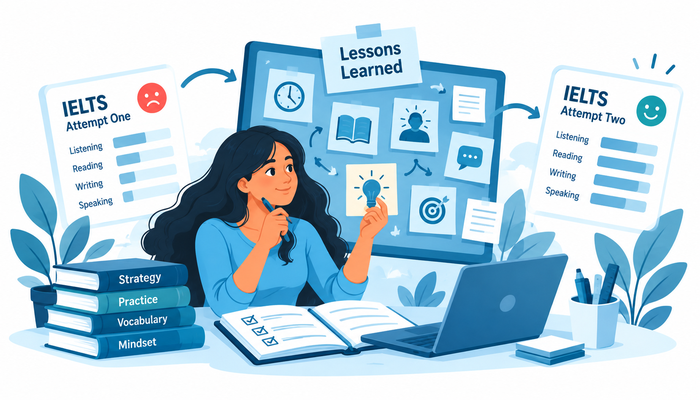
Lessons Learned From Taking IELTS Twice: What I Changed the Second Time
Taking IELTS twice taught me something that my first preparation plan never did: knowing English and knowing how to demonstrate your English under test conditions are related, but they are not the same skill. After my first attempt, I initially thought the solution was simple. I would study more, complete more practice tests, memorize more vocabulary, and return better prepared.
That approach would probably have produced the same problems.
The second attempt improved only when I stopped treating my first score as a disappointment and started treating it as evidence. Instead of asking why I was not good enough, I asked what the result showed about my preparation, timing, strategy, and weakest skills.
Table of Contents
My First Score Was Data, Not a Verdict
I Stopped Studying All Four Skills Equally
More Practice Tests Were Not the Answer
Feedback Changed My Writing Preparation
Speaking Needed Flexibility, Not Scripts
Timing Had to Become Automatic
Vocabulary Needed Accuracy, Not Decoration
My Second Test Needed a Different Plan
Retaking One Skill May Be an Option
What Nobody Tells You About Taking IELTS Twice
Second Attempt Checklist
FAQ
My First Score Was Data, Not a Verdict
My first reaction to a disappointing IELTS result was emotional. I focused on the overall band and immediately compared it with the score I needed. The gap felt like failure.
IELTS reports Listening, Reading, Writing, and Speaking separately, alongside an overall band. That breakdown is valuable because two candidates with the same overall score can have completely different preparation needs.
I Stopped Studying All Four Skills Equally
I gave Listening, Reading, Writing, and Speaking similar amounts of time because that seemed responsible. After receiving my result, I realized balance was not necessarily efficient.
If one component is already comfortably above your requirement, pushing it even higher may be less valuable than improving the skill that prevents your application from meeting the stated threshold.
My second study plan was intentionally uneven.
The weakest required skill received the largest share of focused preparation. Skills already near the target received enough practice to maintain performance. Stronger areas were monitored without consuming most of my available time.
A retake should be different.
You already have evidence from a real test. Use it to allocate your preparation time according to risk rather than preference.
More Practice Tests Were Not the Answer
After my first attempt, my instinct was to complete as many mock tests as possible.
But mock tests mainly measure performance. They do not automatically repair the problems they reveal.
If you repeatedly make the same Reading mistake, another complete Reading test may simply confirm that the mistake still exists. If your Writing lacks development, producing another essay without analyzing why your ideas remain underdeveloped can reinforce the same habits.
My second preparation cycle became more deliberate:
Test, analyze, isolate, practice, and retest.
Feedback Changed My Writing Preparation
Writing was the skill where self-study had the clearest limitation.
I could read my own essay and notice obvious grammar problems, but I could not always identify weaknesses in task response, paragraph development, coherence, or vocabulary choice. Worse, I sometimes believed a sentence sounded sophisticated when it was actually unnatural.
The most valuable comments were specific enough to change the next practice session. “Improve grammar” was too broad. “Your complex sentences repeatedly lose control when you use multiple dependent clauses” gave me something concrete to investigate.
I also learned to separate drafting from correction.
During timed practice, I wrote under realistic conditions. Afterward, I analyzed the response carefully, identified recurring problems, and sometimes rewrote only the weakest paragraph rather than producing another complete essay immediately.
Speaking Needed Flexibility, Not Scripts
My first Speaking preparation relied too heavily on familiar topics.
I had practiced answers about my hometown, hobbies, education, work, travel, technology, and environmental issues. Repetition made those topics feel comfortable, but comfort created false confidence.
Suddenly, I was not retrieving a polished answer. I had to understand the question, decide what I thought, organize an idea, choose vocabulary, control grammar, and keep speaking at the same time.
That is the skill I should have practiced.
For my second attempt, I used unfamiliar questions more often. I recorded answers without restarting. If I forgot a word, I described the idea differently. If I made a small grammatical mistake, I corrected it naturally when possible and continued.
Timing Had to Become Automatic
Knowing what to do is different from doing it quickly enough.
During my first preparation period, I often allowed small timing exceptions. I gave myself another few minutes to finish Writing, paused during difficult practice, or reviewed an answer before continuing.
Those exceptions made my practice results look better than my actual test readiness.
Before the second attempt, timing became part of the skill itself.
I practiced making decisions within the available time. In Reading, that meant recognizing when one question was consuming too much attention. In Writing, it meant protecting enough time to complete both tasks. In Speaking, it meant developing answers without mentally editing every sentence before saying it.
Realistic practice exposed weaknesses while there was still time to correct them. A retake should not merely repeat familiar tasks. It should reproduce the conditions that affected your first performance.
Vocabulary Needed Accuracy, Not Decoration
Before my first IELTS attempt, I collected advanced vocabulary aggressively.
I believed sophisticated words would make my English sound more academic and automatically improve my score. The problem was that knowing a definition did not mean I understood how a word behaved.
For my second attempt, I changed how I learned vocabulary.
I paid more attention to context, collocations, word families, register, and common usage. Instead of asking, “Is this word advanced?” I asked, “Would this word naturally express what I mean here?”
I also practiced paraphrasing.
That helped in both productive and receptive skills. If one word disappeared during Speaking, I could explain the idea another way. In Writing, I had alternatives without forcing obscure vocabulary into the response.
My Second Test Needed a Different Plan
I rebuilt mine around four questions:
What score did I need?
Which component was preventing me from reaching it?
Why was that component weaker?
What evidence would show that the problem had improved?
Those questions gave every study session a purpose.
A second attempt should be based on accumulated evidence.
You are not starting from zero. You have a real test result, preparation history, and experience of test day. That information should make the second plan more precise than the first.
Retaking One Skill May Be an Option
Taking IELTS twice does not always mean repeating all four sections.
IELTS currently offers One Skill Retake for eligible candidates who want to retake Listening, Reading, Writing, or Speaking. Under current IELTS rules, the original full test must have been IELTS on computer at a center offering One Skill Retake, and the retake must be completed within 60 days of the original test. Only one One Skill Retake is allowed per original full test.
IELTS recommends checking directly with the organization receiving your score before booking One Skill Retake. Universities, professional regulators, employers, and immigration authorities can have their own requirements.
There is also an important 2026 delivery change. IELTS announced that from mid-2026 it would stop offering the traditional paper-based test, with exact timelines varying by market, while selected markets would introduce a Writing on Paper option within computer-delivered testing.
Current local options should therefore be checked when booking.
What Nobody Tells You About Taking IELTS Twice
The second test can feel more stressful than the first.
I used fewer resources. I reviewed mistakes more deeply. I stopped comparing my preparation schedule with strangers online. Most importantly, I separated official requirements from personal experiences.
Official IELTS sources were useful for test format, scoring, policies, and current options. Receiving organizations were the source for the score they required and what results they accepted.
Lived experience served a different purpose.
Someone who has already taken IELTS while preparing to study, work, or relocate abroad can help you understand practical pressure, scheduling, and mistakes they wish they had avoided. That perspective can be valuable, but it should complement official guidance rather than replace it.
Second Attempt Checklist
Before booking another IELTS attempt, check the following:
Confirm the exact overall score you need.
Confirm every minimum component requirement.
Verify the correct IELTS test for your purpose.
Compare your first result with your target.
Identify the skill creating the largest gap.
Review your practice history for the same pattern.
Decide whether the problem is linguistic, strategic, or both.
Build study time around weaknesses rather than preferences.
Use realistic timing during simulations.
Analyze mistakes before completing another full test.
Seek reliable feedback for Writing and Speaking.
Practice unfamiliar questions, not only comfortable topics.
Learn vocabulary through context and accurate usage.
Track performance across several sessions.
Check current test availability in your location.
Investigate One Skill Retake if one component is the problem.
Confirm that your receiving organization accepts the result type you plan to submit.
Leave enough time before your application deadline for unexpected problems.
Book when your preparation provides evidence that something meaningful has changed.
Conclusion
Taking IELTS twice taught me that a retake should never be treated as a replay.
The first attempt gives you information that you did not have before: a real score, experience under official conditions, evidence of how you manage time, and a clearer picture of which skills remain vulnerable.
Use that information.
Do not automatically double your study hours. Diagnose the result first. Prioritize the component that matters most. Replace endless mock tests with targeted practice. Get useful feedback. Practice under strict timing. Build vocabulary you can control. Prepare for unfamiliar questions instead of memorizing comfortable answers.
Most importantly, connect your IELTS plan to the actual requirement behind it.
Your university, regulator, employer, or relevant authority determines what score and result type it accepts. Official IELTS resources explain the test and available options. Verify both before making decisions about another attempt.
FAQ
How soon can I retake IELTS after my first test?
IELTS states that you can apply to take the full test again as soon as you feel ready; there is no mandatory waiting period for a full retake. However, booking immediately is not always the best strategy. Review your first performance, identify what needs improvement, and make sure your preparation has addressed the problem before paying for another test.
Can I retake only one IELTS skill?
Yes, eligible candidates can use IELTS One Skill Retake for one section: Listening, Reading, Writing, or Speaking. The original full test must have been IELTS on computer at a center offering the service, and the One Skill Retake must be completed within 60 days. It can be used only once per original full IELTS test.
Will every university accept IELTS One Skill Retake?
No assumption should be made. IELTS specifically recommends checking directly with the organization receiving your result before booking One Skill Retake. Acceptance can depend on the institution, regulator, employer, immigration authority, or other organization involved in your application.
Should I study all four skills again before my second attempt?
Not equally in every case. Review your component scores and the minimum requirements for your application. If one skill is substantially weaker while the others already meet your target, that weaker component may deserve more preparation time. Continue maintaining stronger skills so their performance does not decline.
Is taking IELTS twice bad for my application?
Taking the test more than once is not automatically evidence of a problem. What matters is whether the result you submit meets the receiving organization’s requirements and policies. If you are concerned about how multiple results are handled, verify the current rules directly with the institution or authority evaluating your application.
What should I change before my IELTS retake?
Start with diagnosis rather than a new collection of study materials. Identify why your first score missed the target, then change the preparation behavior connected to that cause. This could mean targeted grammar work, better Writing feedback, stricter timing, more flexible Speaking practice, improved Reading strategy, or deeper Listening review.
Is a second IELTS attempt usually easier?
Not necessarily. Familiarity with the test can reduce uncertainty, but pressure may increase because you know what is at stake. The advantage of a second attempt is information. You now have a real result and test-day experience. Use that evidence to make preparation more targeted, realistic, and efficient than it was the first time.