Why I Failed My First English Exam
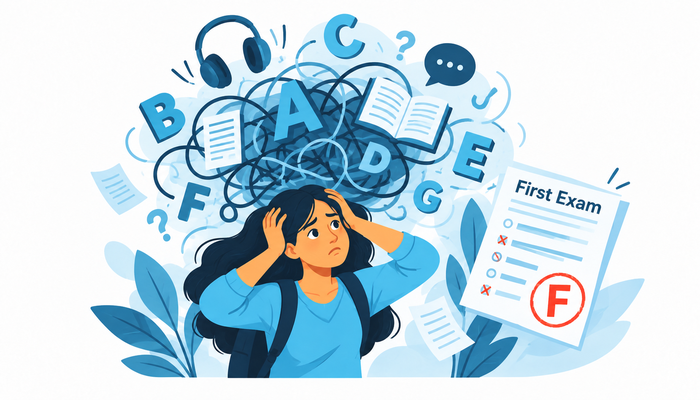
Why I Failed My First English Exam: The Mistakes That Changed How I Prepared
I walked into my first English exam believing that preparation meant knowing English. I had studied grammar, memorized vocabulary, watched English videos, and completed enough exercises to feel reasonably confident. What I had not learned was how to perform under the specific rules of a standardized language test.
My first disappointing result was not proof that I was bad at English. It showed that language ability and test performance overlap, but they are not identical. A candidate can communicate comfortably in everyday situations and still lose points because of timing, unfamiliar task types, weak answer development, or misunderstanding the scoring criteria.
IELTS made that lesson especially clear. The test measures Listening, Reading, Writing, and Speaking separately, and each skill has its own demands. Writing, for example, is assessed through task achievement or task response, coherence and cohesion, lexical resource, and grammatical range and accuracy. Speaking uses fluency and coherence, lexical resource, grammatical range and accuracy, and pronunciation.
I had prepared English. I had not prepared strategically for the exam.
That failure eventually became useful because it forced me to understand what effective preparation actually looks like.
Table of Contents
I Confused English Ability With Exam Readiness
I Studied Without a Baseline
I Practiced What Felt Comfortable
I Ignored the Scoring Criteria
I Used Vocabulary to Impress
I Underestimated Timing
I Practiced Without Enough Feedback
I Treated Mock Tests as Study
What I Changed After Failing
What Nobody Tells You About Failure
A Better Preparation Checklist
FAQ
I Confused English Ability With Exam Readiness
My first mistake was assuming that general English ability would automatically produce the score I needed.
It helps, obviously. No test strategy can replace the underlying language skills being assessed. But standardized exams also require familiarity with instructions, timing, question types, assessment criteria, and the kind of response each task expects.
My preparation had focused almost entirely on language knowledge.
A better question would have been: Can I demonstrate that knowledge reliably under the exact conditions of the exam?
That is a different skill, and it needs deliberate practice.
I Studied Without a Baseline
Before my first exam, I never completed a serious diagnostic assessment under realistic conditions.
I simply started studying.
That sounds productive, but it meant I had no objective answer to several important questions. Which skill was furthest from my target? Which question types repeatedly caused errors? Was my Writing actually improving? Did my performance decline under time pressure?
Without a baseline, every study session felt equally important.
After the disappointing result, I changed the process. I completed timed practice, recorded Speaking responses, reviewed Writing against the published criteria, and created an error log for Reading and Listening.
Patterns appeared quickly.
Some weaknesses were linguistic. Others were strategic. A few were surprisingly simple, such as spending too long on difficult questions and then rushing through easier ones later.
I Practiced What Felt Comfortable
Another reason I failed was uncomfortable to admit: I was practicing the parts I liked.
Listening felt satisfying because I could check answers immediately. Vocabulary study felt productive because every new word created visible progress. Watching English content was enjoyable and easy to justify as preparation.
Writing was harder.
It exposed weaknesses that I preferred not to see. Speaking recordings made me notice hesitation, repetition, and pronunciation problems. Difficult Reading question types damaged my confidence.
So I unconsciously avoided them.
After failing, I began organizing study time around weaknesses rather than preferences.
That did not mean abandoning stronger skills. They still needed maintenance. But the largest gap between my current performance and required score received the most attention.
Preparation became less comfortable and much more useful.
I Ignored the Scoring Criteria
I also made the mistake of treating the examiner as a mysterious judge.
Instead of learning how performance was assessed, I relied on vague advice: use advanced vocabulary, write long answers, speak confidently, avoid simple sentences, and include impressive expressions.
Some of that advice was incomplete. Some was actively distracting.
IELTS publishes assessment criteria for productive skills. Writing is evaluated through task achievement or response, coherence and cohesion, lexical resource, and grammatical range and accuracy. Speaking is evaluated through fluency and coherence, lexical resource, grammatical range and accuracy, and pronunciation.
Scoring criteria turn preparation from guesswork into diagnosis.
I Used Vocabulary to Impress
My vocabulary strategy was probably the clearest example of studying for appearance rather than communication.
I collected sophisticated words because they looked like shortcuts to a higher score. Then I tried to insert them into essays and Speaking answers whether they belonged there or not.
Some words were technically related to the topic but unnatural in context. Others created collocation problems. Occasionally, I chose a complicated expression when a simpler word would have communicated the idea more accurately.
IELTS Writing criteria explicitly consider whether vocabulary is accurate and appropriate. Range matters, but precision matters too.
The lesson applies beyond IELTS. A language exam is not a competition to display the rarest words you know. Vocabulary is valuable when it helps you communicate meaning accurately, naturally, and efficiently.
I Underestimated Timing
At home, I could produce decent work because I quietly gave myself extra time.
Five additional minutes did not feel important. Pausing a practice session to check something seemed harmless. Finishing an essay and then spending another ten minutes improving it made the final version look stronger.
IELTS Academic Writing allows 60 minutes for both tasks, with Task 2 weighted more heavily. Official guidance suggests roughly 20 minutes for Task 1 and 40 minutes for Task 2.
Timed practice exposed these habits.
Eventually, I learned to separate training from simulation. During skill-building sessions, I could slow down and analyze problems. During exam simulations, the clock was nonnegotiable.
Both types of practice were necessary.
I Practiced Without Enough Feedback
Practice can reinforce improvement, but it can also reinforce mistakes.
That was especially true for Writing and Speaking.
I could complete another essay every day, but if I misunderstood what a strong response required, repetition alone would not correct the misunderstanding. I could speak for twenty minutes, but if I never reviewed the recording, recurring problems could remain invisible.
Feedback changed that.
Specific feedback creates specific practice.
When professional or teacher feedback is unavailable, official sample tasks, model responses, scoring resources, recordings, and structured self-review can still make practice more informed. IELTS currently provides official sample questions and preparation resources that candidates can use to understand task formats and practice under timed conditions.
The key is to avoid producing endless work without analysis.
I Treated Mock Tests as Study
After realizing I needed more realistic preparation, I initially overcorrected.
I started taking full practice tests repeatedly.
A mock test is primarily a measurement tool. It shows what happens when several skills must operate under test conditions. It can reveal timing problems, stamina issues, recurring errors, and performance trends.
But measurement is not the same as repair.
The better cycle was simple:
Test, analyze, isolate, practice, retest.
A mock identified the problem. Targeted practice addressed it. A later mock checked whether the change survived under pressure.
What I Changed After Failing
My second preparation plan looked completely different.
First, I wrote down the exact score required for my application, including any minimum component requirements. A “good IELTS score” was no longer the goal. The required score was.
Second, I established a realistic baseline and ranked weaknesses by importance.
Third, I reduced the number of resources I used. Instead of jumping between random videos, books, websites, and social media tips, I relied more heavily on official IELTS materials and a smaller set of preparation resources.
Fourth, every practice activity needed a purpose.
A Reading session might target one recurring question type. A Writing session might focus on developing examples. A Speaking session might focus on answering unfamiliar Part 3 questions without freezing.
Finally, I reviewed progress weekly.
The question was not, “Did I study enough hours?”
It was, “Which problems are becoming less frequent, and which problems are still limiting performance?”
What Nobody Tells You About Failing
Failing an English exam can feel strangely personal.
When a language test is connected to university admission, immigration planning, professional registration, or relocation, the score seems bigger than an exam. It can feel like a judgment about your intelligence, future, or ability to function abroad.
It is not.
A score is evidence of performance on a particular assessment at a particular time. It can reveal genuine weaknesses, and those weaknesses should be taken seriously, but turning the result into an identity makes improvement harder.
The useful response is investigation.
Was the target realistic? Did you understand the test? Which component caused the problem? Was your practice representative of exam conditions? Did you receive reliable feedback? Did anxiety expose weaknesses in preparation that comfortable practice had hidden?
People who have already studied, worked, or relocated abroad can sometimes help you understand how language testing fits into the larger application timeline. Their lived experience can be useful for planning, but it should complement official requirements, not replace them.
A Better Preparation Checklist
Before your next English exam, make sure you can answer these questions:
What exact score does my receiving organization require?
Are there minimum scores for individual components?
Am I taking the correct test and version?
What is my current realistic baseline?
Which skill is furthest from the required level?
Which question or task types repeatedly cause problems?
Do I understand the official assessment criteria?
Am I practicing under realistic time limits?
Do I analyze mistakes instead of only checking answers?
Am I receiving useful feedback on productive skills?
Can I explain why my previous performance fell short?
Does my study schedule prioritize weaknesses?
Am I using reliable, current preparation materials?
Do I have enough time before my application deadline for another attempt if necessary?
Most importantly, make sure your preparation produces evidence of change.
Conclusion
I failed my first English exam because I misunderstood preparation.
I thought knowing more vocabulary, reviewing grammar, consuming English content, and completing exercises would automatically translate into the score I needed.
They did not.
The exam required me to demonstrate language ability through specific tasks, within specific time limits, under specific assessment criteria. I had not trained that complete process.
I measured my baseline. I identified weaknesses. I learned the scoring criteria. I stopped using complicated vocabulary merely to sound impressive. I practiced under realistic timing. I sought feedback. I used mock tests to measure progress rather than replace targeted study.
If your first English exam did not go as planned, do not respond by repeating exactly the same preparation with more intensity.
FAQ
Does failing IELTS mean my English is bad?
Not necessarily. IELTS measures performance across four specific skills under standardized conditions. A disappointing result can reflect genuine language weaknesses, but it may also reveal problems with timing, task familiarity, answer development, or preparation strategy. Review individual component scores and practice evidence before deciding what needs to change.
Should I take another IELTS test immediately?
Not automatically. First identify why your previous result missed the requirement. If the same weakness remains unchanged, booking another test quickly may reproduce the same outcome. Consider your application timeline, current performance, available preparation time, and the requirements of the organization receiving your score.
Are official IELTS practice materials worth using?
Yes. Official IELTS resources include sample questions and preparation materials designed to familiarize candidates with test formats and task types. They are especially useful for understanding what the actual assessment expects and for practicing under realistic conditions.
How is IELTS Writing scored?
IELTS Writing uses four criteria: task achievement for Task 1 or task response for Task 2, coherence and cohesion, lexical resource, and grammatical range and accuracy. Task 2 contributes more heavily to the final Writing score than Task 1.
How is IELTS Speaking scored?
IELTS Speaking uses four equally weighted criteria: fluency and coherence, lexical resource, grammatical range and accuracy, and pronunciation. Preparation should therefore develop communication across all four areas rather than concentrating only on vocabulary or grammatical perfection.
Should I memorize advanced vocabulary before retaking IELTS?
Build vocabulary, but do not prioritize rare words simply because they appear advanced. IELTS assessment considers accurate and appropriate vocabulary use. Learn words in context, understand common combinations, and practice using them naturally. A precise familiar word is usually more useful than an impressive word used incorrectly.
What is the biggest lesson from failing a language exam?
Treat the result as diagnostic information rather than a personal verdict. Determine exactly where performance fell below the requirement, identify why it happened, and redesign preparation around those causes. The strongest second attempt is not simply more preparation. It is better targeted preparation.