What Nobody Told Me About the IELTS Speaking Test
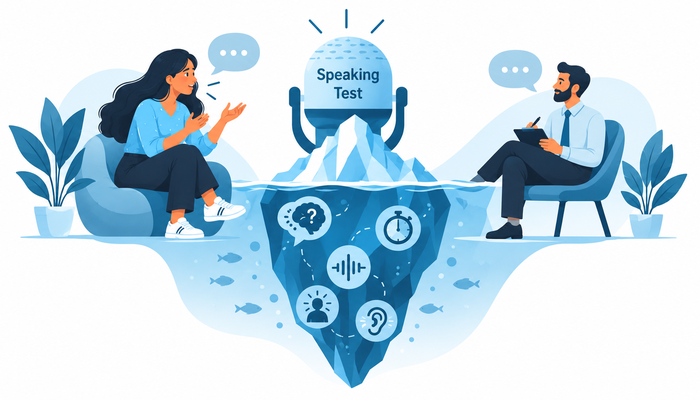
What Nobody Told Me About the IELTS Speaking Test: What Actually Matters
Before preparing for IELTS Speaking, I assumed the challenge was obvious: speak English correctly, use impressive vocabulary, avoid grammatical mistakes, and try not to become nervous. That sounded reasonable, but it missed what makes the test difficult.
IELTS Speaking is not a performance where the candidate with the most sophisticated vocabulary automatically wins. It is a structured conversation designed to show how effectively you communicate when you cannot predict every question, prepare every sentence, or pause indefinitely to choose perfect language.
That difference changes how you should prepare.
The current IELTS Speaking test lasts 11–14 minutes and contains three parts. Certified examiners assess candidates using four equally weighted criteria: fluency and coherence, lexical resource, grammatical range and accuracy, and pronunciation.
Once you understand those criteria, many popular preparation habits start looking less useful. Memorizing model answers, forcing advanced vocabulary into simple conversations, eliminating every trace of your natural accent, or panicking after one grammatical mistake can distract you from what the examiner is actually assessing.
The most useful preparation therefore starts by understanding what the test really asks you to do.
Table of Contents
The Examiner Is Not Looking for Perfect English
Part 1 Is Simple but Easy to Misjudge
Part 2 Tests More Than Your Memory
Part 3 Changes the Conversation
Your Accent Is Not Automatically a Problem
Memorized Answers Can Become a Trap
Pausing Does Not Mean You Are Failing
Self-Correction Is Normal
Common Speaking Preparation Mistakes
What Nobody Tells You About Test Day
A Better Preparation Strategy
Final Checklist
FAQ
The Examiner Is Not Looking for Perfect English
One of the most important things nobody told me was that IELTS Speaking does not require flawless English.
The official assessment criteria make this clear. Fluency and coherence considers continuity, pace, logical organization, and how effectively ideas connect. Lexical resource evaluates vocabulary range, precision, appropriateness, and the ability to express meaning in different ways. Grammatical range and accuracy considers both variety and control. Pronunciation focuses on producing speech that listeners can understand without excessive effort.
This means a grammatical mistake does not automatically destroy a strong answer.
Ironically, trying to eliminate every mistake can create another problem. Candidates sometimes monitor themselves so aggressively that they stop after minor errors, restart sentences, reconsider vocabulary, and lose the natural flow of the conversation.
Speaking requires decisions in real time.
A better objective is controlled communication. Use language you can handle, attempt enough range to demonstrate your ability, and continue when a small error occurs.
Your performance is assessed across the entire test, not through one imperfect sentence. The official band descriptors also state that ratings reflect average performance across all parts.
That perspective removes unnecessary pressure from individual mistakes.
Part 1 Is Simple but Easy to Misjudge
Part 1 lasts approximately four to five minutes. The examiner asks questions about familiar subjects such as home, family, work, studies, and interests.
Because the topics sound easy, candidates often prepare for this section poorly.
One extreme is giving answers that are too short. If the examiner asks whether you enjoy cooking and you answer, “Yes, I do,” the response communicates basic information but gives very little evidence of your speaking ability.
The opposite extreme is equally problematic. Some candidates transform every simple question into a long prepared speech because they believe longer always means better.
Natural development works better.
You might explain that you enjoy cooking on weekends because weekdays are busy, then mention one meal you regularly prepare. That provides a reason and relevant detail without turning a conversational question into a presentation.
Practice extending answers naturally rather than counting sentences.
Part 1 is also a useful reminder that ordinary topics deserve practice. Candidates sometimes spend weeks discussing artificial intelligence, environmental policy, and globalization but struggle to describe their neighborhood or morning routine naturally.
The test evaluates communication across familiar and less familiar contexts. Everyday English matters.
Part 2 Tests More Than Your Memory
Part 2 introduces a different challenge. You receive a task card, have one minute to prepare, and then speak for up to two minutes. The examiner may ask one or two related questions afterward.
The preparation minute can disappear surprisingly quickly.
A common mistake is trying to write complete sentences. This consumes time and creates a script that you may then attempt to reproduce while speaking.
Use notes as navigation instead.
If you are asked to describe a memorable place, you might note the location, when you visited, who was there, two memorable details, and why the experience mattered. Those prompts create direction while leaving you free to speak naturally.
You also do not need an extraordinary story.
Candidates sometimes invent complicated experiences because they think the examiner will reward interesting content. But the examiner is evaluating your English, not judging whether your life is exciting enough.
A clear description of a neighborhood café can demonstrate more language ability than an elaborate fictional story that becomes difficult to control.
The deeper skill in Part 2 is organizing ideas quickly and continuing coherently when you are responsible for maintaining the speech.
Part 3 Changes the Conversation
Part 3 is where many candidates realize that IELTS Speaking is not simply a collection of personal questions.
The discussion becomes broader and more abstract. Questions are connected to the Part 2 topic but give you opportunities to explain ideas in greater depth.
Suppose Part 2 asked about a memorable trip. Part 3 could move toward tourism, transportation, environmental effects, changing travel habits, or differences between generations.
Now personal storytelling is not enough.
You need to explain an opinion.
A useful approach is to state your position, explain why you hold it, provide an example, and consider a consequence or contrast. You do not need to force this structure onto every answer, but practicing it helps you develop ideas instead of stopping after one claim.
If asked whether tourism benefits local communities, for example, you might discuss employment and small businesses before acknowledging possible pressure on housing or infrastructure.
The examiner is not evaluating your political or social opinion. IELTS guidance emphasizes language performance rather than whether an examiner agrees with your beliefs.
Focus on developing the idea clearly.
Your Accent Is Not Automatically a Problem
Many candidates waste preparation time trying to acquire a British or American accent.
Pronunciation matters, but accent and poor pronunciation are not the same thing.
Official IELTS pronunciation guidance considers features such as rhythm, stress, intonation, connected speech, individual sounds, and the degree of effort required for a listener to understand the candidate. It also considers the effect an accent has on intelligibility.
That last point matters.
The goal is not to erase every sign of where you come from. The goal is to communicate clearly enough that your pronunciation does not make understanding unnecessarily difficult.
Instead of asking, “Do I sound native?” ask, “Can another person understand me comfortably?”
Record yourself and identify specific problems. Perhaps particular consonants become unclear, word stress changes meaning, or you speak so quickly that words merge together.
Those are practical pronunciation targets.
Imitating an accent without improving intelligibility can consume hours while leaving more important weaknesses untouched.
Clear speech is a much better goal than performing somebody else’s identity.
Memorized Answers Can Become a Trap
Memorizing complete answers feels attractive because IELTS Speaking contains uncertainty.
If you can predict the questions and prepare perfect responses, test day seems safer.
The problem is that conversation does not behave like a script.
Official IELTS guidance warns against over-rehearsed responses and emphasizes conversational communication. Examiners are trained to recognize memorized material, and scripted answers may fail to demonstrate a candidate’s genuine ability to communicate flexibly.
Even without detection, memorization creates practical problems.
Imagine preparing an excellent answer about why you love your hometown. The examiner instead asks how your hometown has changed during your lifetime. Trying to force your prepared response into that question can make your answer irrelevant.
Scripts are also fragile. Forget one sentence and the sequence may collapse.
Prepare language, not performances.
Build useful vocabulary around common themes. Practice describing experiences, comparing situations, explaining causes, discussing consequences, and giving opinions.
Those abilities transfer between questions.
A flexible speaker with ordinary but accurate vocabulary is often in a stronger position than a candidate carrying twenty sophisticated speeches and hoping the correct question appears.
Pausing Does Not Mean You Are Failing
Silence feels different during an exam.
A brief pause that would seem completely normal in conversation can feel enormous when you know someone is assessing you.
Candidates often respond by filling every gap with repeated sounds, restarting sentences, or speaking before they know what they want to say.
Fluency does not mean speaking continuously without thinking.
IELTS guidance describes fluency in terms of continuity, rate, effort, and whether speech is excessively interrupted by false starts, repetition, backtracking, or pauses used to search for language.
A short content-related pause can therefore be different from repeatedly stopping because you cannot construct language.
Practice this distinction.
Ask yourself unfamiliar Part 3 questions and allow a brief moment to organize your idea before answering. Then continue with purpose.
The objective is not maximum speed.
Speaking extremely quickly can create pronunciation problems and reduce clarity. Speaking unnaturally slowly can break connections between ideas.
Aim for a sustainable conversational pace that allows you to think while remaining understandable.
Self-Correction Is Normal
Another misconception is that correcting yourself proves your English is weak.
Natural speakers self-correct too.
The problem appears when correction becomes constant enough to disrupt communication.
Suppose you say, “Last year I go—sorry, I went—to Germany.” That correction can happen quickly without destroying the answer.
Now imagine stopping after nearly every sentence to reconsider an article, verb tense, or word choice. The listener has to follow your editing process instead of your message.
Learn which mistakes deserve immediate attention.
If an error changes the meaning or you can correct it naturally, do so and continue. If you notice a tiny mistake several seconds later, returning to repair it may create more disruption than leaving it behind.
This is one reason recorded practice is useful.
During the conversation, focus on communication. Afterward, review the recording and analyze recurring errors in detail.
Separating performance from analysis allows you to improve accuracy without turning every speaking session into live proofreading.
Common Speaking Preparation Mistakes
The first mistake is trying to sound more advanced than you really are. Rare vocabulary is not automatically better vocabulary. If you use a sophisticated word inaccurately or unnaturally, complexity has not improved communication.
The second mistake is practicing only familiar questions. Repeating the same topics creates confidence but may not create flexibility.
Another mistake is ignoring pronunciation while concentrating entirely on vocabulary and grammar. Pronunciation is one of the four equally weighted assessment criteria.
Candidates also spend too much time interpreting the examiner’s behavior. A serious expression does not tell you your score. An interruption does not automatically mean your answer was poor. IELTS guidance specifically advises candidates not to overanalyze examiner reactions.
Finally, many candidates practice answers but never practice recovery.
Real preparation should include forgetting a word, receiving an unfamiliar question, making a grammatical mistake, and continuing anyway.
That resilience matters because no realistic speaking test will feel perfect from beginning to end.
What Nobody Tells You About Test Day
The first surprise is how quickly the test moves.
Eleven to fourteen minutes is a short window. There is little time to analyze how the previous answer went because another question is already arriving.
The second surprise is that ordinary questions can feel unexpectedly difficult.
You may have prepared complicated social topics and then struggle to explain whether you prefer mornings or evenings because you have never practiced developing simple personal answers.
The third surprise is how much mental energy self-monitoring consumes.
If half your attention is asking, “Was that grammar correct?” you have less attention available for listening to the examiner and developing your next idea.
This is why realistic simulation matters.
Practice all three parts without stopping. Record the session. Use questions you have not seen. Continue after mistakes. Review everything afterward.
Official IELTS sample materials are useful because they reflect the actual test structure, and the Speaking test is the same for Academic and General Training candidates.
Familiarity reduces unnecessary test-day surprises.
A Better Preparation Strategy
Start with a complete recorded simulation before intensive preparation.
Listen back and identify behaviors rather than judging yourself emotionally.
Where do you hesitate? Do you repeat basic vocabulary? Are answers developed? Can you paraphrase when a word disappears? Do grammatical errors increase during longer answers? Is your pronunciation consistently understandable?
Then connect each weakness to the official criteria.
For fluency and coherence, practice extending ideas and linking them logically.
For lexical resource, learn vocabulary in context and practice expressing the same idea in different ways.
For grammatical range and accuracy, identify structures you already control and gradually expand them.
For pronunciation, prioritize intelligibility, stress, rhythm, intonation, and recurring sound problems.
Practice Part 1 for natural extension, Part 2 for organization and sustained speech, and Part 3 for explanation and abstraction.
Most importantly, use unfamiliar questions regularly.
Someone who has already completed IELTS while preparing to study or relocate abroad can also provide useful practical perspective about balancing preparation with applications and deadlines. That lived experience should complement official information, not replace it.
Final IELTS Speaking Checklist
Before test day, make sure you can:
explain the three-part Speaking structure;
recognize the four assessment criteria;
answer familiar questions without sounding scripted;
extend short answers naturally;
use Part 2 preparation time efficiently;
speak at length from brief notes;
explain opinions in Part 3;
provide reasons, examples, contrasts, and consequences;
paraphrase when vocabulary disappears;
recover after grammatical mistakes;
tolerate short thinking pauses;
use vocabulary accurately rather than decoratively;
vary grammar without sacrificing control;
speak clearly without imitating an artificial accent;
complete full simulations without restarting;
review recordings using specific criteria;
respond to unfamiliar questions;
continue after an answer feels imperfect.
Do not measure readiness by the number of topics you have memorized.
Measure whether you can communicate when the topic is unexpected.
Conclusion
What nobody told me about IELTS Speaking is that the hardest part is not simply speaking English.
It is managing English in real time.
You must understand an unexpected question, decide what you think, organize an answer, select vocabulary and grammar, pronounce everything clearly, notice mistakes without becoming distracted, and continue interacting with another person.
That is why memorization provides such fragile confidence.
A stronger strategy develops flexibility.
Understand the assessment criteria. Learn what each part requires. Record yourself. Practice unfamiliar questions. Develop ideas rather than stretching answers artificially. Improve pronunciation for intelligibility rather than accent imitation. Correct mistakes when useful, then keep moving.
IELTS Speaking becomes less mysterious when you stop treating it as a performance where perfect English is expected.
It is a structured conversation that gives the examiner evidence of your speaking ability.
Prepare for the conversation, not a script.
FAQ
Is IELTS Speaking the same for Academic and General Training?
Yes. IELTS states that the Speaking test is the same for Academic and General Training candidates. Both use the same three-part structure and assessment approach. The differences between Academic and General Training are found in Reading and Writing rather than Speaking.
How long does IELTS Speaking take?
The Speaking test lasts approximately 11–14 minutes and contains three parts. Part 1 covers familiar topics, Part 2 requires an extended response after preparation time, and Part 3 develops a broader discussion related to the Part 2 topic.
What are the four IELTS Speaking assessment criteria?
The four criteria are fluency and coherence, lexical resource, grammatical range and accuracy, and pronunciation. IELTS states that these criteria are equally weighted when the Speaking score is calculated.
Do I need a British or American accent?
No. The official pronunciation criteria focus on intelligibility and pronunciation features rather than requiring candidates to imitate one specific national accent. Work on clarity, stress, rhythm, intonation, connected speech, and sounds that make your speech difficult to understand.
Is it bad if the examiner interrupts me?
Not necessarily. IELTS guidance notes that examiners may interrupt candidates and move the conversation forward. Do not interpret every interruption as negative feedback. Focus on answering the current question and demonstrating your language ability instead of trying to read the examiner’s reaction.
Should I memorize IELTS Speaking answers?
No. Preparing vocabulary and practicing common themes can be useful, but complete memorized scripts reduce flexibility and may sound unnatural. IELTS guidance specifically warns against over-rehearsed answers. Practice responding to new questions using language you can adapt naturally.
What should I do if I forget a word during the test?
Keep communicating. Lexical resource includes the ability to express meaning using alternative vocabulary when a particular word is unavailable. Describe the object, explain the concept, or use a simpler synonym rather than freezing while searching for one perfect word. That ability to paraphrase is itself relevant to the assessment.
Make the article genuinely first-person Replace isolated sentences with fuller paragraphs