The IELTS Mistake That Cost Me My Application
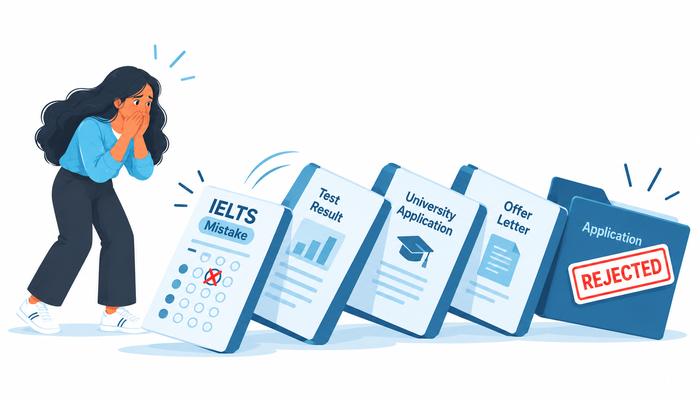
The IELTS Mistake That Cost Me My Application: What I Wish I Had Checked Earlier
The IELTS mistake that can cost you an application is not always getting a terrible score. Sometimes, the result looks good. You may even celebrate when you see your overall band, tell your family that the exam is finally finished, and move on to the next stage of your university application.
Then you read the admission requirements again and notice four words you underestimated: “minimum in each component.”
That changes everything.
Imagine that your program requires an overall IELTS band of 7.0, with no individual skill below 6.5. Your result shows strong Listening, Reading, and Speaking scores, but Writing is 6.0. Your overall band may still look impressive, yet your result does not satisfy that program’s stated requirement.
The problem becomes much worse if you discover this shortly before an application deadline.
This is the IELTS mistake applicants rarely discuss when talking about preparation. Everyone focuses on vocabulary, mock tests, Writing Task 2, Speaking questions, and achieving a higher overall band. Far fewer people talk about making sure they are preparing for the right score, the right test, and the right deadline.
IELTS itself reports an overall score plus individual scores for Listening, Reading, Writing, and Speaking. The overall band is calculated from the four component scores and rounded according to IELTS rules. IELTS
But the score that matters for your application is ultimately the score your receiving organization requires.
Understanding that distinction before you book the exam can save you from an avoidable application crisis.
Table of Contents
The mistake: focusing on the overall band
Why a “good IELTS score” is not enough
Overall scores and component requirements
Choosing the correct IELTS test
Why timing can become the real problem
Building a safer IELTS timeline
What to do after a near-miss score
Common IELTS application mistakes
Lessons learned from the experience
What nobody tells you about IELTS planning
Application checklist
FAQ
The Mistake: I Prepared for an Overall Score
The original assumption sounds completely reasonable: if the university says IELTS 7.0, prepare until you can achieve 7.0.
Unfortunately, requirements are not always that simple.
A receiving organization may specify an overall band and minimum component scores. A program might also have different English requirements from another program at the same institution. Professional registration, immigration, and university admission can involve separate rules.
This means “I need IELTS 7” is not a sufficiently detailed preparation target.
A useful target looks more like this:
Requirement | Example Target |
Overall IELTS | 7.0 |
Listening | 6.5 minimum |
Reading | 6.5 minimum |
Writing | 6.5 minimum |
Speaking | 6.5 minimum |
Those figures are only an example, not a universal requirement. The important point is the structure.
Before studying, you should know whether your receiving organization cares only about the overall band or also establishes individual minimums.
IELTS currently reports each of the four skills separately, and the overall band is based on the average of those four component scores. IELTS
That means strong performance in one area can influence your overall score without necessarily solving a weakness that matters to your application.
There Is No Universal “Good IELTS Score”
Applicants often ask, “Is 7.0 a good IELTS score?”
From a language-proficiency perspective, IELTS describes Band 7 as a “Good” level. But from an application perspective, the better question is whether that particular score satisfies the requirements for your intended purpose. IELTS
A score can be excellent for one application and insufficient for another.
That is why copying another applicant’s target can be risky. Your friend may be applying to a different university, degree, profession, immigration pathway, or institution. Even when two people are moving to the same country, their language requirements may not be identical.
Your target should therefore come from the organization that will actually evaluate your result.
Go to the official program or authority page. Check the current requirements. Look specifically for individual skill minimums, accepted test types, score validity rules, and submission procedures.
If anything remains unclear, ask the organization directly.
An extra email before the test is easier than trying to rescue an application afterward.
Overall Band Scores Can Hide the Real Problem
Consider a hypothetical candidate who receives these scores:
Skill | Band |
Listening | 8.0 |
Reading | 7.5 |
Writing | 6.0 |
Speaking | 7.0 |
Looking only at the stronger scores can create false reassurance.
The candidate may clearly have substantial English ability, but if the intended program requires at least 6.5 in Writing, that single component becomes the problem.
This also changes how the candidate should prepare for another attempt.
Spending equal amounts of time on all four skills would probably be inefficient. Moving Listening from 8.0 to 8.5 may feel rewarding, but it does nothing to solve the Writing requirement.
The preparation strategy should instead investigate why Writing remains weaker.
Is the candidate misunderstanding the task? Are ideas insufficiently developed? Is paragraph organization weak? Are grammar errors interfering with clarity? Is time management causing the second half of the response to deteriorate?
The answer determines what should happen next.
This is why application-focused IELTS preparation should begin with a requirement map and a performance diagnosis rather than a generic study schedule.
Make Sure You Are Taking the Correct IELTS Test
Score requirements are only one part of the problem.
You also need the appropriate IELTS test for your purpose.
IELTS currently offers different test types, including IELTS Academic and IELTS General Training, while IELTS for UKVI is relevant for specific UK visa circumstances. IELTS states that Academic and General Training share the same Listening and Speaking sections, while their Reading and Writing sections differ. IELTS
IELTS Academic is generally designed for people seeking undergraduate or postgraduate study and can also be relevant for professional registration. General Training is designed for purposes including migration to certain English-speaking countries and study or training below degree level. IELTS
Those descriptions help you understand the tests, but they should not replace checking the requirements for your specific application.
Do not choose General Training simply because somebody says it is easier. Do not automatically choose Academic merely because you associate it with a higher level of English.
Choose the test your receiving organization requires.
The distinction becomes even more important when one IELTS result may be connected to several processes. A test accepted for university admission should not automatically be assumed to satisfy immigration or professional-registration requirements.
Different purpose, different verification.
The Real Problem Was Timing
Missing a component requirement is frustrating.
Missing it six months before an application deadline and missing it six days before the deadline are completely different situations.
That is where a manageable IELTS problem can become an application problem.
Many candidates create a timeline that assumes success on the first attempt. They choose a test date, estimate when the result will be available, and place the exam just before the university deadline.
The schedule works beautifully if everything goes according to plan.
It has no recovery capacity if anything goes wrong.
Even a well-prepared candidate can receive a result below their target in one component. Test-day concentration, timing, unfamiliar tasks, or a weakness that was not obvious during preparation can affect performance.
Your IELTS timeline should therefore include uncertainty.
Instead of asking, “What is the latest date I can take IELTS?” ask, “What test date still leaves me realistic options if the first result is not enough?”
That is a much safer planning question.
Build a Recovery Window Before You Need One
A strong application timeline works backward from the actual deadline.
First, identify when your receiving organization needs the language result. Then check how the result must be submitted and whether there are separate document deadlines.
From there, create room for an unexpected result.
That buffer might need to accommodate reviewing your score, identifying what went wrong, preparing again, finding another available test date, completing a retake, receiving the new result, and sending it correctly.
The appropriate amount of time will vary according to your circumstances.
The principle does not.
Your first IELTS attempt should ideally not be your only workable opportunity.
This is particularly important during busy application periods, when test availability and your personal schedule may reduce your flexibility.
Planning early also improves preparation psychologically. Instead of treating one exam date as a single irreversible moment, you can approach it as part of a broader application plan.
That does not mean expecting to fail.
It means refusing to build an important application around the assumption that nothing unexpected will happen.
What If Only One IELTS Skill Is Below the Target?
A near-miss result can be especially frustrating.
If Listening, Reading, and Speaking meet your target but Writing falls half a band short, repeating the entire exam may feel inefficient.
IELTS currently offers One Skill Retake in eligible circumstances. It allows eligible test takers to retake one of the four skills rather than completing all four again. IELTS says candidates must have completed a full IELTS on computer test at a center offering the option, and the One Skill Retake must be completed within 60 days of the original test. Only one One Skill Retake is permitted for each original full test. IELTS
However, there is a crucial application detail.
IELTS explicitly recommends checking directly with the receiving organization to confirm that it accepts One Skill Retake before booking it. IELTS
That last step is exactly the type of verification applicants can overlook.
An available test option is not automatically an accepted application option.
Before paying for any retake, confirm what your university, regulator, employer, or relevant authority will recognize.
Do Not Immediately Retake Without Diagnosing the Result
When you miss your target by half a band, the emotional reaction is often immediate: book another test as soon as possible.
Sometimes that makes sense.
Sometimes it repeats the same problem.
Before deciding, compare the official result with your practice history. If your Writing was consistently around your target and one exam produced an unusually low score, your decision may differ from someone whose practice performance was consistently below the required level.
Ask what actually needs improvement.
If timing caused the problem, practice under strict conditions.
If task interpretation caused it, work on analyzing prompts before producing more full responses.
If grammar repeatedly limits clarity, isolate those patterns instead of memorizing new vocabulary.
If Speaking falls short, identify whether fluency, vocabulary, grammar, pronunciation, or response development is creating difficulty.
A retake should be the end of a corrective process, not simply a repetition of the previous attempt.
Common IELTS Application Mistakes
The first mistake is checking only the overall band requirement. Always look for minimum component scores.
The second is using another applicant’s requirement as your own. Similar applications can still have different criteria.
The third is booking the test too close to the deadline. A schedule without a recovery window assumes perfect execution.
The fourth is choosing a test type based on general internet advice rather than the receiving organization’s current rules.
The fifth is assuming a retake option will automatically be accepted. Verify acceptance before relying on One Skill Retake or any alternative arrangement.
Another common mistake is spending preparation time according to preference. Candidates naturally practice the sections they enjoy, especially when those sections produce encouraging scores.
Your application does not care which section you enjoy.
It cares whether the result satisfies the requirement.
Finally, applicants sometimes rely on old screenshots, forum posts, social media videos, or advice from people who applied years earlier. Those sources may be useful for lived experience, but current requirements should be verified through official sources.
Lessons Learned
The first lesson is simple: prepare for the application requirement, not an abstract IELTS score.
Write down the exact test type, overall target, individual minimums, deadline, and submission method before creating your study plan.
The second lesson is that IELTS preparation and application planning should not be separated. Your test date affects what happens if you need another attempt, and your application deadline determines how much flexibility you have.
The third lesson is to treat your weakest required component as a bottleneck.
If three skills comfortably exceed the requirement while one repeatedly falls below it, that weaker skill deserves disproportionate attention.
The fourth lesson is to verify assumptions at the source.
Official IELTS information explains the test itself. Universities, immigration authorities, professional regulators, and other receiving organizations determine what they accept for their own purposes.
You need both pieces of information.
What Nobody Tells You About IELTS Planning
IELTS can become stressful for reasons that have very little to do with English.
The exam sits inside a larger chain of decisions: applications, document preparation, university deadlines, finances, housing research, visa planning, and eventually relocation.
A delay at one stage can create pressure elsewhere.
That is why the most valuable IELTS advice is sometimes not another vocabulary technique. It is learning to plan backward from the real objective.
There is also an important difference between official information and lived experience.
Official sources tell you what the rules are. Someone who has already studied or relocated abroad may help you understand what those rules felt like in practice: how early they booked their test, what they underestimated, how they balanced exam preparation with applications, and which delays created unexpected pressure.
This is where speaking with an experienced expat mentor can be useful. The mentor should not replace official IELTS guidance or provide legal decisions. The value is practical context: understanding the parts of the process that formal instructions may not explain.
IELTS Application Checklist
Before booking IELTS, confirm all of the following:
the exact IELTS test required for your purpose;
your required overall band score;
any minimum Listening score;
any minimum Reading score;
any minimum Writing score;
any minimum Speaking score;
your application deadline;
your language-document deadline, if different;
how the organization wants your result submitted;
whether your planned test date leaves recovery time;
which skill is currently furthest from your target;
whether your practice reflects realistic test conditions;
what you will do if one component misses the requirement;
whether any retake option you are considering is accepted.
Save the official requirement page and check it again before submission.
IELTS recommends that results generally be considered valid for two years, although accepting organizations can choose to accept results for longer. That is another reason to confirm the policy directly with the organization using your score. IELTS
Conclusion
The IELTS mistake that can cost an application is often surprisingly ordinary.
You prepare for an overall band instead of the complete requirement. You overlook one component minimum. You choose a test date with no recovery window. Or you assume that an option available through IELTS will automatically be accepted by the organization evaluating your application.
None of these mistakes means your English is poor.
They mean the test was treated as an isolated exam rather than one part of a larger application process.
A safer strategy begins before intensive preparation.
Identify the correct test. Verify the current requirement. Record every component minimum. Diagnose your weakest skill. Choose a test date that leaves room for uncertainty. Understand your retake options before you need them.
Then prepare for the exact result that unlocks your next step.
The goal is not simply to achieve an IELTS score that looks impressive. The goal is to produce the right evidence, in the right form, at the right time, for the organization that actually makes the decision.
That small change in perspective can prevent a language-test setback from becoming a missed application.
FAQ
Can I meet an IELTS requirement if my overall score is high but one skill is below the minimum?
Not necessarily. IELTS provides an overall band plus individual Listening, Reading, Writing, and Speaking scores. If your receiving organization establishes minimum component scores, you need to check whether your individual results satisfy those requirements rather than relying only on the overall band. IELTS
Is IELTS Academic always required for university admission?
IELTS Academic is designed for purposes including undergraduate and postgraduate study, but you should verify the exact requirement with the institution receiving your score. IELTS Academic and General Training have the same Listening and Speaking sections, while Reading and Writing differ. IELTS
Can I retake only one IELTS skill?
Eligible candidates may use IELTS One Skill Retake to retake Listening, Reading, Writing, or Speaking. Current IELTS rules require the original full test to have been IELTS on computer at a center offering the service, with the retake completed within 60 days. You can use One Skill Retake only once for each original test. IELTS
Will every university accept IELTS One Skill Retake?
No universal assumption should be made. IELTS specifically recommends confirming acceptance directly with the organization receiving your score before booking One Skill Retake. IELTS
How early should I take IELTS before an application deadline?
There is no single timeline that works for every applicant. Work backward from your institution’s deadline and account for preparation, test availability, results, submission procedures, and the possibility that you may need another attempt. The safest plan leaves a meaningful recovery window rather than using the latest technically possible test date.
How long is an IELTS result valid?
IELTS recommends that organizations consider test results valid for two years from the test date, based on research into second-language loss. However, organizations can choose to accept results for longer, so the policy of the organization receiving your score should always be checked directly. IELTS
What should I do if I miss my target by only half a band?
First determine whether the lower score reflects your normal performance or an unusual result. Identify the skill and specific weakness involved, then investigate your available options. Depending on eligibility and acceptance, those options may include further preparation, a full IELTS retake, or One Skill Retake. Do not book the next test until you have verified what your receiving organization accepts.