Creating an Effective English Study Plan
Creating an Effective English Study Plan for Study, Work, or Immigration
An effective English study plan is not a calendar filled with random grammar exercises. It is a system that connects your current ability with the English level required for a specific goal. That goal might be university admission, an IELTS or TOEFL score, a professional interview, international work, or simply being able to function confidently after moving abroad.
Without a clear destination, it is easy to spend months studying useful English that does not solve the problem in front of you. A learner may watch videos every evening yet still struggle to write an academic essay. Another may memories vocabulary while avoiding conversation. Someone preparing for migration may reach the formal language minimum but discover that their workplace requires much stronger communication.
A strong study plan therefore begins with four questions: where am I now, where do I need to be, what is creating the gap, and what can I realistically do each week to close it?
Start With a Real Baseline
Do not build the plan around the level you hope you have. Measure it.
If you are preparing for IELTS or TOEFL, complete a realistic diagnostic test under timed conditions. Record the result for each skill rather than only the overall score. If your goal is professional English, test whether you can explain your work, understand a meeting, write a clear email, and answer an interview question without preparing every sentence in advance.
The purpose of the baseline is not to judge yourself. It is to identify where effort will produce the largest return.
Many learners have uneven profiles. Reading may be strong because they consume English online, while Speaking remains hesitant. Vocabulary may be broad but Writing may contain recurring grammatical errors. Listening can be comfortable in videos with subtitles but difficult in fast conversation.
A personalized plan starts from those differences instead of assuming every skill needs equal attention.
Define the Outcome Precisely
“Improve my English” is too vague to guide daily study.
A useful goal includes a purpose, a measurable target, and a time frame. “Reach IELTS 7.0 with no component below 6.5 before my January application” creates a much clearer plan. So does “be able to complete an English job interview confidently within four months.”
The target should also reflect what happens after the test. If you are preparing for an English-taught master's program, academic reading and writing matter even after you meet the admissions requirement. If you plan to work abroad, workplace vocabulary, meetings, emails, and spontaneous conversation may matter more than an impressive exam score once you arrive.
Formal requirements tell you the minimum needed to enter. Your future environment tells you the English needed to succeed after entry.
Break the Goal Into Specific Skill Gaps
Once the target is clear, divide it into Listening, Reading, Writing, and Speaking and identify what actually limits each skill.
A weak Reading score can come from limited vocabulary, slow processing, difficulty understanding complex sentences, or poor exam timing. Weak Speaking may come from anxiety, pronunciation, limited vocabulary, or an inability to develop ideas quickly. Writing problems can involve grammar, structure, argument development, or misunderstanding the task.
The cause determines the solution.
If timing is the main Reading problem, another vocabulary book may not help. If Speaking is fluent but difficult to understand because of pronunciation, practicing more grammar exercises will not fix the central issue.
Write down one or two priority problems for each important skill. This turns a broad language goal into a set of manageable training problems.
Build a Weekly Schedule You Can Maintain
The best schedule is not the most ambitious one. It is the one you can repeat for months without constantly restarting.
If you can realistically study ninety minutes on five days each week, build around that. Do not create a four-hour daily plan because it looks impressive on paper. Unrealistic schedules often create guilt, followed by skipped sessions and eventual abandonment.
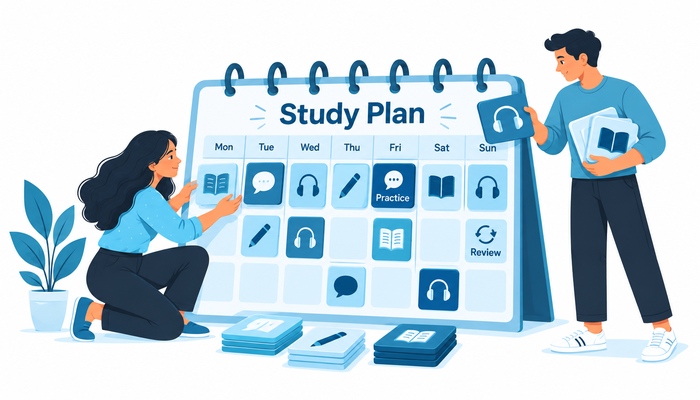
Each week should include three types of work: input, output, and review. Input means reading and listening to useful English. Output means writing and speaking. Review means returning to mistakes, difficult vocabulary, and previous material until the weakness improves.
Many independent learners overuse input because it is comfortable. Watching a video or reading an article feels productive and requires little risk. Output is harder because it exposes gaps. A balanced plan deliberately includes both.
Give More Time to the Skills That Matter Most
Equal time is not always fair time.
If your Reading already exceeds the required score while Writing is far below it, spending twenty-five percent of your study time on every skill is inefficient. Strong skills need maintenance, but weak or high-stakes skills deserve more attention.
This becomes especially important near an exam deadline. A learner who consistently gets 8.0 in Listening and 6.0 in Writing while needing 6.5 in every component should not keep treating both skills equally.
The same logic applies outside exams. If your future job requires presentations and meetings, Speaking deserves more emphasis than it would for someone whose main goal is reading academic research.
A good plan changes as the importance of each skill changes.
Use English That Matches Your Future Environment
General English is useful, but relevant English is more powerful.
A future engineering student should read technical and academic material connected to engineering. A marketing professional can listen to industry discussions, analyze campaign reports, and practice explaining results. Someone planning to work in hospitality should focus on customer interaction, problem solving, and natural spoken English.
This approach develops language and professional familiarity at the same time.
It also keeps motivation higher because the material has a visible connection to your future. Instead of learning isolated vocabulary lists, you encounter words repeatedly in realistic contexts and learn how they are actually used.
Exam candidates can combine this with test practice. The test is the immediate target, but real-world material prevents preparation from becoming a collection of narrow tricks.
Create a Feedback Loop
You cannot reliably fix mistakes you do not notice.
Reading and Listening provide relatively clear feedback because answers can often be checked. Writing and Speaking are harder. A learner may repeat the same grammar pattern for months without realizing it is wrong, or may believe a spoken answer is clear when another listener finds it difficult to follow.
This is where a teacher, tutor, language partner, or structured self-review process becomes valuable.
Good feedback should change the next study cycle. If Writing feedback repeatedly shows weak paragraph development, the next week should contain deliberate work on developing examples and explanations. If pronunciation is reducing clarity, add focused pronunciation practice rather than more vocabulary.
Feedback is only useful when it changes behavior.
Measure Progress With Comparable Evidence
Language progress feels inconsistent. A difficult conversation can make you believe you have become worse even when your overall ability has improved.
Use comparable evidence instead of daily emotion.
For exam preparation, repeat similar timed tasks every few weeks. For professional English, record yourself answering the same type of interview question after a month. Rewrite a similar email or presentation. Revisit an article that previously felt difficult and compare comprehension.
The measurement does not need to be perfect. It needs to be consistent enough to reveal direction.
If the same weakness shows no improvement after several weeks, change the method. A study plan is a hypothesis about what will help. Evidence should determine whether that hypothesis continues.
Practical Example: Sara Has Four Months Before Applications
Imagine Sara plans to apply for an English-taught postgraduate program in four months. Her diagnostic assessment shows strong Reading, acceptable Listening, weak Writing, and hesitant Speaking.
A generic plan might divide her time equally among four skills. Sara instead allocates most of her active practice to Writing and Speaking. She writes two focused tasks each week and receives feedback. She records spoken responses, practices explaining academic ideas aloud, and schedules one live conversation session.
Reading and Listening remain in the plan, but mainly as maintenance and as sources of useful vocabulary.
After four weeks, Sara reassesses. Writing has improved, while Speaking still breaks down when she has to answer unexpected follow-up questions. She adjusts the next month by adding more spontaneous conversation.
The plan works because it responds to evidence rather than protecting the original timetable.
Use Fewer Resources More Deeply
Resource collecting can become a form of procrastination.
You do not need seven grammar books, six apps, fifteen YouTube channels, four courses, and hundreds of saved posts. Too many resources make it difficult to know whether any one approach is working.
Choose a small core set that covers your needs. For an exam, include official or high-quality practice material. For general development, select one reliable grammar reference, one vocabulary system, regular listening or reading sources, and a way to practice output.
Complete and review material before constantly replacing it.
Depth matters because language improves through repeated exposure and correction. Switching resources every few days can create novelty without mastery.
Build Rest and Buffer Into the Plan
A strong plan assumes that real life will interrupt it.
Work becomes busy, family responsibilities appear, illness happens, and motivation fluctuates. If the schedule has no buffer, one difficult week can make the whole plan feel broken.
Include at least one lighter day and leave spare weeks before important tests or application deadlines. That buffer can absorb missed sessions, allow a retake, or give extra time to a skill that improves more slowly than expected.
Rest is also part of learning. Concentrated language work becomes less effective when every session happens under exhaustion.
A sustainable plan should make progress possible without requiring perfect discipline every day.
What Nobody Tells You About English Study Plans
The best plan often becomes less balanced over time.
At the beginning, you may need broad exposure because you are still learning where the weaknesses are. Later, the evidence may show that one skill deserves half of your study time. That is not a failure of balance. It is efficient allocation.
The plan should also become more realistic about what English is for. A test score is useful because it unlocks another step, not because the number itself is the final destination.
If your formal requirement is already secure, continuing to chase a much higher score may be less valuable than practicing the language you will actually need at university or work.
Monthly evidence keeps your preparation focused on measurable progress.
Conclusion
An effective English study plan starts with a real baseline and a precise outcome. It identifies the specific gaps between them, allocates time according to importance, combines input with output, creates regular feedback, and changes when evidence shows that something is not working.
The plan should also prepare you for the English you will need after the exam, admission, or visa decision. Language is not only an application requirement; it is part of the life you are preparing to enter.
Do not measure success by how many resources you finish or how busy the schedule looks. Ask a more useful question at the end of every month:
“Am I measurably closer to using English at the level my next stage actually requires?”
If the answer is yes, keep refining the system. If the answer is unclear, change the plan before simply adding more study hours.
FAQ
How many hours per week should I study English?
There is no universal number. Choose a workload you can sustain consistently and increase it only when the additional time remains focused and useful.
Should I study all four English skills equally?
Not necessarily. Maintain all four where relevant, but give more time to skills that are weakest or most important for your goal.
How often should I review my study plan?
A structured monthly review works well for many learners, with smaller weekly adjustments when obvious problems appear.
Do I need a teacher to follow an effective plan?
No, but reliable feedback can be especially valuable for Writing, Speaking, pronunciation, and errors that are difficult to identify independently.
Should exam preparation include real-world English?
Yes. Combining test practice with language connected to your future studies, profession, or daily life helps the score remain useful after the exam.
What should I do if my progress stops?
Identify the exact skill and recurring problem, then change the method or feedback process rather than simply increasing study hours.
How many study resources should I use?
Use a small set deeply enough to measure progress. Add or replace resources only when you can explain what the current ones fail to provide.