Understanding Minimum Language Scores for Immigration
Understanding Minimum Language Scores for Immigration
Minimum language scores look simple until you compare immigration programs. Canada uses Canadian Language Benchmarks, the UK often refers to CEFR, and Australia can require results in each skill rather than one overall number. A headline such as “IELTS 6.5 is enough for immigration” is rarely useful without the route behind it.
The score depends on the country, visa category, occupation, test version, and sometimes applicant type. The safest approach is to identify the immigration route first and the score second. Language testing should support a specific application within a migration strategy.
Minimum Score Means Eligibility, Not Necessarily Competitiveness
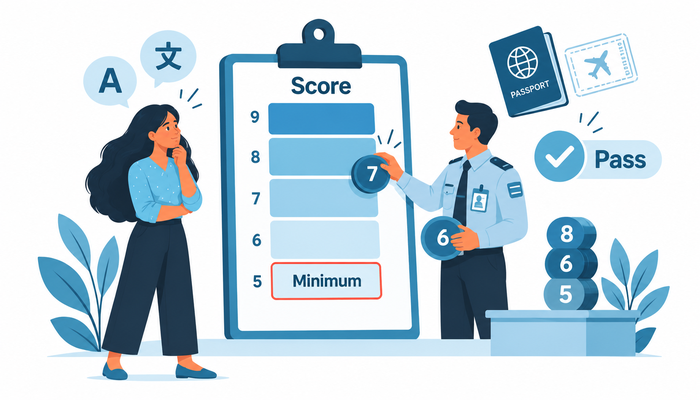
A minimum language score is usually the lowest level accepted for a particular legal or program requirement. Reaching it may allow you to remain eligible, but that does not always mean the score is strategically strong.
Points-based systems illustrate the difference clearly. A candidate can meet the language minimum yet receive fewer ranking points than someone with a stronger result. In another route, there may be no benefit at all to scoring far above the minimum. The same extra month of study could be more valuable if spent gaining work experience, completing qualification recognition, improving a second language, or strengthening finances.
This is why your target score should be connected to the role language plays in your specific application. Ask whether the test is merely a threshold, a major source of points, a professional requirement, or all three. Then decide how much margin above the minimum is worth pursuing.
Canada: Understand CLB Before You Understand IELTS
Canada does not evaluate Express Entry language ability by looking only at the IELTS band printed on your score report. Immigration, Refugees and Citizenship Canada converts approved English test results into Canadian Language Benchmarks, or CLB levels.
For the Federal Skilled Worker Program, the current minimum for the first official language is CLB 7 in all four abilities. Under the Canadian Experience Class, TEER 0 or 1 occupations require CLB 7, while TEER 2 or 3 occupations require CLB 5. The Federal Skilled Trades Program currently uses CLB 5 for speaking and listening and CLB 4 for reading and writing.
Canada currently accepts CELPIP-General, IELTS General Training, and PTE Core for English under Express Entry. IELTS Academic is not the IELTS option specified, and TOEFL iBT is not on the approved Express Entry list. Canada also states that IELTS One Skill Retake is not accepted for Express Entry.
For Canadian immigration, therefore, your first question should be “Which CLB level does my program and points strategy require?” Only then should you convert that target into the score profile of your chosen approved test.
Why One Weak Skill Can Matter More Than Your Overall Score
Candidates often focus on the overall band because it is the easiest number to remember. Immigration systems may care much more about individual skills.
Suppose an applicant has an IELTS overall score of 7.0 but one component falls below the threshold required by the program. A strong Reading or Listening score may lift the average, but that does not necessarily compensate for a weak Writing or Speaking result where each ability is assessed separately.
Canada’s CLB conversion is an obvious example because all four abilities are considered. Australia’s English categories can also require a specified score in each component. The lesson is broader: never prepare toward an overall target until you have checked whether the route imposes section minimums.
Create a simple table with Listening, Reading, Writing, and Speaking. Put the exact required threshold beside each skill. That one-page view is far safer than carrying a vague goal such as “I need IELTS 7.”
United Kingdom: CEFR Levels Matter More Than a Universal IELTS Number
UK immigration often expresses English requirements through the Common European Framework of Reference for Languages rather than one universal IELTS band. Applicants may encounter levels such as A1, B1, or B2 depending on the route and stage of immigration.
For the Skilled Worker route, current guidance says applicants who need to prove English for a first qualifying application generally need reading, writing, speaking, and understanding at least at CEFR B2. People extending, updating, or switching who held the route before January 8, 2026 can in some situations remain subject to B1 requirements. Where a test is used, the route can require a Secure English Language Test from an approved provider.
This is why asking “What IELTS score do I need for the UK?” can produce incomplete advice. The better sequence is to identify the visa, determine the CEFR requirement, then check which approved evidence can prove it.
The same principle applies when a degree taught in English or another permitted form of evidence can satisfy the requirement without a fresh test. The legal route determines the evidence, not the popularity of a particular exam.
Australia: Overall Scores and Component Scores Can Be Different Problems
Australia uses several English-proficiency categories across its migration system, and the exact requirement depends on the visa or points context. The Department of Home Affairs changed its approved English-test framework in August 2025, so older score charts can be unreliable.
For “Proficient English,” current guidance lists at least IELTS 7 in each of Listening, Reading, Writing, and Speaking. The same page provides test-specific component thresholds for other approved exams, including TOEFL iBT. Australia also makes clear that fully online at-home tests such as IELTS Online and TOEFL iBT Home Edition are not accepted for visa purposes.
Student visas use a different standard. For tests taken under the framework applying from August 7, 2025, the standard Student visa minimum is currently IELTS 6.0 or TOEFL iBT 67, with lower thresholds possible in specified packaged English-language or pathway arrangements.
These examples show why a score can be sufficient for study but insufficient for a later skilled migration strategy. Applicants planning several stages ahead should check both the immediate and future requirement before deciding how high to aim.
New Zealand: Different Routes, Different Thresholds
New Zealand also uses route-specific language requirements. For current skilled residence visas, Immigration New Zealand lists an IELTS overall score of at least 6.5 or TOEFL iBT 79 for the principal applicant. Partners and dependent children have lower listed thresholds.
Some work routes use very different standards. For Accredited Employer Work Visa applicants in skill levels where English evidence is required, current guidance lists IELTS 4.0 overall or TOEFL iBT 31 among the accepted test options. The results generally need to be no more than two years old and obtained through an accepted in-person test-center arrangement rather than an at-home test.
There is therefore no single “New Zealand immigration score.” Skilled residence and temporary work can involve very different language thresholds, even before professional registration or employer expectations are considered.
Always identify the exact category before interpreting a number.
Immigration Language and Professional Language Are Not the Same Thing
Passing the immigration minimum does not necessarily mean your English is sufficient for your profession.
A nurse, doctor, teacher, engineer, lawyer, or other regulated professional may face licensing or registration language standards separate from the visa. Even unregulated professions can have employers whose practical expectations are much higher than the immigration threshold.
This distinction matters because candidates sometimes stop improving once they meet the legal minimum. They then arrive and discover that interviews, client communication, reports, meetings, or professional exams require a stronger level.
A more useful language plan asks two questions: what score makes the immigration application possible, and what ability makes the career after immigration realistic? Sometimes the second target should guide your preparation even when the visa itself asks for less.
Test Version Matters as Much as the Score
A high score in the wrong test can be useless.
Canada’s Express Entry system specifies IELTS General Training rather than IELTS Academic. Australia accepts both IELTS Academic and General Training for several visa-related English standards, subject to the relevant route. New Zealand likewise accepts General or Academic IELTS for certain work and residence requirements.
Delivery mode can matter too. Australia rejects fully remote at-home English tests for visa evidence. New Zealand’s relevant guidance also requires qualifying English-test results for certain routes to come from accepted test-center sittings rather than remote testing.
Before paying, verify the test provider, exact module, delivery method, validity period, and whether retakes or single-skill options are accepted. A candidate should never discover these restrictions after months of preparation.
TOEFL’s New 2026 Scale Requires Careful Interpretation
TOEFL introduced a new 1–6 score scale on January 21, 2026, with half-point increments and closer alignment to CEFR. During a two-year transition period, ETS also reports a comparable overall result on the older 0–120 scale.
This creates a temporary challenge because some immigration or institutional pages may still display older TOEFL thresholds. Do not assume that your own conversion will automatically be accepted. Use the current requirement published by the receiving authority and, where necessary, confirm how post-January-2026 scores are interpreted.
The broader lesson is that language tests evolve. Requirements that were accurate when a friend migrated three years ago may no longer match the current test or immigration framework.
Current official information should always override historical comparisons.
Practical Example: Same IELTS Goal, Different Strategy
Imagine Amir and Sara both say they need “IELTS 7 for immigration.”
Amir is preparing for a Canadian Express Entry pathway. He needs to understand the CLB conversion and how improvements in individual skills affect eligibility and points. The fact that another applicant obtained “overall 7” tells him almost nothing unless the component scores and program are also known.
Sara is planning an Australian pathway where her target category requires a specified result in every component. Her challenge may be a single weaker Writing score even when her overall average looks strong.
Both applicants can use IELTS, but their preparation strategies should differ because their immigration systems interpret results differently.
This is why score advice should begin with the route rather than with the test.
What Nobody Tells You About Minimum Language Scores
Language scores attract attention because they feel controllable. You can measure them, practice toward them, and watch the number improve. Other parts of migration, such as labor-market demand, employer interest, or processing time, are less predictable.
That can lead applicants to overinvest in the test while neglecting the rest of the profile.
A higher language score is valuable when it changes the application. It is not automatically the best use of another three months. Once you have a strong enough result, the next bottleneck may be work experience, licensing, savings, documentation, or route selection.
Treat the language test as one component of the migration system, not the entire system.
Conclusion
Minimum language scores for immigration are route-specific, not universal. Canada uses CLB and approved immigration tests. The UK often works through CEFR levels and approved evidence. Australia applies visa-specific English categories and can require component scores. New Zealand sets different thresholds across residence and work pathways.
The number you hear in a forum or from a friend is meaningful only when it belongs to the same route, test, version, and time period as your own application.
Before studying toward any band, ask: “What exact language evidence does my specific immigration route require, and does a higher score materially improve my position?”
That question gives you a real target instead of a generic number.
FAQ
Is IELTS 6.5 enough for immigration?
Sometimes, but there is no universal rule. The required result depends on the country, program, test version, and whether component minimums apply.
Does Canada accept IELTS Academic for Express Entry?
No. Express Entry currently specifies IELTS General Training, along with CELPIP-General and PTE Core as approved English options.
What English level does the UK Skilled Worker route require?
Current guidance generally requires B2 CEFR for first qualifying Skilled Worker applications where English must be proven, with transitional B1 rules for some existing route holders.
Does Australia require IELTS 7 in every skill for Proficient English?
Yes. Current Proficient English guidance lists at least IELTS 7 in Listening, Reading, Writing, and Speaking.
What IELTS score does New Zealand require for skilled residence?
Current guidance lists an overall IELTS score of at least 6.5 for the principal applicant.
Should I aim higher than the immigration minimum?
Aim higher when it improves points, professional access, or your margin of safety. If it changes nothing important, another part of your profile may deserve more attention.
Can language requirements change?
Yes. Test formats, score scales, approved providers, and immigration rules can change. Verify current official requirements before booking and again before submitting.