TOEFL vs IELTS Requirements by Country
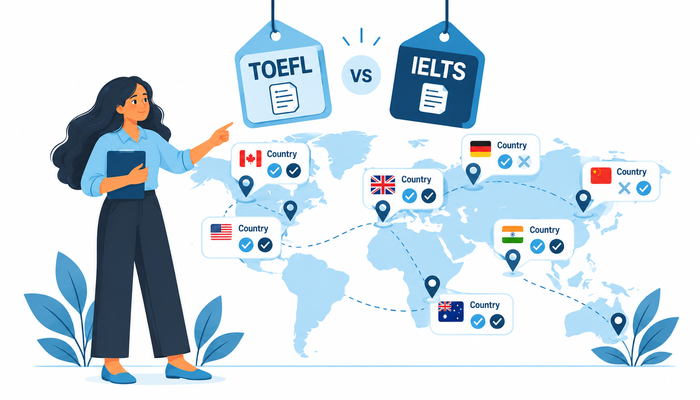
TOEFL vs IELTS Requirements by Country: What Applicants Need to Check
Choosing between TOEFL and IELTS becomes confusing when applicants search by country and expect one national answer. In reality, English requirements are usually controlled by several different organizations. A university may accept both tests, an immigration authority may accept only one specific version, and a professional regulator may impose separate language rules. The same person can therefore hold a score that is perfectly valid for admission but useless for the visa or licensing stage that follows.
The safest comparison starts with the purpose of the score. Ask whether you need English evidence for admission, immigration, professional registration, employment, or several purposes at once, then check the organization that actually makes that decision.
Why Country Requirements Are More Complicated Than They Look
There is rarely one universal “IELTS score for Canada” or “TOEFL score for Germany.” Universities have their own admissions policies, and individual faculties can set higher thresholds than the university minimum. Immigration programs can use completely different tests and scoring frameworks. Health, law, teaching, and other regulated professions may also require language evidence that goes beyond both admission and visa rules.
A common mistake is preparing for the test accepted by a university and only later discovering that a future immigration pathway requires another test or IELTS module. Before booking, list every organization likely to need your score. This can reveal whether one test offers broader coverage or whether separate tests may be necessary.
Canada: IELTS Can Serve Immigration Where TOEFL Cannot
Canada is one of the clearest examples of why academic acceptance and immigration acceptance must be separated. Canadian universities commonly accept TOEFL iBT and IELTS Academic, although each institution and program sets its own minimum scores. A student applying to a Canadian university may therefore be able to choose between the two based on personal strengths and the university’s policy.
Express Entry is different. Immigration, Refugees and Citizenship Canada currently accepts CELPIP-General, IELTS General Training, and PTE Core for English. TOEFL iBT is not on the approved English-test list for Express Entry, and IELTS Academic is not the IELTS version specified for that system. Canada also states that IELTS One Skill Retake is not accepted for Express Entry.
This means an applicant considering both Canadian study and later economic immigration should think beyond university admission. IELTS Academic may satisfy the university but not Express Entry, while IELTS General Training may serve immigration but not necessarily the academic admission requirement. TOEFL may be excellent for university applications yet provide no direct value for Express Entry.
Canada therefore demonstrates an important rule: one country can contain several English-testing systems that should not be treated as interchangeable.
United Kingdom: The Visa May Use CEFR Rather Than a Headline IELTS Score
The United Kingdom adds another layer because immigration requirements are often expressed through CEFR levels rather than one universal IELTS or TOEFL score. Universities can accept IELTS, TOEFL, or other evidence under their own admissions policies, but visa requirements depend on the relevant route and the permitted way of demonstrating English.
For the Skilled Worker route, current UK guidance states that applicants who need to prove English for a first qualifying application must generally show reading, writing, speaking, and understanding at least at CEFR B2. Certain people extending, updating, or switching after holding the route before January 8, 2026 can remain subject to B1 rules. Where an approved language test is required, it must be a Secure English Language Test from an approved provider.
The practical lesson is that a university saying “we accept TOEFL” does not automatically mean the same TOEFL result is the evidence your immigration route will use. Likewise, an IELTS score accepted academically is not automatically the correct IELTS product for every UK visa situation.
Applicants should therefore check university admission and visa evidence as two separate tasks even when both involve proving English.
Australia: Both Tests Are Accepted, but Test Conditions Matter
Australia accepts multiple English tests for visa purposes, including IELTS and TOEFL iBT, but the required scores depend on the visa and the English level being demonstrated. The rules also changed in August 2025, so older comparison tables can now be misleading.
For the Student visa, Australian Home Affairs currently lists IELTS Academic or General Training 6.0 and TOEFL iBT 67 as standard minimum test scores for tests taken under the newer framework, with lower scores possible in particular packaged English-language or pathway arrangements. From January 21, 2026, applicants using TOEFL for Australian visa purposes must select “Taking TOEFL for Australia” when registering.
Australia also makes delivery method important. The Department of Home Affairs does not accept fully online, remote-proctored tests such as IELTS Online or TOEFL iBT Home Edition as visa evidence. For its “Proficient English” standard, the current IELTS requirement is at least 7 in each of the four components, while TOEFL uses separate component thresholds and must be registered through the Australian pathway.
For applicants considering Australia, the choice is therefore not simply IELTS versus TOEFL. You must confirm the visa, the date of the test, the test format, and the exact score profile required.
New Zealand: Both IELTS and TOEFL Can Work for Skilled Residence
New Zealand currently accepts both IELTS and TOEFL iBT for several immigration purposes. For skilled residence visas, Immigration New Zealand lists an IELTS overall score of at least 6.5 or TOEFL iBT 79 for the principal applicant. Partners and dependent children have lower listed thresholds.
Work routes can have different requirements. For certain Accredited Employer Work Visa applicants in skill levels where English evidence is required, current guidance lists IELTS 4.0 overall or TOEFL iBT 31 among the test options. Results must generally be no more than two years old and must be obtained through an accepted in-person testing arrangement rather than an at-home test.
The contrast between skilled residence and some work-visa requirements shows why searching for a single “New Zealand English score” is misleading. The route determines the threshold.
If both IELTS and TOEFL are accepted for your exact route, then test format, university requirements, and your own performance can become the deciding factors.
Germany: University Requirements Usually Matter More Than a National IELTS Rule
Germany does not have one universal TOEFL-versus-IELTS score for every international degree. English-taught programs typically set their own requirements, which can differ between universities and even between programs at the same institution. Some accept several tests or alternative evidence of English-medium education, while German-language programs naturally focus on German proficiency.
For Germany, use a program-first approach. Shortlist actual degrees, record the accepted evidence and section minimums, and choose the test that works across your shortlist. For employment or residence routes, English testing may not be central at all; professional recognition, job conditions, or German ability can matter more.
Spain and Italy: Check the Program, Not a Generic Country Score
Spain and Italy also lack one national IELTS or TOEFL score for every English-taught degree. Institutions and programs set their own language evidence, while student immigration requirements are separate from academic admission.
A score accepted by one university may not satisfy another. Applicants should compare their actual shortlist and remember that an English-taught degree does not remove the practical value of Spanish or Italian for internships, work, administration, and life after graduation.
TOEFL’s 2026 Scoring Change Makes Old Comparisons Risky
TOEFL changed substantially on January 21, 2026. ETS now reports TOEFL iBT section and overall results on a 1–6 scale in half-point increments. During a two-year transition period, score reports also include a comparable overall score on the older 0–120 scale so institutions can adjust their admissions policies.
This transition matters because university websites are not all updated simultaneously. You may still encounter an admissions page asking for TOEFL 90 or 100 while newer materials use the 1–6 scale. ETS currently provides comparison guidance, but the receiving institution remains the authority on what it accepts.
Applicants should therefore avoid converting a score themselves and assuming the university will use the same interpretation. If an admissions page appears outdated, ask the institution how it evaluates post-January-2026 TOEFL scores.
This is one area where current information matters much more than old forum advice.
IELTS Delivery Has Changed Too
IELTS announced that from mid-2026 it would stop offering the traditional fully paper-based test, with exact transition timing varying by market. IELTS on computer becomes the standard delivery method, while selected markets can offer a “Writing on Paper” option for candidates who prefer handwriting that component.
This means old comparisons that describe IELTS as the paper-friendly alternative to TOEFL are increasingly outdated. Both tests now require applicants to think seriously about computer-based performance.
If typing speed, screen reading, or digital note management affects you, practice in realistic conditions before choosing. Do not base the decision on what IELTS or TOEFL looked like several years ago.
How to Choose the Right Test Across Several Countries
If you are applying to multiple countries, create a requirement matrix before studying. Put each university, visa route, and professional body in a separate row. Then record the accepted test, required version, minimum overall score, section minimums, validity period, and any restrictions on home testing or retakes.
The best test is usually the one that covers the largest number of important applications without forcing you into a format that consistently produces weaker performance.
For example, an applicant considering Canadian Express Entry should give serious weight to IELTS General Training or another IRCC-approved immigration test because TOEFL cannot serve that route. Someone applying only to universities in the United States and Europe may have much more freedom between IELTS Academic and TOEFL.
Your future plans should determine the value of each test, not global popularity.
If your shortlist is changing, priorities a test accepted across the widest range of realistic options, but do not sacrifice performance for theoretical flexibility. An accepted exam is valuable only when you can reach the required score within your application timeline.
What Nobody Tells You About IELTS vs TOEFL by Country
The most expensive mistake is often not choosing the harder test. It is choosing a test that solves only the first stage of your journey.
Language testing sits inside a larger education and migration plan. Admission, immigration, professional licensing, and long-term career development can each create separate requirements. If you identify those stages early, you may be able to reduce retesting or at least know in advance that another exam will eventually be necessary.
This is also where lived experience can help. Someone who recently followed a similar study or migration route can explain which language requirement became important later, but that experience should complement current official rules rather than replace them.
Conclusion
TOEFL and IELTS requirements cannot be understood accurately by country name alone. Canada separates academic acceptance from Express Entry testing. The UK often uses route-specific CEFR requirements and approved evidence. Australia accepts both tests for many purposes but applies detailed score and delivery conditions. New Zealand accepts both for several routes while using different thresholds across residence and work categories. Germany, Spain, Italy, and the United States often leave academic thresholds largely to individual institutions.
Before booking, identify every organization that may need your score and verify its current policy. Then choose the test that covers your real applications and matches your strengths.
The question is not “Which country prefers IELTS or TOEFL?” It is “Which exact test result will remain useful across the next stages of my plan?”
FAQ
Does Canada accept TOEFL for Express Entry?
No. Express Entry currently accepts CELPIP-General, IELTS General Training, and PTE Core for English, not TOEFL iBT.
Does Australia accept both IELTS and TOEFL?
Yes, for various visa purposes, but score thresholds and delivery conditions depend on the visa and test date.
Does New Zealand accept TOEFL for skilled residence?
Yes. Current skilled-residence guidance lists TOEFL iBT 79 or IELTS 6.5 overall for the principal applicant.
Is TOEFL required for universities in the United States?
No universal national rule requires TOEFL. Individual institutions decide which English tests and minimum scores they accept.
Do Germany, Spain, and Italy have one national IELTS score for English-taught degrees?
No. Universities and individual programs generally set their own English-language admission requirements.
Did TOEFL scoring change in 2026?
Yes. Since January 21, 2026, TOEFL iBT uses a 1–6 scale, with transitional reporting that also provides a comparable overall score on the former scale.
What should I check before choosing IELTS or TOEFL?
Check every important university, immigration route, and professional regulator for accepted tests, versions, score thresholds, section minimums, validity rules, and delivery restrictions.