IELTS Explained: Everything You Need to Know
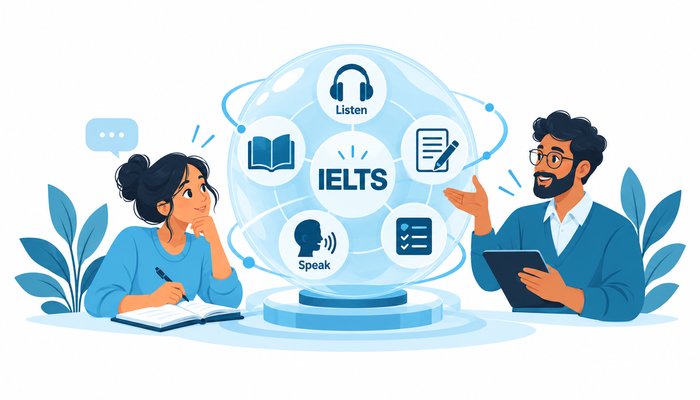
IELTS Explained: Everything You Need to Know Before Taking the Test
IELTS can look confusing when you first start researching it because there is not just one decision to make. You need to know whether you need Academic or General Training, what score your university or immigration program requires, how each section is marked, and whether the test format available in your location suits the way you perform best.
The good news is that the basic structure is much simpler once you separate the exam itself from the requirement of the organization asking for it. IELTS measures four skills—Listening, Reading, Writing, and Speaking—and reports your performance using a nine-band scale. There is no universal IELTS “pass” or “fail.” Universities, employers, professional bodies, and immigration authorities decide which test type and scores they will accept.
That makes your first step surprisingly important: before studying for IELTS, confirm exactly which version and scores you actually need.
What Is IELTS?
IELTS stands for the International English Language Testing System. It is designed to measure the English ability of people who want to study, work, train, or migrate in environments where English is important.
The test covers Listening, Reading, Writing, and Speaking. IELTS currently reports a separate band score for each of those four components plus an overall band score. The scale runs from Band 1 to Band 9, with half-band scores such as 6.5 and 7.5 also used.
IELTS is accepted by universities, employers, governments, and professional organizations around the world. However, acceptance of IELTS does not mean every organization accepts every IELTS format or the same minimum score. You should always check the exact requirements of the institution or immigration program you are applying to.
IELTS Academic vs General Training
The most important choice is usually between IELTS Academic and IELTS General Training.
IELTS Academic is primarily intended for higher education and certain professional registration purposes. If you are applying for undergraduate or postgraduate study, this is usually the version you will encounter. IELTS General Training is designed more around everyday and workplace English and is commonly used for migration, work-related purposes, training, or study below degree level.
Listening and Speaking are the same in Academic and General Training. Reading and Writing are different because they are designed around different contexts. Academic Reading uses material suited to higher education, while Academic Writing includes tasks such as describing visual information and writing an essay. General Training Reading uses more everyday and workplace-oriented material, while its first Writing task typically involves a letter.
Do not choose General Training simply because you have heard it described as easier. The correct test is the one your receiving organization requires.
What Happens in the Four IELTS Sections?
The complete IELTS test takes approximately 2 hours and 45 minutes. Listening takes about 30 minutes, Reading 60 minutes, Writing 60 minutes, and Speaking approximately 11–14 minutes.
Listening contains four parts and 40 questions. You hear different types of conversations and monologues and may answer multiple-choice, matching, map or diagram, completion, and short-answer questions. One practical difficulty is that spelling and word limits matter. If a question says “NO MORE THAN TWO WORDS,” writing three can cost the mark even when the meaning is correct.
Reading also contains 40 questions. The exact texts differ between Academic and General Training, but both test skills such as identifying main ideas, locating details, understanding arguments, and interpreting meaning from context.
Writing has two tasks and lasts 60 minutes. In Academic IELTS, Task 1 usually requires you to describe visual information such as a graph, chart, table, process, or diagram, while Task 2 is an essay. Task 2 contributes twice as much as Task 1 to the final Writing score, so poor time management can have a serious effect on your result.
Speaking is a conversation with an IELTS examiner and contains three parts. It begins with questions about familiar topics, moves to a longer individual response, and finishes with a more developed discussion related to the Part 2 topic. The Speaking test is the same for Academic and General Training.
How IELTS Band Scores Work
You receive one band for each skill and an overall band calculated from the four component scores.
The overall score is the average of Listening, Reading, Writing, and Speaking, rounded according to IELTS rules to the nearest whole or half band. For example, an average of 6.25 becomes 6.5, while 6.75 becomes 7.0.
There is no single score that means you have “passed IELTS.” A university might require one overall score while also setting minimum scores for individual components. An immigration program may use a completely different standard. A professional regulator can impose its own requirements as well.
This is why aiming vaguely for “IELTS 7” can be a mistake. If your target institution requires 7.0 overall with no component below 6.5, getting 7.5 overall with Writing 6.0 may still leave you below the requirement.
How Writing and Speaking Are Assessed
Writing is not marked only for grammar.
IELTS examiners assess Writing using criteria covering whether you answer the task appropriately, how clearly your ideas are organized, your vocabulary, and the range and accuracy of your grammar. Task 2 receives more weight than Task 1.
That means memorizing sophisticated vocabulary without using it accurately is unlikely to solve weak Writing performance. Candidates often improve more by answering the question directly, organizing ideas logically, developing examples properly, and reducing repeated grammatical errors.
Speaking works in a similar way: the goal is not to sound like a native speaker or use the most complicated words possible. You need to communicate fluently and coherently, use vocabulary and grammar effectively, and remain understandable.
A candidate with natural, well-developed answers can perform better than someone who has memorized impressive-sounding responses that do not fit the question.
IELTS Is Moving Toward Computer Delivery
Test format is especially important in 2026 because IELTS has changed how tests are delivered.
IELTS announced that from mid-2026 it would phase out the traditional fully paper-based test and move test-center delivery toward computer-based testing, with the exact transition timing varying by market. In selected countries, candidates who prefer handwriting can choose a “Writing on Paper” option while completing the other components through the computer-based format.
For IELTS on computer, Listening, Reading, and Writing are completed on a computer, while Speaking remains with an examiner. Computer-test results are generally available within 1–5 days.
Because availability can differ by location, check your local IELTS booking system rather than assuming a particular delivery mode is offered.
What Is IELTS One Skill Retake?
One Skill Retake can be extremely useful if you achieve the scores you need in three areas but narrowly miss the requirement in one.
Eligible candidates can retake one component—Listening, Reading, Writing, or Speaking—rather than sitting the entire four-part test again. The retake must be completed within 60 days of the original test, can only be used once for that original test, and depends on availability at the test center.
You receive an updated Test Report Form containing the new result for the retaken skill and the original scores for the other three skills.
However, there is one important catch: not every receiving organization necessarily accepts One Skill Retake. IELTS itself recommends checking with your university, immigration authority, employer, or other receiving organization before relying on it.
How Long Is an IELTS Result Valid?
IELTS recommends that results be treated as evidence of current English ability for two years from the test date. Some organizations may choose to accept older results if they have evidence that the candidate has maintained or improved their English, but you should never assume they will.
This matters when IELTS is part of a longer migration or university plan. Taking the test too early can mean your score is no longer acceptable when you finally need to submit it.
Work backward from your expected application date before deciding when to book the exam.
What Score Should You Aim For?
The correct target score comes from your actual destination, not from what other IELTS candidates consider a “good” score.
Before preparing, write down three things: the overall score you need, the minimum score required in each skill, and the date by which the result must be valid.
This can completely change your preparation strategy. Someone who needs 6.5 overall and has balanced skills needs a different plan from a candidate who already scores 8.0 in Reading but repeatedly receives 6.0 in Writing while needing 7.0 in every component.
Your target should therefore be requirement-specific and skill-specific.
Common IELTS Preparation Mistakes
One common mistake is studying English generally without learning the IELTS format. Good English helps, but IELTS also rewards the ability to understand task instructions, manage time, structure responses, and recognize recurring question types.
The opposite mistake is learning IELTS techniques while ignoring weak English fundamentals. Templates cannot compensate indefinitely for limited vocabulary, weak grammar, or difficulty understanding natural speech.
Another mistake is taking full practice tests repeatedly without analyzing errors. A practice test is useful only if you understand why answers were wrong and what pattern needs improvement.
Finally, many candidates prepare all four skills equally even when one is clearly holding back the required result. Once you know your baseline scores, preparation should become more targeted.
A Better Way to Prepare
Start with an official practice test under realistic timing. Use the result to identify whether your main problem is language ability, exam technique, time management, or one specific skill.
Then divide preparation accordingly. If Reading is weak because you cannot finish, work on speed and question strategy. If Listening errors mostly come from spelling or losing concentration, practice those specific weaknesses. For Writing, get feedback wherever possible instead of assuming that writing more essays automatically produces improvement.
Speaking should also be practiced aloud. Thinking about an answer is not the same as producing one naturally under time pressure.
Your preparation should become more specific as the test approaches, not more random.
What Nobody Tells You About IELTS
IELTS preparation becomes much easier once you stop treating Band 7 or Band 8 as the goal in itself.
The score is only useful because another decision depends on it.
If you need IELTS for university, your real goal is admission and being able to function academically after arrival. If you need it for migration, the goal is satisfying the specific language requirement without allowing the test to delay the rest of your plan unnecessarily.
That perspective also prevents over-preparation. If your program needs 6.5, spending another year chasing 8.0 may add very little value unless stronger English itself supports your future study or career.
Conclusion: Understand Your Requirement Before You Study
IELTS becomes much less confusing when you approach it in the right order.
First determine whether you need Academic, General Training, IELTS for UKVI, or another approved version. Then confirm the exact overall and component scores required by the organization receiving your result. Only after that should you build the preparation plan.
The exam itself tests four skills, but your strategy should be based on your weakest relevant skill, your deadline, and the purpose for which you need IELTS.
Before booking the test, ask:
“Exactly which IELTS result will make my next application possible?”
Once that answer is clear, everything from test selection to preparation becomes much easier.
FAQ
What is IELTS used for?
IELTS is used by educational institutions, employers, professional organizations, and immigration authorities to assess English-language ability. The required test type and score depend on the receiving organization.
What is the difference between IELTS Academic and General Training?
Academic is mainly designed for higher education and some professional registration purposes. General Training focuses more on everyday and workplace English and is commonly used for migration and training. Listening and Speaking are the same; Reading and Writing differ.
How long is the IELTS test?
The complete test takes approximately 2 hours and 45 minutes, including Listening, Reading, Writing, and Speaking.
Is there a pass or fail score in IELTS?
No. IELTS uses a nine-band scale rather than a universal pass mark. The organization receiving your result decides what score it requires.
How long are IELTS results valid?
IELTS recommends treating results as valid evidence of English ability for two years, although individual organizations can set their own acceptance policies.
Can I retake only one IELTS section?
Potentially. IELTS One Skill Retake allows eligible candidates to retake one skill within 60 days of the original test, but availability and acceptance by receiving organizations should be confirmed first.
Is IELTS still available on paper?
IELTS announced the phase-out of the traditional paper-based format from mid-2026, with local transition dates varying. Selected markets may offer computer-based IELTS with the Writing component completed by hand.