Building Your Personal Immigration Roadmap
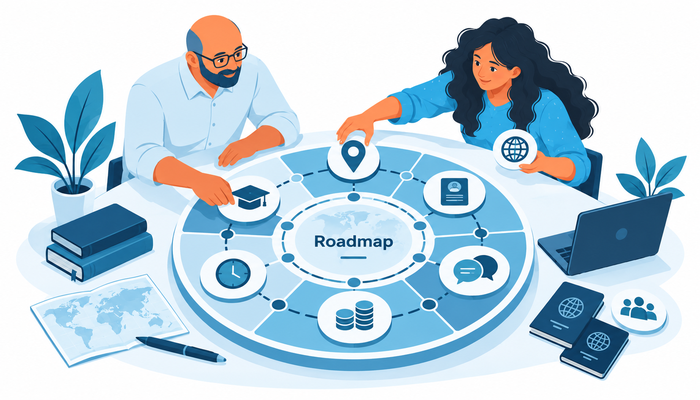
Building Your Personal Immigration Roadmap: From Profile Assessment to Long-Term Settlement
A good immigration plan should feel less like chasing visas and more like building a sequence of decisions.
Many people begin by searching for countries, visa names, or the fastest route. They collect requirements, compare processing times, and save dozens of links. What they often do not have is a roadmap that connects their current profile to where they want to be three or five years later.
That missing structure creates confusion. You may qualify for several routes but have no clear way to compare them. You may spend money on language courses, degrees, applications, or business plans without knowing which step actually moves you closer to your goal. You may even choose a route that gets you into a country but makes the next stage harder.
A personal immigration roadmap solves that problem by turning migration into a sequence: assess your profile, define the target, identify the gaps, choose a primary route, create a backup, prepare the evidence, and review the plan as conditions change.
The roadmap does not remove uncertainty, but it makes uncertainty easier to manage.
Start With Your Current Profile, Not Your Dream Country
The first part of the roadmap is a realistic inventory of what you already have.
Write down your age, education, occupation, years of experience, professional licenses, language ability, savings, family situation, and whether you already have international employers, clients, relatives, or business connections. Then identify which of those factors are likely to matter in the routes you are considering.
The goal is not to judge whether your profile is “good” or “bad.” It is to understand what kind of migration strategy your profile naturally supports.
Someone with ten years of professional experience may be strongest in employment-based migration. A recent graduate may benefit more from education. A founder with customers and capital may have a stronger business pathway. Someone with a qualifying spouse or family relationship may already have a route that makes a separate economic strategy unnecessary.
The strongest roadmap usually begins with the route that requires the least reinvention.
Define the Outcome Before the Visa
The second step is deciding what you are actually trying to achieve.
Do you want a permanent relocation or a few years of international experience? Is career growth the priority? Are you trying to move with children? Do you want to build a business, study, work for an employer, or eventually become financially independent from one company or sponsor?
These questions matter because two routes can both lead to the same country while creating very different lives.
A master's program may provide a legal path to residence but delay earnings. A job route may create immediate income but tie you more closely to an employer. A business route can offer independence but expose you to greater financial uncertainty.
Without a clear outcome, it is easy to choose based on what looks easiest today rather than what supports your life later.
Build a Gap Analysis
Once the starting point and destination are clear, identify what is missing.
Suppose your preferred route is skilled employment, but employers in your field expect stronger local-language ability. The gap is not another degree; it is language.
If your profession is regulated, the gap may be qualification recognition. If you want to study but your academic profile is weak, the gap may be prerequisites or funding. If you want to use an entrepreneur route, the gap may be real customer validation rather than a longer business plan.
This step prevents wasted effort because it tells you what actually needs improvement.
A good roadmap should contain only the gaps that materially affect the chosen route. Collecting random certificates because they “might help” usually creates activity without direction.
Choose a Primary Route
Your primary route should be the option that best combines eligibility, career fit, financial sustainability, and long-term flexibility.
That does not always mean choosing the route with the highest theoretical chance of approval. It means choosing the route that still makes sense after arrival.
If your career is already strong, employment may be more efficient than returning to university. If your profile is early-stage, education may provide the local credentials and experience you are missing. If you already run a viable business, entrepreneurship may deserve serious attention.
The key is to be able to explain why the route matches your profile, not just why you technically qualify for it.
Create a Real Backup Route
A roadmap becomes much stronger when the primary plan is not the only plan.
The backup should be related to your existing profile and realistic enough to use if the first route does not work.
For example, someone pursuing skilled employment may also prepare for a study route if the job market does not respond. A student may use the degree period to build the language and professional experience needed for later employment. A founder may preserve enough professional credibility to return to salaried work if the business underperforms.
The backup route should not require a completely new identity. If Plan A fails, you should not need another three years of education or a completely unrelated career just to activate Plan B.
Put the Steps in the Right Order
The sequence of preparation matters as much as the steps themselves.
Imagine spending heavily on a degree before checking whether your existing qualifications are already enough for employment. Or registering a company before understanding whether the business model supports the intended residence route. Or applying for jobs before your qualifications have been recognized.
A roadmap should show dependencies.
If language is necessary before recognition, do language first. If recognition is necessary before job applications, complete it early. If a university application requires a particular test, schedule the test before the deadline. If an entrepreneur route depends on market evidence, validate demand before investing heavily in incorporation.
Good sequencing saves both money and time.
Build a Financial Timeline, Not Just a Budget
Immigration finances should be mapped across time.
It is not enough to know how much money you have today. You need to understand when money will leave and when income is realistically expected to begin.
A study route may require a large upfront payment followed by several months without meaningful income. A job-search route can burn savings unpredictably. A business route may need separate personal and operating reserves.
Your roadmap should show the financial position at key stages: application, relocation, Month Three, Month Six, and the end of Year One.
This makes it easier to see whether the plan is financially stable or only technically possible.
Add Family as a Separate Workstream
If you are moving with a spouse or children, the roadmap should include their transition rather than treating them as dependents added near the end.
For a spouse, consider work rights, recognition of qualifications, language, and the likely timing of their career restart. For children, consider school language, curriculum, childcare, housing, and how the timing of the move fits the academic year.
A route that works well for the main applicant can create unnecessary stress if the rest of the household has no clear plan.
The roadmap should therefore answer two questions at once: how do you obtain residence, and how does the family become stable after arrival?
Plan Language Around the Real Destination Life
Language planning should connect to your actual objectives.
If the visa does not require a local language but the employers do, the roadmap should reflect the labour market rather than the visa checklist. If you are planning a local service business, language may be important for customers even if company registration can be completed with professional support.
Set a practical target and deadline.
Instead of “learn German,” the roadmap might say “reach B1 before beginning full-scale job applications.” Instead of “improve Spanish,” it might say “reach professional conversational ability before launching local sales.”
Specific language goals are much easier to manage than vague intentions.
Build a Document Strategy Early
Documents create delays when they are treated as an afterthought.
A roadmap should identify which records may be needed and how long they take to obtain. Degrees, transcripts, employment letters, birth and marriage certificates, professional licenses, criminal-record documents, and financial evidence can all involve translation, legalization, or updated versions.
Some documents remain useful for years. Others expire quickly.
Prepare stable documents early and time sensitive ones closer to the application stage. This prevents the common situation where one missing record delays the entire process.
Practical Example: Maya's Roadmap Changes After the First Review
Imagine Maya is a 29-year-old digital marketing specialist with six years of experience, strong English, limited German, and enough savings for roughly a year of living expenses.
Her original plan is a master's degree in Germany because she assumes studying is the easiest route. After assessing her profile, she realizes that her professional experience may already be valuable enough to test the employment market first.
Her roadmap changes. For the next six months, she focuses on German language improvement, adapting her CV to the market, and applying to relevant employers. At the same time, she prepares a shortlist of master's programs as a backup.
If the employment route works, she avoids the cost and career interruption of unnecessary study. If it does not, she has not lost the year because the language improvement and market research also strengthen the study pathway.
That is what a roadmap should do: make progress useful even when the primary route changes.
Add Decision Points, Not Just Deadlines
Most immigration plans have deadlines. Better plans also have decision points.
A deadline says, “Apply by September.”
A decision point says, “If I have fewer than five serious employer conversations by June, I will activate the university backup.”
That is much more useful.
Decision points help prevent endless waiting. They also make it easier to change direction without feeling that the original plan has failed.
Build review points every few months and define what evidence would justify staying on the current route, changing it, or postponing the move.
Map the First Year After Arrival
A personal immigration roadmap should not end at visa approval.
The first year is when many of the most important transitions happen.
You may need to complete local registration, open accounts, arrange insurance, search for housing, begin work or study, support a spouse, enroll children, and improve language skills. If the route depends on business activity, you may also need to establish the company and generate revenue.
Create a first-year stabilization plan so that arrival is not treated as the finish line.
The stronger the first year, the easier it becomes to move toward more secure residence and professional independence.
Review the Three-to-Five-Year Path
The roadmap should eventually answer what happens after the first permit.
Can you change employers? Can you transition from study into work? Can a spouse gain more independence? Can you move from temporary to more secure residence? Does the route continue to support the career you want?
You do not need every detail solved years in advance, especially because laws can change. But you should understand the direction of travel.
A migration route is stronger when the next steps become more flexible rather than more restrictive.
What Nobody Tells You About Immigration Roadmaps
The roadmap will change.
That does not mean it was poorly designed.
Visa rules change, employers respond differently than expected, family priorities evolve, and opportunities appear that were impossible to predict at the beginning. The purpose of the roadmap is not to predict every event. It is to give you a framework for deciding what to do when events change.
The best roadmap is therefore structured but not rigid.
It has a clear primary route, useful backup options, financial boundaries, and decision points. At the same time, it leaves enough flexibility to use new information.
Your Personal Immigration Roadmap Checklist
Start by documenting your current profile and defining the life you want after migration. Identify the strongest immigration basis in your profile and the gaps preventing you from using it.
Choose a primary route and one realistic backup. Put preparation steps in dependency order, then build a financial timeline that covers the application, relocation, and first year.
Add separate plans for language, documentation, spouse career, children, and professional development. Create decision points every few months so the plan can change before time or money runs out.
Finally, review the three-to-five-year direction so the first visa supports long-term stability rather than becoming an isolated short-term solution.
Conclusion: A Roadmap Turns Migration Into a Sequence of Decisions
A personal immigration roadmap does not begin with a visa name.
It begins with your current profile and ends with the kind of life you are trying to build.
Between those two points, the roadmap should show which route fits best, which gaps need to be closed, what the process will cost, when decisions need to be made, and what happens if the original plan does not work.
Instead of asking, “Which visa should I apply for?”, ask:
“What sequence of decisions gives my current profile the strongest chance of reaching the career, family, and long-term residence outcome I actually want?”
Once that sequence is clear, immigration becomes much easier to plan.
FAQ
What should be included in a personal immigration roadmap?
It should include your current profile, target outcome, primary route, backup route, skill or language gaps, finances, documents, family planning, deadlines, and long-term residence goals.
How far ahead should an immigration roadmap plan?
It is useful to plan the application and first year in detail while also understanding the general three-to-five-year direction.
Should I have more than one immigration route?
Usually, having one realistic backup route is helpful, especially when the primary plan depends on employment, admission, business performance, or another uncertain outcome.
How often should I update the roadmap?
Review it every few months and whenever there is a major change in visa rules, finances, family circumstances, career opportunities, or the response to your applications.
Should language be included in the immigration plan?
Yes. Set language goals based on employment, study, business, and daily-life needs rather than only the minimum visa requirement.
When should I prepare documents?
Prepare stable documents early, but time-sensitive documents should usually be obtained closer to the application stage so they remain valid.
What is the main purpose of an immigration roadmap?
Its purpose is to connect your current profile to a realistic long-term outcome through a clear sequence of preparation, applications, financial decisions, and backup options.