Lessons Learned From Opening a Company Overseas
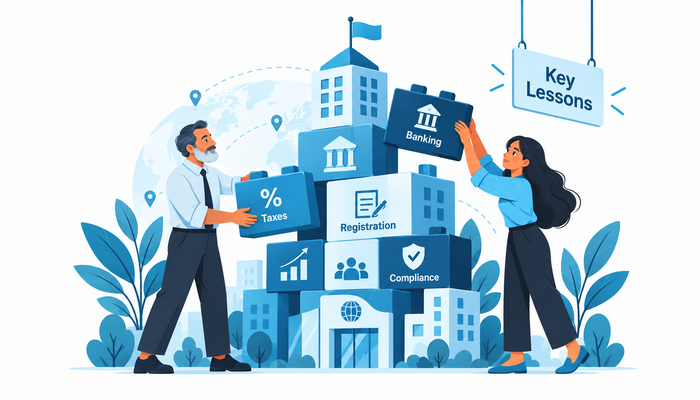
Lessons Learned From Opening a Company Overseas: What I Would Do Differently
Opening a company overseas taught me that incorporation is usually the easiest part of the process.
Before I started, I thought the biggest challenge would be registering the business correctly. I expected forms, appointments, legal documents, and a few frustrating administrative steps. Once the company existed, I assumed the real work would begin and everything else would become more straightforward.
The reality was almost the opposite.
Registration was only one small milestone inside a much larger transition. The difficult part was understanding how the business would actually operate in a new country, how taxes and accounting affected cash flow, how customers made decisions, how banking worked, and how much local context I had underestimated.
The biggest lesson was this: opening a company overseas is not primarily a registration project. It is a market-entry, financial, legal, and personal transition happening at the same time.
I Should Have Started With the Business Model, Not the Company
My first mistake was thinking about legal structure too early.
I spent time comparing company types, registration procedures, and administrative costs before I had fully answered a more basic question: what exactly would this business sell in the new market, and why would customers buy from it?
That sounds obvious, but incorporation creates a powerful sense of progress. Once the company name exists and documents are signed, it feels like something real has been built. In reality, a legal entity without customers is still only infrastructure.
If I were doing it again, I would validate the offer first. I would identify the exact customer, test pricing, understand the buying process, and try to create early demand before committing too much time or money to structure.
The company should support the business. The business should not exist simply because the company has already been opened.
I Underestimated How Different Local Customers Would Be
I assumed that if a service or product worked in one country, it would work similarly somewhere else.
That was one of the most expensive assumptions.
Customers in a new market may value different things. They may expect different payment terms, respond to different messaging, trust different proof, or take much longer to make a decision. Something that feels normal to you may feel risky or unfamiliar to them.
I also learned that local credibility matters more than founders often expect. A strong track record abroad can help, but customers may still want local references, local-language support, or evidence that you understand their environment.
The lesson was to treat every country as a new market, even if the business itself is not new. Existing experience is useful, but it does not remove the need to learn again.
I Chose the Legal Structure Before Understanding the Full Cost
At the beginning, I focused heavily on setup cost.
How much does it cost to register the company? How much capital is required? How fast can it be done?
Those questions mattered, but they were incomplete.
The real cost appeared later through accounting, tax filings, payroll, insurance, registered addresses, professional advice, software, banking, and annual compliance. A structure that looked inexpensive at incorporation could become much more expensive over a full year.
That changed how I think about company formation.
The right question is not, “How much does it cost to open?”
It is, “How much does it cost to operate correctly for twelve months?”
That one change in perspective would have made my original comparison much more realistic.
I Learned That Tax Should Be Planned Before Revenue Arrives
I treated tax as something to organize once the company started earning more.
That was too late.
The moment money begins moving through the company, the structure already matters. How invoices are issued, what expenses are deductible, how the founder is paid, whether VAT or similar obligations apply, and how profits move between the company and the owner can all affect the real economics of the business.
What looked like healthy revenue on paper sometimes felt much smaller after tax, accounting, social contributions, and business costs were considered.
If I were starting again, I would involve a qualified local accountant earlier and build forecasts using after-tax numbers. Revenue is not the same as usable income, and a founder should understand that before setting prices.
Banking Took More Attention Than I Expected
I also assumed banking would be a simple operational step.
In practice, business banking can affect the entire company. Verification procedures, transaction limits, international transfers, payment processing, and documentation can all create friction, especially for founders who are new to the country.
This matters even more if customers are in different countries or currencies.
A company can be legally registered and still struggle to operate smoothly if money cannot move efficiently.
I now see banking as part of business design, not administration. Before opening a company overseas, I would investigate how customers will pay, how suppliers will be paid, which currencies are involved, and whether the available banking infrastructure actually fits the business.
Practical Example: The Company Was Ready Before the Sales Process Was
Imagine someone opening a consulting company abroad.
They complete registration, hire an accountant, open a business account, build a website, and prepare contracts. Everything looks ready.
Then they begin selling.
They discover that local customers expect a longer sales cycle, want local references, and prefer a different pricing model. The business is legally prepared but commercially unprepared.
That situation is common because setup tasks feel concrete. Customer validation feels uncertain.
The lesson is not to delay all registration until the first sale. Some businesses need the company structure before they can trade properly. The lesson is to make sure the commercial plan develops at the same speed as the legal one.
A perfectly registered company with no demand is still a weak business.
I Should Have Kept Fixed Costs Lower
Once the company existed, I started making decisions as if it needed to look established.
I paid for tools and services that were useful but not essential. I wanted the business to feel professional from the beginning.
Some of that spending made sense. Some of it was simply premature.
The first year abroad already creates uncertainty. Adding unnecessary fixed costs makes that uncertainty more dangerous because every slow sales month burns more runway.
If I were doing it again, I would keep the company deliberately lean until revenue became predictable. I would spend first on compliance, customer acquisition, and the things directly required to deliver the service.
Everything else could wait.
Personal and Business Money Need Clear Separation
One of the most useful lessons was learning to separate the company's financial health from my own.
A business can technically have cash while the founder is under personal pressure. The opposite can also happen: the founder may have savings while the company itself cannot sustain its operating costs.
Those two situations require different decisions.
I should have created separate reserves from the beginning. One for business expenses and one for living expenses. That would have made it much easier to understand whether the company was actually becoming viable or whether I was quietly supporting it with personal money.
For founders relocating with family, this separation becomes even more important. Business risk should not automatically consume the household's security reserve.
Local Professionals Were More Valuable Than I Expected
I initially tried to understand everything myself.
That helped me learn, but it also created unnecessary risk.
Tax, employment rules, licences, contracts, and accounting systems can be technically complicated. Reading general guidance gives useful context, but it does not always tell you how the rules apply to your exact business.
I eventually learned that the right local professionals do more than complete forms. They can explain what founders usually misunderstand, which deadlines matter, and where small mistakes become expensive.
The key is to use them selectively. You do not need to outsource every decision, but the areas with legal or financial consequences deserve professional review earlier than I originally thought.
The Company Structure Should Match the Business Stage
Another lesson was that there is no prize for choosing the most sophisticated structure.
Founders sometimes assume that a limited company, holding structure, or complex setup makes the business more serious. Sometimes it does solve real problems. Other times it creates unnecessary cost and administration.
The right structure depends on the business stage.
A solo consultant may need something different from a startup with investors. A local service business may need something different from a software company selling internationally.
The mistake is choosing based on image rather than function.
If I were starting again, I would ask what the business needs today, what it will realistically need in two years, and whether the structure can evolve without creating excessive complexity now.
Hiring Changes the Business Much More Than Expected
Hiring employees abroad is not simply a growth decision.
It changes compliance, payroll, social contributions, employment contracts, management, and cash flow.
A business that works well with one founder and a few contractors can feel completely different once permanent employees are added.
I underestimated how much responsibility comes with payroll and how important it is to understand the full employer cost rather than only the employee's headline salary.
The lesson was to hire when the business model supports it, not because the company feels more legitimate with a team.
Growth should reduce fragility, not increase it.
Language Became a Business Issue, Not Just a Personal One
Before moving, I thought of language mainly as part of daily life.
Later, I saw how much it affected the company.
Language influenced networking, customer trust, administrative conversations, supplier relationships, hiring, and sometimes the ability to understand what people really meant rather than just the literal words they used.
For international businesses, English may be enough in many contexts. But if the company depends on local customers, local language can become a competitive advantage.
I would now include language in market-entry planning instead of leaving it in a separate personal-development category.
I Learned to Review the Business After the First Six Months
The original business plan looked much more certain before the company opened.
After six months, I knew much more.
Some costs were higher than expected. Some customer segments were weaker. Other opportunities appeared that I had not considered.
The mistake would have been treating the original plan as something to defend.
Instead, the business needed to be reviewed.
I now believe every founder opening a company overseas should create scheduled checkpoints. At three months, review the setup assumptions. At six months, review the commercial model. At twelve months, ask whether the country and structure are still helping the business.
A plan is useful because it creates a starting point. It should not prevent adaptation.
What Nobody Tells You About Opening a Company Overseas
The company may be international, but the founder becomes very local very quickly.
You still need to understand local systems, build trust, deal with local professionals, and function inside the country's administrative environment.
That is why company formation services can sometimes create a misleading impression. They can help you register quickly, but they cannot make you understand the market, build customers, or manage the business for you.
The legal entity can be created in days or weeks. Local understanding takes much longer.
That gap is where many founders struggle.
What I Would Do Differently Now
If I were opening a company overseas again, I would validate demand before investing heavily in setup. I would compare the full annual cost of legal structures rather than only incorporation fees and speak with a local accountant before the first invoice.
I would keep business and personal reserves completely separate, minimize fixed costs, and test the market with the simplest professional setup possible.
I would also spend more time building local relationships and learning how customers actually buy. Finally, I would schedule formal reviews of the business so that changing the original plan felt normal rather than like admitting a mistake.
Conclusion: Registration Was the Beginning, Not the Achievement
The biggest lesson I learned from opening a company overseas was that incorporation creates permission to operate, not a reason for customers to choose you.
The real work comes afterward. You have to understand the market, protect cash flow, manage tax and compliance, build credibility, and adapt the business to the country rather than expecting the country to adapt to your original plan.
If I were doing it again, I would spend less energy trying to create the perfect company from the beginning and more energy creating a business that could learn cheaply.
The question I would ask first is no longer, “How quickly can I open the company?”
It is:
“How can I enter this market with enough legal structure to operate properly, but enough flexibility to change once I understand what actually works?”
That is the lesson I wish I had understood before the first registration form was signed.
FAQ
What is the biggest lesson from opening a company abroad?
The biggest lesson is that business registration is only the beginning. Market demand, taxes, cash flow, compliance, and local customer behavior matter much more over time.
Should I validate the market before opening a company?
Whenever possible, yes. Customer conversations, pilot work, and pricing tests can reduce the risk of building an expensive structure around an unproven market.
What costs are often overlooked?
Accounting, tax compliance, insurance, banking, software, licences, payroll, and professional advice can make the annual cost much higher than the incorporation fee.
Should business and personal savings be separated?
Yes. Keeping separate reserves makes it easier to understand whether the company is genuinely sustainable and protects personal finances from unlimited business risk.
Do I need local professionals?
Not for every decision, but local accountants, legal professionals, and other specialists can be particularly valuable where mistakes have tax, employment, or regulatory consequences.
When should I review the original business plan?
Review it regularly, especially after the first three, six, and twelve months, when real customer and operating data can replace early assumptions.