Germany vs Portugal for Entrepreneurs
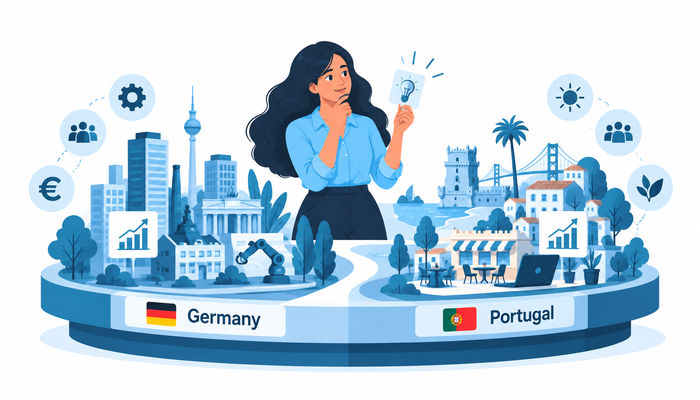
Germany vs Portugal for Entrepreneurs: Visas, Business Setup, Market Access, and Long-Term Residence
Germany and Portugal can both work for foreign entrepreneurs, but they support very different founder profiles.
Germany offers access to one of Europe's largest economies, a deep industrial base, strong B2B markets, and a self-employment residence route that focuses heavily on economic value, demand, and financing.
Portugal offers a smaller domestic market but a comparatively straightforward company-formation environment, a specific residence route for independent professionals and entrepreneurs, and a dedicated Startup Visa for innovative founders working through certified incubators.
That means the real comparison is not:
“Which country is better for entrepreneurs?”
It is:
“Which country fits the type of business I am building, the customers I need, the capital I have, and the role I want to play as a founder?”
For a manufacturing supplier, enterprise software company, independent consultant, and early-stage tech founder, the answer can be completely different.
Germany Treats Entrepreneurship as an Economic Case
Germany does not operate one generic startup visa that automatically applies to every founder.
Instead, non-EU entrepreneurs generally use the residence framework for self-employment.
Germany distinguishes between commercial entrepreneurs and freelancers.
For a commercial business, the current official requirements include evidence of commercial interest or regional demand, positive expected effects on the economy, and secured financing through personal capital or a loan commitment. These points are expected to be explained convincingly in the business plan.
This makes the German route highly connected to the substance of the business.
The immigration authority is not simply asking whether you want to start a company.
It is asking whether the company has enough economic logic to support your residence.
That can suit founders who already have industry experience, market evidence, clients, financing, or a clear local commercial case.
Portugal Offers a Broader Entrepreneur Residence Route
Portugal provides a residence visa route for people who want to carry out independent professional activity or entrepreneurial activity.
For entrepreneurs, the current official process can require a declaration explaining the investment already made or intended in Portugal, including its nature, value, and duration, as well as evidence that the applicant has financial means available in Portugal and intends to make the identified investment.
Portugal also provides a residence pathway for independent professionals, such as freelancers or service providers, where documents such as a service contract or proposal can be relevant.
This gives Portugal a structure that can work for more than one type of entrepreneur.
A consultant, service-based founder, conventional business owner, and innovative startup may not all use the same exact process, but they are not forced into one innovation-only category.
Portugal Also Has a Dedicated Startup Visa
Portugal's Startup Visa creates another option for founders building technology- and knowledge-based businesses.
The program is managed through IAPMEI and works with certified incubators.
According to the current official program, applicants are expected to develop innovative goods or services, build or relocate technology- or knowledge-focused projects, demonstrate potential to create qualified employment, and show potential for significant future turnover or asset value. The assessment also considers innovation, scalability, market potential, team quality, and qualified job creation.
The incubator is an important part of this process.
A founder is not simply submitting a business plan directly into a generic visa system.
The project enters an innovation ecosystem that includes certified incubators and IAPMEI evaluation.
That makes Portugal's Startup Visa structurally different from Germany's broader self-employment residence route.
Germany Is More Directly Tied to Local Economic Demand
Germany's commercial entrepreneur route places strong emphasis on whether the product or service makes sense in the German economy or a particular region.
That can be useful for founders with a clear market.
Suppose you are launching industrial automation software for German manufacturing companies.
You may be able to demonstrate customer demand, pilot interest, relevant professional experience, and a credible financing plan.
That fits naturally with the questions Germany already asks under its self-employment framework.
By contrast, a highly experimental startup without clear demand may need a stronger explanation of why the business should be based there.
Germany does not require every business to be a venture-backed technology startup.
But it does expect a serious economic case.
Portugal Can Be More Structured Around the Founder Ecosystem
Portugal's Startup Visa is explicitly designed to attract international founders into the country's startup environment.
Certified incubators are part of the process, and the program evaluates whether a project has innovation and scaling potential.
For a first-time international founder, this can provide a clearer institutional structure around relocation.
The founder may gain access to an incubator, local startup connections, and a program specifically created for international entrepreneurs.
That does not mean the business becomes easy to build.
Incubation does not create customers automatically.
But for someone moving with an early-stage technology project, the support structure may matter.
Germany's self-employment route is less centered on an incubator-based immigration process.
Business Formation Is Comparatively Streamlined in Portugal
Portugal has a formal service called Empresa na Hora that allows certain common company types, including limited companies and single-member limited companies, to be created through a single service point.
The current official fee for the standard service is €360, and the process can make company formation relatively fast once the required documents and structure are ready.
Portugal also supports online company creation for several common company forms, while the traditional process remains available.
That can reduce friction at the incorporation stage.
But a fast company registration should not be confused with a complete business launch.
Tax registration, licensing, accounting, social security, immigration, and sector-specific obligations can still apply.
The company may be easy to create while the business itself remains complex.
Germany Requires More Attention to the Activity Classification
Germany makes an important legal distinction between a commercial business and a freelance profession.
Freelancers face different residence requirements from commercial entrepreneurs.
For freelance activity, current official guidance focuses on sufficient financing, the ability to support yourself, and professional authorization where the occupation requires it. Applicants over 45 can also face additional pension-provision requirements.
That means the classification of the activity matters early.
A consultant, architect, software professional, or creative professional may not automatically fall into the same category as someone opening a retail or manufacturing company.
Founders should understand how their activity is legally classified before building the immigration strategy.
Practical Example: Amir Is Building B2B Logistics Software
Imagine Amir has ten years of logistics experience and wants to build software for warehouse operators.
He has a prototype and several potential customers.
In Germany, his case may benefit from the fact that he can show direct relevance to a large industrial and logistics market.
He can build the immigration case around commercial demand, economic benefit, his own sector experience, and secured financing.
Portugal presents a different opportunity.
If Amir's platform is genuinely innovative and scalable, he may investigate the Startup Visa and certified-incubator route.
The Portuguese domestic market is smaller, but Amir may plan to use Portugal as a European base while selling internationally.
The business is the same.
The strategic logic is different.
Germany may be evaluated primarily as a customer and industrial market.
Portugal may be evaluated as a founder base and startup ecosystem.
Market Size Can Change the Business Model
Germany's domestic market is substantially larger than Portugal's.
For entrepreneurs selling enterprise software, industrial services, machinery, professional services, or products aimed at large local customer bases, that scale can matter.
A founder may be able to build a company almost entirely around German customers.
In Portugal, a founder with a scalable digital business may need to think internationally much earlier.
That is not necessarily a disadvantage.
Some businesses are international from Day One.
For them, the size of the local customer base matters less than operating costs, talent, networks, lifestyle, and access to the wider EU market.
A local consumer business, however, will feel the difference much more directly.
Language Matters Differently in Each Country
Neither country should be treated as an English-only business environment.
In Germany, many startup, technology, and multinational environments operate heavily in English.
But local-language ability can become increasingly important when selling to traditional German businesses, hiring local employees, dealing with administration, or building long-term professional relationships.
Portugal can also be workable in English in international startup environments and some service sectors.
But Portuguese becomes much more important for local customers, local operations, government interaction, and deeper integration.
Founders should therefore separate two language questions:
Can I legally start the business without fluency?
and:
Can I sell effectively without fluency?
The second question usually matters more commercially.
Cost Should Be Compared Against Revenue Potential
Portugal is often considered attractive because founders may expect lower operating and personal costs than in major German cities.
That can extend runway.
But lower cost does not automatically mean stronger business economics.
If your customers are in Germany and your company needs to be physically close to them, the higher cost of operating there may be commercially justified.
If the business sells globally and can operate from anywhere, preserving runway may matter more.
The useful calculation is therefore not simply monthly rent or salary cost.
It is:
How much revenue opportunity does each euro of operating cost create?
A more expensive market can still be more efficient if it produces significantly stronger sales.
Company Setup Speed Is Not the Same as Bureaucratic Simplicity
Portugal's Empresa na Hora system can make incorporation fast.
But entrepreneurs still need to manage tax, accounting, social security, banking, residence documentation, licences, and potentially AIMA procedures.
Germany is often associated with heavier administrative processes, and founders need to manage residence permission, business registration where applicable, tax setup, insurance, accounting, and local requirements.
Neither country should be evaluated only by how quickly the company can be registered.
The real administrative question is how much ongoing compliance the business will need after Month One.
Portugal's Startup Visa Is Not for Every Small Business
This point is important because the name can be misleading.
Portugal's Startup Visa is focused on innovative, technology- or knowledge-based projects with growth and qualified-employment potential.
A normal local restaurant, small shop, traditional consulting activity, or ordinary service business should not automatically be treated as a Startup Visa project.
Those founders may need to examine Portugal's broader entrepreneur or independent-professional residence route instead.
This is similar to the distinction in other European systems between ordinary self-employment and innovation-focused startup programs.
The immigration route should follow the real business.
Long-Term Residence Looks Different
Germany gives successful commercial self-employed founders a potentially accelerated route toward permanent settlement.
A person holding a qualifying Section 21 self-employment residence permit can currently request a settlement permit after three years if the business has operated successfully, appears sustainable, and the founder can permanently support themselves and their family.
Portugal has its own residence and nationality framework.
Portugal's official justice guidance currently states that legal residents can potentially qualify to apply for Portuguese nationality after at least five years of legal residence, subject to the other applicable requirements.
These are not equivalent legal milestones.
Permanent residence and nationality are different statuses.
But founders planning long term should compare the entire pathway rather than only the first entrepreneur visa.
Family Needs Can Change the Comparison
A solo founder can tolerate more uncertainty than a household with children.
Families need to think about housing, schools, healthcare, spouse employment, and how much personal cash remains after investing in the business.
A founder may prefer Portugal because the company can operate with a lower personal runway.
Another family may choose Germany because the founder's sector has more employers, customers, or backup opportunities there.
The spouse's career can also matter.
If the business struggles, can the founder or spouse realistically find employment in the local market?
That backup plan deserves more attention than founders often give it.
What Nobody Tells You About Germany vs Portugal
The two countries can encourage very different founder behavior.
Germany can push the entrepreneur toward proving local commercial relevance early.
You need to think carefully about the customer, economic value, and financing.
Portugal's Startup Visa can push an innovative founder toward scalability, incubation, qualified employment, and international growth.
Neither framework guarantees a successful business.
They simply reward different evidence.
This is why copying the same business plan into applications for both countries makes little sense.
The company may be identical.
The argument for why it belongs in each country should be different.
Germany vs Portugal Entrepreneur Checklist
Before choosing, define whether you are building a commercial company, freelance practice, ordinary small business, or scalable innovative startup.
Then identify where the customers actually are.
Compare how each residence route evaluates your business and whether you already have the evidence required.
Calculate business runway and personal runway separately.
Investigate company formation, accounting, licensing, tax, and social-security obligations before relocating.
Consider language based on your customer strategy rather than only the visa requirements.
Finally, compare the five-year picture: business growth, family stability, alternative career options, and the path toward long-term residence.
Conclusion: Compare the Business You Are Actually Building
Germany and Portugal can both support foreign entrepreneurs, but they should not be treated as interchangeable startup destinations.
Germany's self-employment framework currently asks commercial founders to demonstrate demand, positive economic impact, and secured financing, while distinguishing commercial entrepreneurship from freelance activity.
Portugal offers a broader residence route for entrepreneurs and independent professionals and also maintains a dedicated Startup Visa for qualifying innovative projects working through certified incubators.
Portugal also provides relatively streamlined company-formation mechanisms such as Empresa na Hora, while Germany can offer successful commercial entrepreneurs a settlement-permit pathway after three years under the relevant conditions.
The useful question is therefore not:
“Should an entrepreneur choose Germany or Portugal?”
It is:
“Does my company need a large local market and strong industrial demand, or does it benefit more from an innovation-focused founder ecosystem and a business model that can scale beyond the domestic market?”
Once that is clear, the immigration comparison becomes much easier.
FAQ
Does Germany have an entrepreneur visa?
Germany uses residence permits for self-employment rather than one generic entrepreneur visa. Commercial entrepreneurs and freelancers are assessed under different conditions.
What does Germany require from a commercial entrepreneur?
Current official requirements include commercial interest or regional demand, positive expected economic effects, and secured financing for the business.
Does Portugal have an entrepreneur visa?
Portugal provides a residence visa framework for independent professionals and immigrant entrepreneurs. Applicants may need to show the intended investment and available financial means.
What is Portugal's Startup Visa?
It is a specific program for foreign entrepreneurs developing innovative, technology- or knowledge-based projects through Portugal's certified incubator system.
Is Portugal's Startup Visa suitable for any small business?
No. The program focuses on innovative and scalable projects with potential for qualified employment and significant future economic activity.
Is it easier to create a company in Portugal?
Portugal offers Empresa na Hora, which can create certain common company forms through a single service point. The standard service currently costs €360, but incorporation is only one part of business compliance.
Can successful entrepreneurs obtain permanent residence in Germany?
Under current rules, qualifying commercial self-employed founders can request a settlement permit after three years if the business has operated successfully, remains sustainable, and the founder can support themselves and their family.