Startup Visa vs Investor Visa
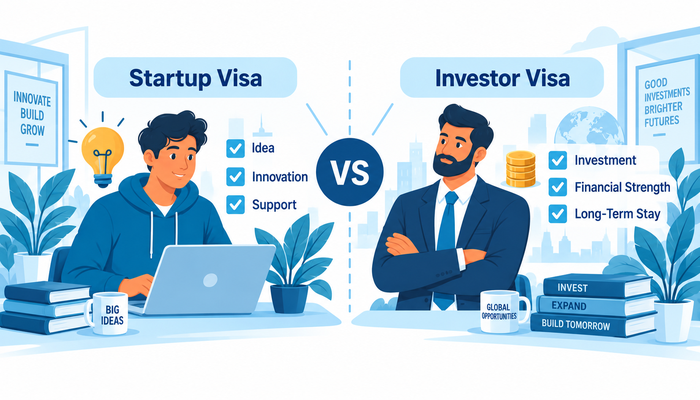
Startup Visa vs Investor Visa: What Founders and Investors Should Compare
Startup visas and investor visas can look similar because both connect money, business activity, and immigration.
But they are built around different people.
A startup visa is usually designed for a founder who will actively build and operate a business.
An investor visa is usually designed for someone who contributes capital to a qualifying asset, company, fund, government bond, or other approved investment without necessarily becoming the person running the business every day.
That difference changes almost everything.
The amount of money required may be different. The level of business involvement is different. The risk is different. The evidence needed for the application is different. Even the long-term residence strategy can be different.
So the useful question is not:
“Which one is easier?”
It is:
“Do I want my immigration status to depend mainly on building a business or mainly on maintaining a qualifying investment?”
A Startup Visa Is Usually About the Founder
Startup and entrepreneur routes generally evaluate the person as well as the project.
Authorities may look at the founder's professional background, business plan, market potential, financing, innovation, and level of involvement.
Spain's current entrepreneur route is a clear example. It is designed for foreign founders over 18 who want to develop an innovative business with special economic interest for Spain. There is no universal minimum investment or job-creation threshold. Instead, ENISA evaluates the founder's professional profile, involvement in the project, business plan, financing, innovation, and contribution to the Spanish economy.
That means the route is not simply:
“Bring a certain amount of money.”
The founder has to explain why the business itself is credible.
An Investor Visa Is Usually About the Capital
Investor visas work differently.
The business idea may matter less because the residence route is based primarily on placing capital into a qualifying investment.
Italy currently operates one of the clearest examples in Europe.
The Investor Visa for Italy is a two-year visa for non-EU nationals who make one of several qualifying investments: €2 million in Italian government bonds, €500,000 in an Italian limited company, €250,000 in an Italian innovative startup, or €1 million in a philanthropic initiative.
The applicant still needs to satisfy the program's legal and financial requirements.
But they do not necessarily need to create and personally manage a company from zero.
This is the central distinction.
A startup visa evaluates an operator.
An investor visa evaluates an investor and the qualifying capital.
Germany Shows Why the Names Can Be Misleading
Germany does not currently operate a broad passive golden-visa system comparable to Italy's investor route.
For non-EU entrepreneurs, the official framework is based mainly on self-employment.
A commercial founder generally needs to show economic interest or regional demand, positive expected economic impact, and secured financing through personal capital or a loan commitment.
That makes Germany much closer to the startup or entrepreneur side of this comparison.
Simply having substantial capital does not automatically create residence.
The business itself needs to support the immigration case.
This is why online lists of “European investor visas” should be treated carefully.
Different countries may use completely different legal models.
Spain Shows Why Current Rules Matter
Spain is an especially important example because the country's old investor regime is no longer open to new applicants under the previous legal framework.
Organic Law 1/2025 removed Articles 63 through 67 of Law 14/2013, which governed the investor residence regime. Transitional protections remain for qualifying earlier applications and certain existing authorizations. Spain's own migration reporting notes that the golden-visa regime ended for new cases from April 3, 2025.
At the same time, Spain's entrepreneur route remains available for qualifying innovative projects.
This creates a very practical lesson.
A country may close an investor visa while continuing to welcome founders.
“Investor immigration” and “entrepreneur immigration” are separate policy choices.
Startup Routes Usually Need More Personal Involvement
A startup route normally expects the applicant to be directly involved in the business.
Spain explicitly evaluates the founder's professional profile and degree of involvement.
Italy's Startup Visa is also specifically designed for non-EU innovators who want to establish an innovative company in Italy.
This means the applicant cannot usually treat the startup as a passive asset.
They are expected to build it.
That can involve hiring, sales, product development, fundraising, compliance, customer acquisition, and operational management.
For someone who genuinely wants to become a founder, this may be exactly the point.
For someone whose primary goal is preserving capital and gaining residence, the workload may be unnecessary.
Investor Routes Can Require More Capital Up Front
The financial profile of the two routes can be very different.
Investor programs often have explicit capital thresholds.
Italy's current program begins at €250,000 for a qualifying innovative startup investment and rises to €2 million for government bonds.
Startup routes may not always impose one universal minimum.
Spain, for example, currently states that its entrepreneur route has no fixed minimum investment or job-creation requirement. Instead, the financing must make sense for the project being proposed.
This can make startup immigration accessible to founders who do not have investor-level capital.
But it does not mean the route is cheap.
The founder still needs enough money to launch the business and support themselves while it grows.
Practical Example: Daniel Has €500,000 but Does Not Want to Run a Company
Imagine Daniel has €500,000 available.
He wants residence in Europe but has no interest in managing employees, building a product, or finding customers.
A startup visa may technically sound attractive, but it does not fit Daniel's actual objective.
Creating an artificial startup only to obtain residence would give him operational responsibilities he never wanted.
Italy's investor route may fit his profile more naturally because €500,000 can currently qualify when invested in an Italian limited company, subject to the program's other requirements.
Now imagine Maya has only €90,000 but has built a technology product, has relevant industry experience, pilot customers, and a strong plan for Spain.
She may not have enough capital for a traditional investor route.
But Spain's entrepreneur framework does not impose a fixed minimum investment and instead evaluates the business and founder through ENISA.
Neither route is universally stronger.
They solve different immigration problems.
Startup Visas Put More Risk Into the Business
Startup immigration ties residence more closely to business execution.
If the company fails, the founder may eventually face both financial and immigration consequences.
Germany's current self-employment residence permit is initially issued for up to three years. Extension depends on the business being successful and the founder being able to support themselves and their family.
That creates a double risk.
The founder can lose money and also weaken the basis of their residence.
This does not make the route unattractive.
It simply means the founder needs enough runway to survive a slow first year.
Investor Visas Put More Risk Into Capital
Investor immigration creates a different kind of dependency.
The applicant may not need to operate a company, but the qualifying investment often needs to be completed and maintained according to the program's rules.
In Italy, the investor first obtains approval and then applies for the two-year investor visa. The official process requires proof of financial resources, and the qualifying investment must follow the program's required procedure.
The investor therefore needs to ask:
How liquid is the asset?
How long must it be held?
What happens if I want to exit early?
What happens if the investment loses value?
The residence structure can reduce financial flexibility even when the investor has no operational business responsibilities.
A Startup Visa Can Give More Control
Founders generally control more of the underlying economic activity.
They choose the product.
They choose the customers.
They may own the company.
They decide whether to hire, pivot, expand, or raise capital.
That can create more upside.
The business may become worth much more than the original investment.
But greater control also means greater responsibility.
A founder cannot simply wait for an asset manager to handle the investment.
They need to make the business work.
This distinction is partly financial and partly lifestyle-based.
Do you want to be an operator or an investor?
That question matters more than the visa label.
Investor Visas Can Be Simpler Operationally
A passive investor may have a much lighter daily workload than a startup founder.
They do not necessarily need to build a sales pipeline, hire employees, manage customers, or run day-to-day operations.
But immigration compliance still exists.
They may need to maintain the investment, document the source of funds, complete renewals, monitor tax residence, and keep the structure compliant.
The route may be simpler operationally.
It is not effortless.
Source of Funds Matters More in Investor Routes
When the immigration case depends directly on large capital transfers, authorities generally care about where the money came from and whether it belongs to the applicant.
Italy's investor process requires evidence that the applicant possesses the financial resources for the investment.
That means inheritance, business-sale proceeds, investment income, or accumulated savings may need clear documentation.
A founder route also requires credible financing.
But investor applications can place even greater emphasis on proving the ownership and legitimacy of the capital because the investment itself is central to eligibility.
Startup Visas Usually Need Better Business Evidence
The reverse is true for founders.
They need stronger evidence about the business.
Market demand.
Innovation.
Founder experience.
Business model.
Financing.
Customer interest.
Growth potential.
Spain's ENISA assessment explicitly considers the founder, the business plan, financing, and the added value or innovation the project creates.
A bank statement alone cannot replace that evidence.
The founder needs to explain why the company deserves to exist.
Family Planning Matters in Both Routes
Whether the applicant is a founder or investor, the family should not be treated as an afterthought.
Can the spouse work?
Can children join?
What healthcare system applies?
How much housing will cost?
Does the family need local-language schooling?
Will the household depend entirely on investment income or startup revenue?
The main applicant may be comfortable taking financial risk.
The spouse and children may experience that risk differently.
A migration structure that looks efficient for one person can feel unstable for a family if too much capital is locked into the investment or too much household income depends on a young business.
Long-Term Residence Should Be Compared Separately
The first visa does not tell you the full value of either pathway.
You need to understand renewal, permanent residence, and eventually citizenship separately.
Germany, for example, currently allows qualifying commercial self-employed founders to apply for settlement after three years if the business has developed sustainably and the founder can support themselves and their family.
Italy's Investor Visa, by contrast, begins with a two-year visa.
These initial structures are not directly comparable because the underlying immigration systems are different.
That is why applicants should map at least five years rather than only comparing the first approval.
Tax Can Change the Financial Comparison
A route that requires less investment can still become more expensive overall if the applicant's tax position changes unfavorably.
Moving residence can affect taxation of salary, dividends, capital gains, business profits, and investment income.
The exact result depends on personal circumstances and tax treaties.
This is particularly important for investor applicants because they may already hold substantial assets outside the destination country.
It also matters for startup founders who own shares in companies across several jurisdictions.
Immigration and tax planning should therefore happen together before major transfers or restructuring.
What Nobody Tells You About Startup vs Investor Visas
The immigration category can push you into a lifestyle you do not actually want.
A person who primarily wants passive wealth preservation may build a startup because the visa threshold appears lower.
A genuine founder may lock a large amount of capital into a passive investor route because it looks administratively simpler.
Both can be poor decisions.
The immigration route should reflect the economic role you genuinely want.
If you want to build, sell, hire, and operate, a startup or entrepreneur route is the natural category to investigate.
If you want to deploy capital without becoming responsible for day-to-day business execution, an investor route may fit more naturally where one currently exists.
Do not redesign your professional life solely around the visa.
Startup Visa vs Investor Visa Checklist
Consider a startup route when you have a credible business idea, relevant founder experience, enough runway to operate, and a genuine desire to build the company.
Consider an investor route when you have sufficient qualifying capital, prefer a more passive economic role, and understand the liquidity and holding obligations attached to the investment.
For either route, verify the current legal program before transferring money.
Separate personal living reserves from startup or investment capital.
Review source-of-funds documentation, tax consequences, family rights, renewal conditions, and the long-term residence pathway.
Most importantly, make sure the visa matches what you actually want to do after moving.
Conclusion: Founder and Investor Routes Solve Different Problems
Startup visas and investor visas are often grouped together as “business migration,” but they are structurally different.
Spain currently offers an entrepreneur route for qualifying innovative projects without a universal minimum investment requirement, while its former investor regime has been abolished for new applications under the old provisions.
Italy currently offers both models: the Italia Startup Visa for non-EU founders establishing innovative businesses and a separate Investor Visa with defined capital thresholds.
Germany primarily uses a self-employment framework that evaluates economic demand, impact, financing, and the viability of the founder's business rather than offering a broad passive golden-visa route.
That leaves one practical question:
Do you want your residence to be built around what you create or around what you invest?
A startup route makes the founder central.
An investor route makes the capital central.
Understanding that difference is far more useful than comparing visa names.
FAQ
What is the main difference between a startup visa and an investor visa?
A startup visa generally requires the applicant to actively build or operate a qualifying business, while an investor visa is primarily based on placing capital into an approved investment.
Does Spain still have an investor visa?
Spain's former investor residence provisions have been repealed for new applicants, while transitional rules remain for certain earlier applications and existing authorizations.
Does Spain still have a startup or entrepreneur visa?
Yes. Spain continues to offer a residence route for qualifying innovative entrepreneurial projects assessed through ENISA. There is currently no universal minimum investment or job-creation requirement.
Does Italy offer both startup and investor visas?
Yes. Italy currently operates the Italia Startup Visa for qualifying innovative founders and a separate Investor Visa with specified investment categories.
How much is required for Italy's investor visa?
Current qualifying options include €2 million in government bonds, €500,000 in an Italian limited company, €250,000 in an innovative startup, or €1 million in a philanthropic initiative.
Does Germany have an investor visa?
Germany's current official framework centers on self-employment and business activity rather than a broad passive investor visa. Commercial founders must generally show economic or regional demand, positive economic impact, and secured financing.
Which route requires more day-to-day involvement?
Startup and entrepreneur routes generally require much more active involvement because the founder is responsible for building and operating the business, while investor routes can be considerably more passive.