Building a Business Relocation Plan
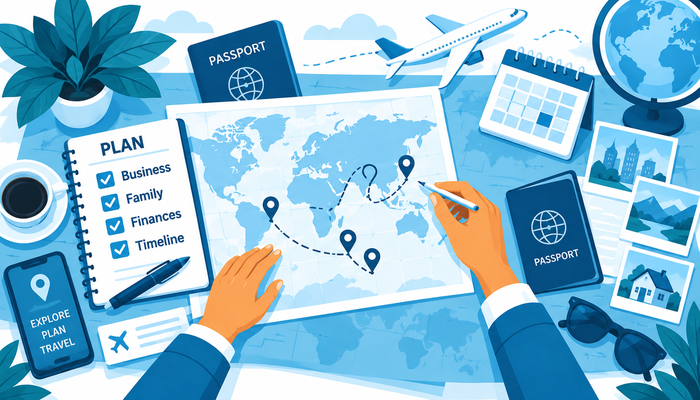
Building a Business Relocation Plan: How to Move Yourself and Your Company Abroad
Relocating a business abroad is not the same as moving abroad and continuing to work.
You are moving two systems at once.
The first is your personal life: residence status, housing, family, healthcare, banking, and daily expenses.
The second is the business: customers, company structure, taxes, contracts, payment systems, suppliers, staff, licenses, and cash flow.
If either side is poorly planned, the other can become unstable.
A founder may choose a country with an attractive entrepreneur route but discover that the market is weak. Another may find excellent customers but create a legal or tax structure that is unnecessarily expensive. Someone else may successfully relocate the company while underestimating how much personal savings are needed before the business produces stable income.
That is why a business relocation plan should answer a broader question:
“How do I move without damaging the business that is supposed to support my new life?”
Start With the Reason for Relocating
Before comparing countries, define what you are trying to improve.
Do you need access to a larger customer market?
Better investors?
Lower operating costs?
More specialized employees?
A stronger international reputation?
A residence pathway?
Or are personal lifestyle goals driving the move?
There is nothing wrong with combining business and personal motivations. The problem appears when they are mixed without being prioritized.
If the real objective is immigration, it can be tempting to design a company mainly around whichever visa looks easiest.
That can produce a weak business.
If the real objective is market expansion, the better country may not be the one with the simplest entrepreneur route.
A strong relocation plan begins by ranking the reasons for moving and making sure the destination supports the most important ones.
Separate Business Relocation From Personal Immigration
This is one of the most important planning principles.
A company can potentially operate in a country without automatically giving its owner the right to live there.
Likewise, a founder may obtain residence rights but still need to complete business registration, tax, licensing, or professional requirements separately.
So create two legal workstreams from the beginning.
The first answers:
How can I legally live and work in this country?
The second answers:
How can the business legally operate there?
Treating those as separate projects makes the sequence much clearer.
It also prevents a common mistake: incorporating first and assuming immigration will naturally follow.
Decide What Is Actually Moving
“Moving the business” can mean several different things.
You may close the old company and create a new one abroad.
You may keep the original company and establish a subsidiary.
You may continue operating the existing business remotely while changing your own residence.
You may transfer intellectual property, contracts, staff, or assets to a new entity.
Or you may simply create a new local company that invoices the same customers.
These structures can have very different legal and tax consequences.
Before relocating, define exactly what is changing.
The founder's residence?
The company?
The place where management decisions are made?
The customer contracts?
Employees?
Bank accounts?
Ownership?
Without that clarity, it is difficult to get reliable professional advice because even the question is still unclear.
Test the Destination as a Business Market
A relocation plan should not be built entirely around immigration.
The business still needs customers.
Before moving, research the target market as if you were making a major commercial investment.
Who are the competitors?
What do customers pay?
How do they buy?
Is your offer priced correctly for the local market?
Does the product need localization?
Does the local language matter?
Are buyers comfortable working with international suppliers?
For B2B businesses, talk to potential customers before relocation whenever possible.
For consumer businesses, test advertising, demand, and pricing before committing to a full move.
The more evidence you have before arrival, the less you are relying on the relocation itself to create demand.
Practical Example: Amir Moves the Wrong Thing First
Imagine Amir operates a small B2B software company with customers in his home country.
He wants to relocate to Germany because he believes the European market will make the company more valuable.
His first instinct is to register a German company and move immediately.
Instead, he pauses.
He speaks with potential customers and discovers that German clients like the product but expect local-language onboarding and stronger data-security documentation.
He also realizes that most of his existing revenue will still come from customers outside Germany for at least the first year.
That changes the relocation plan.
Rather than shutting down the original structure immediately, Amir investigates whether it makes more sense to preserve parts of the existing business while creating a German operating presence gradually.
The lesson is important.
The destination can be right while the original relocation sequence is wrong.
Build a Legal and Tax Map Before Making Structural Changes
Business relocation can trigger consequences that are much more expensive than company-registration fees.
Changing where you live and where the company is managed can affect personal tax residence, corporate taxation, VAT, payroll, social security, dividends, and how contracts are treated.
Cross-border structures can also create questions about permanent establishment or where effective management occurs.
These issues depend heavily on the countries involved and the business structure.
That means generic internet advice is not enough for final decisions.
Before moving the company, create a map with a qualified local accountant or tax professional.
What happens if you keep the old company?
What happens if you create a new one?
What happens if both remain active?
Where will profits be taxed?
How will you pay yourself?
What happens to existing assets?
The right structure should be chosen before large transfers happen.
Keep Existing Revenue Alive During the Move
A relocation becomes much safer when the existing business continues producing cash.
Founders often underestimate how much attention moving consumes.
Finding housing, completing immigration formalities, opening accounts, learning a new tax system, and managing family logistics all take time.
That can reduce sales activity exactly when expenses are increasing.
If possible, stabilize recurring revenue before the move.
Renew important contracts.
Automate routine operations.
Document internal processes.
Delegate work that does not require you personally.
A business with predictable cash flow gives the founder room to handle relocation problems without panicking about every slow week.
Build Two Runways
A founder relocating abroad needs two separate financial buffers.
The business runway covers company expenses.
The personal runway covers life.
Do not combine them mentally.
A company may have six months of operating capital while the founder personally has only six weeks of living expenses.
That is not a safe relocation.
Likewise, a founder may have substantial personal savings but continuously fund a business that has no realistic path to revenue.
The relocation budget should include company registration, professional advice, software, office or equipment costs, marketing, licenses, and possible hiring.
The personal budget should include housing deposits, temporary accommodation, transport, insurance, food, family costs, and an emergency reserve.
One should not silently consume the other.
Plan Your First Customers Before Arrival
The first months after relocation are usually too busy to begin thinking about sales from zero.
If the business is entering a new market, build the pipeline before the move.
Identify prospects.
Start conversations.
Join relevant industry communities.
Book introductory meetings.
Research local events.
If possible, arrive with active opportunities already in progress.
This does not mean every founder needs signed contracts before moving.
It means the commercial strategy should already exist.
Your first 90 days should be about executing a plan, not inventing one while simultaneously learning how the country works.
Decide Whether the Business Needs Local Language
This question is often underestimated.
An international technology business may operate largely in English.
A local consultancy, healthcare service, restaurant, construction company, or consumer brand may depend heavily on the local language.
The founder should distinguish between three levels.
First, the language needed legally or administratively.
Second, the language needed to sell.
Third, the language needed to manage staff and build local relationships.
These can be very different.
A founder may successfully complete immigration in English but still struggle commercially if customers expect German, Spanish, or Italian.
Language should therefore be treated as a business capability, not only a personal integration goal.
Map Every License and Approval
Business registration does not necessarily mean you can begin operating.
Some activities need professional licenses, municipal permits, sector approvals, insurance, safety checks, or additional registrations.
This becomes particularly important in food, healthcare, finance, construction, transport, education, childcare, and regulated professions.
Before signing a commercial lease or purchasing expensive equipment, list every approval the business will need.
Then identify which steps can be completed before arrival and which require local presence.
A two-month licensing delay is manageable if it is expected.
It becomes a crisis if rent, salaries, and loan payments have already started.
Plan Banking and Payments Early
Money movement can become surprisingly disruptive during relocation.
How will existing customers pay you?
Will invoices come from the old company or new one?
Can your payment processor support the new structure?
Will the new business bank account be ready before the first invoice?
How will you pay taxes and suppliers?
What currencies are involved?
For online businesses, a change in company country can affect payment providers, merchant accounts, and verification procedures.
For B2B companies, customers may need new supplier documentation before they can pay the new entity.
These transitions should be planned before the billing address changes.
Your Family Is Part of the Business Relocation Plan
Founders sometimes build excellent company plans and weak household plans.
That is dangerous because personal instability quickly affects business performance.
If a spouse cannot work, children are struggling with school, housing is temporary, or the family budget is under pressure, the founder has less energy to build the company.
If relocating with family, include their needs from the beginning.
What residence rights will they have?
Can the spouse work?
What will childcare cost?
Where will children study?
Does the business runway still work if the household relies on one income for a year?
A founder's risk tolerance can be very different from the family's.
The plan needs to work for both.
Create a 90-Day Operating Plan
The first three months should have a clear purpose.
During the first month, focus on legal and operational stability.
Complete registrations, residence formalities, banking, accounting, insurance, and essential business infrastructure.
During the second month, shift more energy toward customers and local relationships.
Test messaging, pricing, and sales channels.
By the third month, enough real information should exist to compare the original assumptions with reality.
Are leads converting?
Are costs higher than expected?
Is the city right?
Do customers need different features?
Do you need local staff?
The first 90 days should produce evidence, not perfection.
Create a One-Year Decision Framework
A relocation plan should also define what happens if the business does not perform as expected.
Decide in advance which metrics matter.
Revenue.
Cash runway.
Customer acquisition.
Number of qualified leads.
Founder salary.
Operating costs.
Renewal conditions for residence.
Do not wait until cash is almost gone before deciding whether the strategy needs to change.
Set review points at three, six, and twelve months.
The goal is not to threaten yourself with failure.
It is to make decisions before sunk costs and emotion make them harder.
Do Not Close the Old Structure Too Quickly
Founders often want a clean break.
New country, new company, new beginning.
Operationally, that can be risky.
Existing customers may still have contracts with the original company.
Receivables may still be outstanding.
Tax filings may remain due.
Software accounts, trademarks, domains, or supplier agreements may still belong to the old entity.
A gradual transition can sometimes reduce risk.
Close or restructure the original business only after you understand which obligations remain and how the new structure will replace them.
A business relocation should preserve continuity wherever possible.
What Nobody Tells You About Business Relocation
The hardest part is that the founder becomes less productive exactly when the business needs extra attention.
During a normal business year, you already understand your bank, taxes, housing, healthcare, and daily routine.
After relocation, simple tasks take longer.
Every unfamiliar system consumes attention.
This is why founders should reduce unnecessary complexity before moving.
Simplify products.
Document operations.
Automate recurring tasks.
Delay non-essential expansion.
Do not relocate the company, hire several employees, launch three new products, and move your family in the same month unless there is a strong reason.
Complexity multiplies during relocation.
Business Relocation Plan Checklist
Start by defining why the business is moving and exactly which parts of the business will change jurisdiction.
Validate customer demand in the destination before committing heavily.
Separate immigration planning from company formation.
Map tax, accounting, licensing, social-security, and legal consequences with qualified professionals.
Create separate business and personal runways.
Protect existing revenue during the transition and build a customer pipeline before arrival.
Prepare banking and payment systems before switching invoices or contracts.
Include spouse, children, housing, healthcare, and family finances in the plan.
Finally, define 90-day and one-year milestones so you can measure whether the relocation is actually improving the business.
Conclusion: Move the Business in the Right Order
A business relocation plan should protect three things at the same time:
the founder's legal right to live and work,
the company's ability to operate legally,
and the business's ability to continue earning money during the transition.
If one of those is ignored, the move can become much more expensive than expected.
For Germany, Spain, Italy, or another destination, immigration, incorporation, taxation, licensing, and social-security requirements differ and can change. The final structure should always be checked against current official rules and, where appropriate, reviewed by qualified legal and tax professionals.
But the strategic sequence remains useful almost everywhere.
Validate the market first. Map the legal structure. Protect cash flow. Preserve personal runway. Move in stages where possible. Then use the first year to prove that the new location actually makes the business stronger.
The goal is not simply to relocate a company successfully.
It is to arrive with a business that still works.
FAQ
What should be included in a business relocation plan?
It should cover immigration, company structure, taxes, licenses, banking, customers, cash flow, personal finances, family needs, and a timeline for the first year.
Should I register a company before relocating?
Not automatically. First confirm the immigration, tax, and legal consequences and whether a new company is actually the right structure.
Should I close my existing company when moving abroad?
Not necessarily. Some founders keep the original business, create a new entity, or transition gradually. The right approach depends on contracts, taxes, customers, and legal structure.
How much financial runway should a relocating founder have?
There is no universal figure, but business operating capital and personal living reserves should be calculated separately and should allow for slower-than-expected revenue.
When should I start finding customers in the new country?
Before moving whenever possible. Early customer conversations help validate the market and make the first months after arrival more productive.
Does moving the business automatically give me residence rights?
No. Company ownership and personal immigration status are separate legal issues in many countries.
What is the biggest mistake in business relocation?
A major mistake is changing company structure, residence, banking, and customer operations simultaneously without first understanding how those changes affect cash flow and legal compliance.