Starting a Business Abroad Step by Step
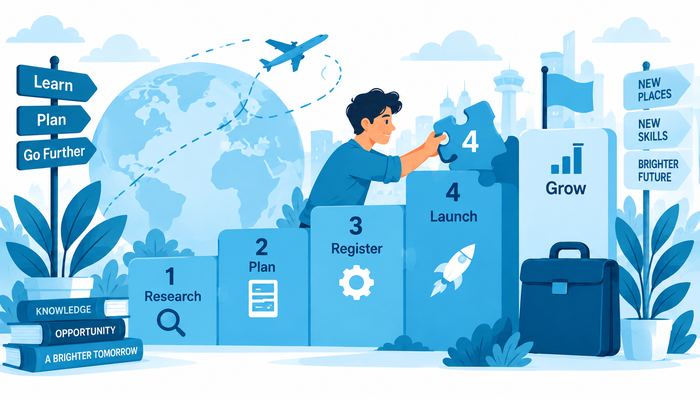
Starting a Business Abroad Step by Step: A Practical Guide for International Founders
Starting a business abroad can look deceptively simple from the outside.
Choose a country, register a company, open a bank account, and start selling.
In practice, there are several decisions that should happen before company registration.
You need to know whether the business has a real market, whether your immigration status allows you to operate it, which legal structure fits the activity, how taxes and social contributions work, what licenses are required, and whether you have enough money to support both the company and yourself.
The order matters.
One of the most expensive mistakes is registering a business first and only later discovering that the immigration route, tax structure, or market does not fit what you are trying to build.
A better approach is to treat international entrepreneurship as two connected projects:
building a viable business and building a legal structure that allows you to operate it abroad.
Step 1: Start With the Business Problem
Before choosing the country, define what you are actually selling.
Who is the customer?
What problem are you solving?
Why would someone pay for it?
How will customers find you?
The answers should be specific enough that you can research the market rather than relying on assumptions.
“Starting an online business in Europe” is too broad.
“Selling inventory-management software to independent logistics companies” gives you something you can test.
This matters because different business models need different environments.
A technology startup may benefit from investors, specialist talent, and startup ecosystems.
A local service business depends much more on city-level demand, language, licensing, and local customer acquisition.
Choose the business model before choosing the immigration label.
Step 2: Test the Market Before Relocating
Moving abroad should not be the first experiment.
Before committing significant money, try to validate demand.
Talk to potential customers.
Research competitors.
Compare pricing.
Understand how customers currently solve the problem.
If possible, test a small version of the product or service.
Even a few serious customer conversations can reveal whether your assumptions are realistic.
This becomes especially important when immigration depends partly on the credibility of the business.
Germany's current self-employment framework, for example, can assess whether there is commercial interest or regional demand and whether the business is expected to have a positive economic effect.
A business that already has market evidence is easier to explain than an idea supported only by enthusiasm.
Step 3: Choose the Country Based on Business Fit
Do not choose a country only because you like the lifestyle.
Ask whether the country supports the type of business you are building.
Consider customers, language, labor costs, taxation, access to talent, suppliers, regulation, and whether your industry is concentrated in particular cities.
Germany, Spain, and Italy can all support entrepreneurship, but the immigration and company structures are different.
Germany distinguishes between commercial self-employment and freelance activity.
Spain allows businesses to operate through forms such as a sole trader or commercial company, and the legal structure affects incorporation and registration requirements.
Italy also offers a dedicated Startup Visa route for qualifying innovative non-EU founders, but that program is specifically designed for innovative startups rather than every small business.
The strongest destination is the one where both the business model and the founder's legal pathway make sense.
Step 4: Separate Company Formation From Immigration
This is one of the most important steps.
Registering or owning a company does not automatically give you the right to live in that country.
Business law and immigration law answer different questions.
Company law determines whether the business can legally exist.
Immigration law determines whether you can live there and operate it.
Germany makes this distinction clearly. EU, EEA, and Swiss citizens generally benefit from freedom of establishment, while many founders from other countries need a residence permit for self-employment.
If you are a non-EU founder, investigate your residence route before spending heavily on incorporation.
Otherwise, you could end up owning a company you cannot legally relocate to manage in the way you planned.
Step 5: Decide Whether You Are a Freelancer or Building a Company
Not every entrepreneur needs a company.
A consultant, designer, architect, writer, or other independent professional may be able to operate as a freelancer or sole trader depending on local law.
A business with multiple founders, employees, investors, significant liability, or plans to scale may benefit from a company structure.
Germany explicitly separates freelancers from commercial entrepreneurs for self-employment purposes, and different immigration conditions apply.
Spain similarly allows people to operate as natural persons, such as sole traders, or through legal entities such as limited companies.
Do not choose the most sophisticated structure simply because it looks more professional.
Choose the structure that matches the actual business.
Step 6: Build a Real Financial Plan
A founder needs two budgets.
The first is for the company.
How much money is needed for registration, equipment, software, marketing, inventory, employees, professional fees, and operating costs?
The second is personal.
How will you pay for rent, food, health insurance, transport, and family expenses while the business grows?
These budgets should remain separate.
Germany's commercial self-employment route currently requires secured financing through personal capital or a loan commitment, while the founder must also be able to support themselves.
This illustrates an important principle.
Having enough money to register a company does not mean you have enough money to build one.
The real question is how long your runway lasts if revenue develops more slowly than expected.
Step 7: Write the Business Plan Before Incorporation
A business plan forces you to answer questions that registration forms do not.
What is the market?
Who are the competitors?
How will revenue grow?
What will the company cost?
Why are you the right founder?
How much financing is required?
What happens if sales are 50% lower than expected?
For immigration-linked entrepreneurship, this document can be especially important.
Germany directly recommends covering economic demand, impact, and financing convincingly in the business plan.
Even when immigration does not require a detailed plan, writing one before incorporation can expose weaknesses while they are still cheap to fix.
Step 8: Choose the Legal Structure
Once the business model, country, and financial plan are clear, choose the formal structure.
This affects liability, ownership, taxes, accounting, fundraising, and administrative complexity.
In Spain, official guidance states that the legal form should be chosen based on factors such as the number of shareholders, share capital, liability toward third parties, and whether the activity involves a physical establishment.
This is an area where professional advice can be valuable.
The cheapest structure to create may not be the cheapest structure to maintain.
And the structure most familiar in your home country may work differently abroad.
Step 9: Register the Business Correctly
Only after the earlier decisions are made should formal registration begin.
The process depends heavily on the country and structure.
Spain's official business portal describes company creation as two broad phases: establishing the legal entity and then completing registration and obtaining the licenses or permits necessary to operate.
For Spanish commercial companies, steps can include confirming the company name and obtaining a tax identification number before completing further incorporation requirements.
Germany's process also differs depending on whether the activity is commercial or freelance.
The important principle is not to copy another founder's checklist blindly.
Your process depends on the activity, city, legal structure, and immigration status.
Step 10: Check Licenses Before You Start Selling
Some businesses can begin operating with relatively little sector-specific regulation.
Others cannot.
Healthcare, food, construction, transport, financial services, childcare, and many regulated professions may require additional approvals.
Even freelance work can require professional authorization.
Germany's current freelance residence guidance specifically notes that applicants must have any permission required to practice the profession.
Research this before renting premises, buying equipment, or announcing a launch date.
A registered company is not automatically authorized to perform every activity listed in the founder's business plan.
Step 11: Understand Taxes and Accounting Before the First Sale
Tax planning should happen before revenue appears.
You need to understand how the company will invoice customers, what records must be kept, whether VAT applies, how income or corporation tax works, and what social-security obligations may exist.
Accounting requirements also vary by legal structure.
A freelancer may have a very different administrative burden from a limited company with employees.
This is an area where using a local accountant early can prevent expensive mistakes.
Do not wait until the first tax deadline to discover how the system works.
The bookkeeping system should exist before the first invoice.
Step 12: Open the Banking and Payment Infrastructure
Your business needs a practical way to receive money and pay expenses.
Depending on the country and structure, you may need a business bank account.
You should also investigate card payments, online payment providers, invoicing tools, international transfers, and currency conversion if customers are abroad.
This sounds operational rather than strategic.
But payment friction can affect the business model.
If customers expect local payment methods that your system does not support, conversion can suffer.
If international transfer fees are high, margins can change.
Include financial infrastructure in the launch plan.
Practical Example: Maya Wants to Start a Consulting Business in Spain
Imagine Maya is a marketing strategist with eight years of experience.
She wants to move to Spain and work independently with European technology companies.
Her first idea is to create a limited company immediately.
Instead, she starts with the business.
She identifies her service, pricing, expected clients, and personal runway.
Then she researches whether operating as an individual self-employed professional or through a company makes more sense.
Spain officially distinguishes between doing business as a natural person and using a commercial company, so the right structure depends on the actual circumstances.
Maya also checks the immigration route separately.
Only after those decisions are clear does she begin registration.
That order can save her from forming a company simply because she assumed every international founder needed one.
Step 13: Get the First Customers Before Optimizing Everything
Founders often spend too long perfecting administration.
Logo.
Office.
Website.
Company presentation.
Complex software.
These things can matter eventually.
But a business becomes real when customers pay.
Once the legal foundation is ready, focus on market activity.
Sales conversations will teach you more than another month of polishing the business plan.
Your first customers may change your pricing, service, positioning, or even target market.
Build enough infrastructure to operate legally and professionally.
Then return your attention to demand.
Step 14: Review Whether the Business Still Supports the Immigration Plan
For founders using a business-based residence route, immigration planning continues after approval.
The business may need to remain active and financially viable for residence renewal.
Germany currently issues self-employment residence permits initially for up to three years, with continuation linked to business success and the ability to support the founder and family. Commercial entrepreneurs can potentially move toward settlement after three years if the relevant conditions are met.
That means revenue, accounting, and business progress can eventually affect more than the company.
They can affect residence security too.
What Nobody Tells You About Starting a Business Abroad
The hardest part is often not registration.
It is operating while learning a new country.
You are building a business while also learning tax systems, language, banking, regulations, customer behavior, and local professional culture.
That creates additional mental load.
The solution is not to understand everything before starting.
It is to identify which mistakes would be expensive and solve those first.
Immigration.
Legal structure.
Tax registration.
Licensing.
Financial runway.
Those deserve early attention.
Your logo can wait.
Starting a Business Abroad Checklist
Validate the business before relocating. Choose the country based on customers and business conditions rather than lifestyle alone.
Confirm your immigration route separately from company formation.
Choose the legal structure based on liability, ownership, tax, and operating needs.
Build separate business and personal budgets.
Prepare the business plan and secure appropriate financing.
Complete registration, tax setup, licenses, banking, and accounting before operating where required.
Then focus aggressively on real customers and track whether the business remains strong enough to support both your finances and long-term residence plans.
Conclusion: Start With the Business, Then Build the Legal Structure Around It
Starting a business abroad is much easier to manage when the steps happen in the right order.
Germany currently separates commercial entrepreneurs and freelancers and requires many non-EU founders to obtain appropriate self-employment residence permission.
Spain separates the choice of legal form from the later registration and operational approvals needed to begin economic activity.
Italy provides a specific pathway for non-EU founders building qualifying innovative startups through the Italia Startup Visa framework.
The legal details differ.
The strategic sequence does not.
Validate the business. Understand your immigration position. Choose the right structure. Secure enough runway. Register correctly. Then find customers.
Do those things in the opposite order, and international entrepreneurship becomes far more expensive than it needs to be.
FAQ
What is the first step when starting a business abroad?
Start by validating the business model and market before registering a company or committing to relocation.
Do I need a visa to start a business abroad?
It depends on nationality and country. In Germany, for example, many non-EU founders need a residence permit for self-employment, while EU, EEA, and Swiss citizens generally benefit from freedom of establishment.
Do I need to create a company to work for myself?
Not always. Some countries distinguish freelancers or sole traders from commercial companies.
Should I register the company before applying for an entrepreneur visa?
The correct sequence varies by route. Some immigration systems require substantial business planning or approval before full operation, so check the exact official procedure first.
How much money do I need to start a business abroad?
There is no universal amount. Calculate both business capital and personal living expenses, including enough runway for slower-than-expected revenue.
Do I need a business plan?
For many entrepreneur and self-employment routes, yes, and even when it is not legally required, it is one of the best ways to test whether the business is financially realistic.
What is the biggest mistake when starting a business abroad?
A major mistake is registering a company before confirming market demand, immigration rights, tax obligations, licenses, and the financial runway needed to operate it.