How Entrepreneur Visas Work
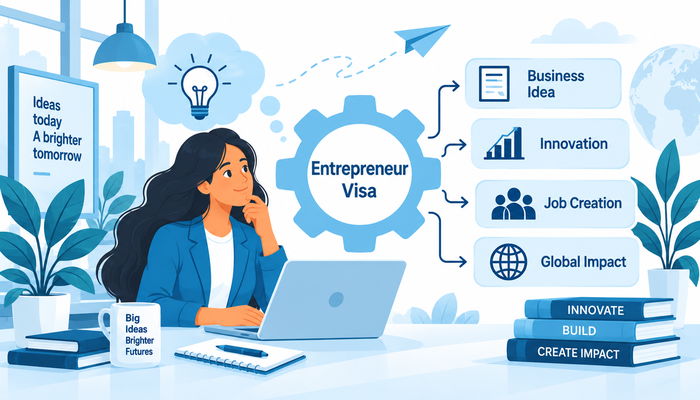
How Entrepreneur Visas Work: A Practical Guide for Founders Moving Abroad
Entrepreneur visas are often described as a simple exchange:
Start a business, invest some money, and receive permission to live abroad.
The reality is more complicated.
Most entrepreneur routes are not designed for someone who simply wants to register a company in another country. Immigration authorities usually want to understand whether the applicant will genuinely operate the business, whether the project is financially credible, and whether it fits the economic or innovation objectives of the country.
The exact test also changes significantly between destinations.
Germany focuses heavily on economic interest, regional demand, financing, and the expected effect of the business on the economy. Spain has a specific entrepreneur residence route for innovative projects with special economic interest. Italy operates a dedicated startup route focused on innovative companies.
So the better question is not:
“Can I open a company and get a visa?”
It is:
“Does my business fit the type of entrepreneurship this immigration route was created to support?”
An Entrepreneur Visa Is a Residence Route Built Around a Business
The core difference between an entrepreneur route and a normal work visa is the source of the applicant's economic activity.
With a work visa, an employer usually provides the job.
With an entrepreneur route, the applicant is trying to create and operate the business themselves.
That means immigration authorities often need to evaluate something that does not fully exist yet.
They may review the founder's experience, business model, available capital, market demand, financial projections, business location, expected economic impact, and whether the applicant will actually be involved in running the company.
This makes entrepreneur applications unusual.
You are not only proving eligibility.
You are making a case that the proposed business is credible enough to support your residence.
A Business Plan Is Usually Central
A strong business plan is not simply a document written to satisfy immigration.
It is usually the main explanation of why the project should be taken seriously.
Authorities may want to understand what the company sells, who the customers are, how revenue will be generated, how the business will be funded, and why the founder is capable of executing the plan.
Germany's current self-employment route illustrates this clearly. A non-EU entrepreneur seeking residence for a commercial business must generally demonstrate economic interest or regional demand, a positive expected effect on the economy, and secured financing through capital or a loan commitment. Germany's official guidance recommends addressing these points convincingly in the business plan.
This means a generic business plan copied from a template is unlikely to answer the most important question:
Why does this specific business make sense in this specific market?
Germany Does Not Have One Generic “Startup Visa”
Germany's system is better understood as a self-employment residence framework.
There are different rules depending on whether someone is establishing a commercial business or working in a liberal profession as a freelancer.
For a commercial entrepreneur, current official rules focus on economic or regional demand, positive economic impact, and secured financing. Applicants over 45 may also need to demonstrate adequate retirement provision.
For freelancers, the assessment is different. The applicant generally needs to show sufficient funding for the activity, secure their own livelihood, and obtain any professional licence required for the occupation.
This distinction matters.
Someone opening a technology company and someone working independently as an architect or consultant may both be self-employed, but they do not necessarily fit the same German legal category.
Germany Also Looks Beyond the Idea
One mistake founders make is thinking that an interesting concept is enough.
Germany's requirements make it clear that financing and economic feasibility matter.
Authorities can also look at factors such as the applicant's entrepreneurial experience and professional background.
That makes sense from an immigration perspective.
An idea may be attractive, but residence is being granted so the applicant can actually build the business.
The founder therefore needs to show a credible connection between personal experience and execution.
If someone has spent ten years working in logistics and wants to build a logistics software company, that professional history may support the case.
If someone has no experience, no customers, no funding, and only a broad idea, the application becomes much harder to explain convincingly.
Spain's Entrepreneur Route Is Specifically About Innovation
Spain takes a different approach.
Its current entrepreneur residence framework under Law 14/2013 is aimed at foreign founders over 18 who want to develop an entrepreneurial activity that is innovative and has special economic interest for Spain.
A particularly important feature is that Spain does not set a fixed minimum investment amount or a fixed minimum number of jobs that every applicant must create under this route.
Instead, the business is evaluated more broadly.
ENISA assesses the applicant's professional profile and involvement in the project, the business plan and financing, and the project's contribution through innovation, added value, or investment opportunities for the Spanish economy.
This means Spain's entrepreneur route should not be interpreted as:
“Invest X euros and receive residence.”
The quality and nature of the project matter.
Spain Also Has a Separate Self-Employment Route
This is another important distinction.
Not every person who wants to run a business in Spain needs to fit the special innovative entrepreneur category.
Spain also has a general residence and self-employment framework for foreigners who want to carry out economic activity on their own account.
That means an ordinary local business and an innovative startup may belong to different immigration strategies.
For example, someone launching a technology platform with a scalable innovative model may investigate the Law 14/2013 entrepreneur route.
Someone planning a more conventional independent business may need to look at the general self-employment framework instead.
This is why the business model should be defined before choosing the immigration route.
Trying to force an ordinary business into an innovation-based visa category can create unnecessary problems.
Italy's Startup Route Is Narrower Than the Name Suggests
Italy has a dedicated Italia Startup Visa program for non-EU entrepreneurs who want to establish an innovative startup in Italy.
The important word is innovative.
The official program specifically targets businesses that can qualify as innovative startups under Italian law rather than every new small business.
The program's FAQ explains that the selection committee examines whether the proposed business model potentially meets the legal definition of an innovative startup, with emphasis on areas such as technological innovation, research and development, or intellectual property.
So opening a normal restaurant, retail shop, or local consulting company would not automatically make someone an Italia Startup Visa candidate.
The business needs to fit the startup program's legal and innovation framework.
Italy Uses a Pre-Approval Stage
Italy's process also illustrates how entrepreneur immigration can involve more than a normal visa appointment.
Under the Italia Startup Visa program, applicants first seek approval through the startup evaluation process and obtain a nulla osta, or certificate of no impediment, before proceeding to the competent Italian embassy or consulate for the visa stage.
After arriving in Italy, the founder must then complete the residence-permit process.
The official program currently describes the initial startup self-employment visa and residence permit as valid for one year. Renewal can lead to a further two-year self-employment residence permit if the business has been properly established and the relevant income requirements are met.
This is an important reminder that entrepreneur immigration is usually a sequence.
Business evaluation, entry visa, business establishment, and residence renewal can all be separate stages.
Practical Example: Amir Has a Business Idea but No Evidence Yet
Imagine Amir has worked in warehouse operations for eight years.
He wants to move to Europe and build software that helps small logistics companies optimize inventory.
He has industry knowledge and has spoken informally with potential customers.
But he has no prototype, no financial plan, and no clear estimate of how much money he needs.
Amir may have the foundation of a credible business.
But he is probably not ready for an entrepreneur application yet.
Before choosing Germany, Spain, or Italy, he needs to strengthen the business itself.
He should define the product more clearly, research the local market, estimate costs, determine how the company will be financed, and document why his professional background gives him an advantage.
Then the countries can be compared based on fit.
Germany may be relevant if he can demonstrate demand, economic impact, and financing.
Spain may be relevant if the product is sufficiently innovative and creates economic value.
Italy may become relevant if the project fits the country's legal innovative-startup framework.
The visa decision should follow the business evidence.
Not the other way around.
Funding Is About More Than Having Money in a Bank Account
Entrepreneurs often focus on finding a minimum number.
“How much money do I need?”
Sometimes immigration systems provide specific financial thresholds.
But entrepreneur routes frequently ask a broader question:
Can this business realistically be financed?
Germany explicitly requires financing for the business concept to be secured through the applicant's own capital or a loan commitment.
Spain's ENISA assessment considers the project's financing, including the investment required and possible funding sources.
The business therefore needs two financial stories.
One explains how the company will survive.
The other explains how the founder will survive.
These are not necessarily the same money.
Using every personal saving to fund the company may leave the founder with no realistic living-cost buffer.
That can weaken the entire relocation plan.
The Founder Profile Matters
Entrepreneur immigration is partly about the project and partly about the person expected to execute it.
A strong founder profile can show relevant professional experience, technical knowledge, previous entrepreneurship, industry connections, or evidence that the applicant has already developed the project.
Spain explicitly includes the applicant's professional profile and level of involvement as part of the ENISA assessment.
Germany's official guidance similarly recommends evidence such as references and entrepreneurial experience.
This is why applicants should not describe themselves as if they were separate from the business plan.
The immigration authority wants to understand why this founder is likely to make this project work.
Creating a Company Does Not Automatically Create Residence
This is one of the most important misconceptions.
In many countries, foreign nationals can own or register companies without automatically receiving the right to live there.
Company law and immigration law are separate systems.
You may be legally capable of owning shares in a company while still needing an appropriate residence permit to live in the country and actively operate it.
An entrepreneur visa or self-employment permit connects those two issues.
It gives immigration authorities a reason to decide whether the founder should be allowed to reside in the country for the purpose of running the business.
Company registration alone should therefore never be treated as an immigration strategy.
Revenue Helps, but Pre-Revenue Does Not Always Mean Impossible
Many entrepreneur applicants are still at startup stage.
They may not have meaningful revenue yet.
That does not automatically disqualify them.
But the earlier the business is, the more other evidence becomes important.
A prototype.
Letters of intent.
Pilot customers.
Industry research.
Founder experience.
Investor interest.
Intellectual property.
A clear go-to-market strategy.
These things help turn an idea into an evidence-based project.
The weaker the operating history, the stronger the explanation of future feasibility needs to be.
Entrepreneur Visas Create Business Risk and Immigration Risk at the Same Time
Employment migration usually separates these risks.
If the company fails, the employee may look for another employer, subject to the relevant immigration rules.
For an entrepreneur, the business itself may be the reason for residence.
If the project does not develop as expected, there can eventually be both financial and immigration consequences.
Germany, for example, initially issues the self-employment residence permit for up to three years. Continuation depends on the business being successful and the applicant being able to support themselves and their family.
This makes runway especially important.
An entrepreneur should not plan only for the cost of obtaining the visa.
They need enough time and capital for the business to reach a sustainable stage.
Long-Term Residence Can Make the Route More Valuable
The first entrepreneur permit is only part of the calculation.
Applicants should also ask what happens if the business succeeds.
Germany currently allows commercial self-employed entrepreneurs to potentially obtain a settlement permit after three years if the business is successful and the applicant can support themselves and their family.
Freelancers follow a different timeline, with Germany's official guidance describing settlement as possible after five years.
These distinctions can materially affect long-term planning.
The strongest entrepreneur route is not only one that lets you launch the company.
It is one whose residence structure still makes sense if the business works.
What Nobody Tells You About Entrepreneur Visas
The biggest misconception is that immigration approval validates the business.
It does not.
A government may decide that the project satisfies the residence requirements.
Customers can still refuse to buy.
The market can still change.
Costs can still be higher than expected.
And a founder can still struggle to build the company.
The reverse is also true.
A commercially promising business does not automatically fit an entrepreneur visa.
It may be profitable but insufficiently innovative for a specific startup route.
It may have strong demand but weak financing evidence.
It may be perfectly viable while belonging under a different self-employment category.
Business viability and immigration eligibility overlap.
They are not identical.
Entrepreneur Visa Checklist
Before choosing the country, define the actual business model and determine whether it is an innovative startup, a conventional commercial business, or freelance activity.
Research the exact residence category rather than searching only for “entrepreneur visa.”
Prepare a serious business plan covering the market, product or service, competition, revenue model, financing, and founder involvement.
Separate business capital from personal living expenses.
Collect evidence supporting the project, such as relevant professional experience, prototypes, customers, contracts, market research, or investment interest where available.
Finally, investigate renewal and long-term residence requirements before committing capital to the move.
Conclusion: Build the Business Case Before the Visa Case
Entrepreneur visas work differently from ordinary employment migration because the applicant is asking the country to accept a future economic project as the basis for residence.
Germany currently focuses on factors including economic or regional demand, positive economic impact, and secured financing for commercial self-employment.
Spain's special entrepreneur route focuses on innovative projects with economic value and uses ENISA to assess the founder, business plan, financing, and contribution to the Spanish economy, without imposing a universal minimum investment or job-creation threshold.
Italy's dedicated Startup Visa is narrower, targeting founders whose businesses can fit the country's legal definition of an innovative startup.
These rules can change, and nationality, current residence status, profession, and business structure can alter the applicable route. Current requirements should always be verified through the relevant official authority before applying.
But the strategic principle is simple:
Do not design a business to fit a visa.
Build a business that has a credible market, financing plan, and reason to exist.
Then choose the immigration route that best matches what you are actually building.
FAQ
What is an entrepreneur visa?
It is a visa or residence route that allows a qualifying founder or self-employed person to live in a country for the purpose of establishing or operating a business.
Do I need a minimum investment for an entrepreneur visa?
It depends on the country and route. Spain's current innovative entrepreneur framework does not set a universal minimum investment or job-creation amount, while applicants must still demonstrate a credible financing plan.
Does Germany have a startup visa?
Germany uses self-employment residence permits rather than one generic startup visa. Different requirements apply to commercial entrepreneurs and freelancers.
What does Spain look for in an entrepreneur application?
Spain's ENISA assessment considers the founder's professional profile, the business plan and financing, and the project's innovation or added economic value.
Is Italy's Startup Visa available for any small business?
No. The Italia Startup Visa specifically targets innovative startups that can fit the relevant legal definition, with emphasis on innovation, R&D, or intellectual property.
Is a business plan enough to get an entrepreneur visa?
No. Authorities may also examine financing, founder experience, legal requirements, economic or innovative value, and the applicant's ability to support themselves.
Does registering a company give me the right to live in that country?
Not automatically. Company ownership and immigration status are separate legal issues. A founder generally needs an appropriate visa or residence permit to live in the country for the purpose of operating the business.