Lessons Learned From Relocating as a Family
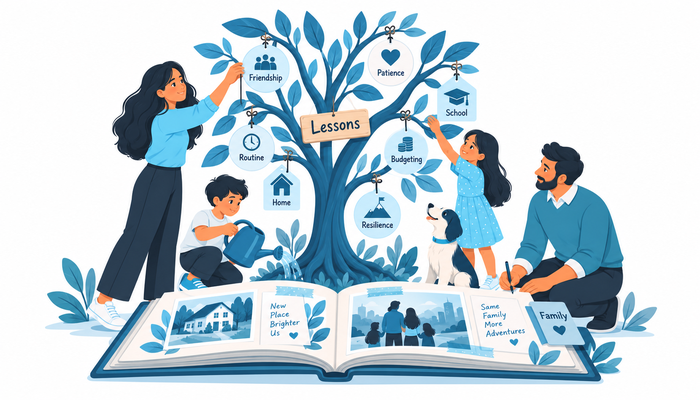
Lessons Learned From Relocating as a Family: What We Would Do Differently
Lessons Learned From Relocating as a Family
Relocating as a family taught us that a successful move is not simply one where everyone gets a visa and arrives safely.
That is only the beginning.
The real test comes later, when the family has to build a functioning life in a new country.
We learned that one person’s career opportunity can affect everyone else’s routine. A child can look settled at school and still feel homesick. A spouse can have full legal work rights and still struggle to restart a career. A family can afford the move on paper and still feel financially fragile after housing, school, transport, and setup costs are added.
The biggest lesson was this:
Family relocation works best when the move is planned as a household transition, not as one person’s immigration project.
Lesson 1: The Main Applicant Is Not the Whole Family Plan
Our first mistake was naturally building the relocation around the person who created the opportunity.
That person had the job, visa pathway, start date, and income.
So most decisions followed their needs.
Where should we live? Close to work.
When should we move? Around the job start date.
Which city should we choose? Where the employer was located.
That made sense initially.
But it also made the rest of the family reactive.
We eventually learned that a strong family plan needs a second layer.
What happens to the spouse’s career? What school options suit the children? Does the neighborhood work for everyone? Can the household still function if the main job changes?
The move may begin with one person’s opportunity, but it should not remain centered on one person forever.
Lesson 2: Legal Work Rights Do Not Equal Career Independence
This was one of the most important lessons for the second adult.
Before moving, we focused heavily on whether the spouse would be legally allowed to work.
That mattered.
But after arrival, we discovered that permission is only the first step.
The spouse may still need stronger local-language ability, qualification recognition, a different CV, local references, or time to understand the labor market.
There can also be fewer opportunities in the specific city.
So the real question is not:
“Can my spouse work?”
It is:
“How realistic is it for my spouse to rebuild a meaningful career here?”
That is a much more useful planning question.
Lesson 3: The Second Career Needs Its Own Strategy
If we were moving again, we would build two professional plans before departure.
The main applicant’s career is usually clearer because there may already be a job.
The spouse’s plan is often more uncertain.
That is exactly why it needs more preparation, not less.
We would research local employers, language expectations, recognition requirements, remote-work possibilities, networking opportunities, and how long it might realistically take to find the first role.
We would also agree in advance on how much time and money the household would invest in rebuilding that career.
Language classes, childcare, professional courses, and networking all require resources.
A second career does not restart automatically just because the family has moved.
Lesson 4: Children Do Not All Experience the Same Move
One of the easiest assumptions to make is that “the children” will adapt as a group.
They do not.
Age, personality, language ability, school stage, and friendships can create completely different experiences.
A younger child may learn the new language quickly and begin making friends within months.
An older child may be dealing with exams, identity, deeper friendships back home, and anxiety about university.
Even siblings can have opposite reactions to the same country and school.
We learned to stop asking:
“Are the kids settling in?”
and start asking:
“How is each child settling in?”
That small change produced much better conversations.
Lesson 5: Children Can Adapt and Still Miss Home
Adaptation is not the same as forgetting the previous life.
A child can speak the local language, have friends, enjoy school, and still become sad when they think about grandparents.
They can be happy in the new country and still wish an old friend lived nearby.
At first, we thought homesickness meant something was going wrong.
Later, we understood that it could simply mean both places still mattered.
That helped us stop treating the old life and new life as competitors.
Children can belong to both.
Maintaining meaningful relationships with people back home did not prevent integration.
It often gave the children enough emotional security to engage more confidently with the new environment.
Lesson 6: Language Is a Household Independence Issue
We originally treated language as an individual responsibility.
Each person would improve at their own speed.
Then we saw how quickly language ability could change family roles.
The person who spoke best became responsible for school communication, phone calls, appointments, landlords, and paperwork.
If the children learned faster than the adults, they sometimes understood the outside world better than their parents.
That showed us that language is about more than employability.
It affects independence inside the household.
A stronger family plan gives every adult a realistic path toward handling normal daily life without relying permanently on someone else.
Lesson 7: Housing Should Be Chosen Around a Weekday
We spent too much time comparing apartments by rent, size, and appearance.
The more useful test would have been:
“What does Tuesday morning look like from this address?”
How long is the school journey?
How long is the commute?
Can both adults reach potential workplaces?
Is childcare nearby?
Can older children travel independently?
Are groceries, parks, and healthcare practical?
A slightly cheaper home can create much more expensive family logistics.
We learned that family housing is not simply a financial decision.
It is an infrastructure decision.
The neighborhood can either make everyday life easier or create small amounts of stress every single day.
Practical Example: The Cheaper Apartment Was Not Actually Cheaper
Imagine a family choosing between two apartments.
The first costs less but is far from school and the main workplace.
The second costs more but sits near public transport, school, and several employers relevant to the spouse.
On paper, the cheaper apartment wins.
Then the family calculates the real routine.
The first home requires longer commutes, additional transport, earlier mornings, and more parental coordination.
The spouse also has fewer nearby employment options.
The second apartment costs more in rent but saves hours every week and makes it easier for both adults to work.
The lesson is not that expensive housing is always better.
It is that rent should be compared with the entire household system around it.
Lesson 8: Relocation Costs and Living Costs Are Different
Before moving, we calculated what the family would need each month.
That was useful, but incomplete.
The relocation itself created a separate category of spending.
Flights, deposits, temporary accommodation, furniture, documentation, household equipment, school items, transport, and replacing things we could not bring all arrived within a short period.
If those costs come from the same savings that are supposed to protect the family after arrival, the emergency fund can disappear quickly.
We learned to think in three budgets.
One for moving.
One for normal life.
One for emergencies.
Keeping those categories separate creates far more financial resilience.
Lesson 9: Do Not Build the Plan Around the Second Income Arriving Quickly
A two-income household can easily assume it will become a two-income household again soon after relocation.
That is risky.
The spouse may need months to find work.
Language preparation can take longer.
Qualification recognition can delay applications.
Childcare arrangements may not be ready immediately.
If the household requires the second salary by Month Two, the move can become stressful very quickly.
We learned that the initial budget should be able to function on confirmed income.
If the second income arrives sooner, that is a benefit.
It should not be the only thing keeping the plan alive.
Lesson 10: The First Three Months Should Be About Stability
We expected to optimize everything too quickly.
The perfect home.
Good jobs for both adults.
Children comfortable at school.
Language improving.
A social life.
A normal routine.
That was unrealistic.
The first three months were more useful when we treated them as a stabilization period.
Complete essential administration.
Create a school routine.
Understand transport.
Set up healthcare.
Make the home functional.
Learn where basic things are.
Once the household has a stable foundation, the family has more energy to improve careers, language, and social life.
Trying to solve everything simultaneously only made the transition feel more chaotic.
Lesson 11: Family Members Adapt at Different Speeds
This was one of the most emotionally important lessons.
One person may love the destination almost immediately.
Another may need a year.
One child may make friends quickly.
Another may struggle.
The spouse may experience the first six months very differently from the person already working.
We learned not to use the fastest-adjusting family member as the standard for everyone else.
That creates unnecessary pressure.
The better question is whether each person is gradually moving toward more stability.
Progress matters more than matching timelines.
Lesson 12: Grandparents and Extended Family Matter More Than We Expected
Relocation affects people who do not move too.
Grandparents may lose regular time with grandchildren.
Adult children may worry about aging parents from a distance.
Family events become flights instead of short trips.
Emergencies feel more complicated.
We had initially treated visits home as a travel-budget issue.
Eventually, we understood that maintaining family relationships needed its own plan.
How often can we realistically visit?
How will grandparents stay involved in the children’s lives?
What happens if a parent becomes ill?
These questions are not reasons to avoid migration.
They are part of honest family planning.
Lesson 13: Relationship Stress Often Comes From Unequal Sacrifice
Migration changes the balance between partners.
One person may gain career momentum.
The other may lose it temporarily.
One understands the language better.
One manages more childcare.
One becomes financially responsible for the household.
Those differences can create resentment even when both people agreed to the move.
We learned that the important thing was not making every sacrifice equal.
That may be impossible.
The important thing was acknowledging the imbalance and creating a plan for it to change.
If one person pauses a career for the first year, what happens in Year Two?
If one adult carries most childcare initially, how will responsibilities shift when the second person starts work?
Temporary imbalance is much easier to tolerate when it has a visible end point.
Lesson 14: The First Job Should Not Control the Whole Family Forever
The initial job may be the reason the family can move.
That can make the household overly dependent on it.
We learned to think about what would happen if the role changed.
Are there other employers nearby?
Could the family stay in the same city?
Would the spouse eventually be earning too?
Could the household survive a period without the main income?
A family becomes more secure when the first job gradually becomes one part of the family's life rather than the foundation of everything.
That independence takes time to build.
It should still be part of the original plan.
Lesson 15: Social Life Does Not Rebuild Automatically
We underestimated how much of ordinary life depends on relationships.
At home, friendships, relatives, neighbors, and familiar professionals already existed.
After relocation, almost every connection had to be rebuilt.
The children's school helped.
Work helped.
Activities helped.
But social stability still took time.
We learned that waiting for friendships to happen was less effective than creating repeated opportunities.
Regular activities, community groups, school events, and professional networks slowly created familiarity.
Belonging usually developed through routine rather than one big breakthrough.
What Nobody Tells You About Family Relocation
The difficult parts do not always happen at the beginning.
The first weeks can actually feel exciting because everything is new.
Some challenges appear later.
After the administrative tasks are completed.
After visiting relatives have gone home.
After the initial excitement fades.
That is when the family begins comparing the new life with the old one more seriously.
This delayed adjustment can surprise people.
We learned not to judge the relocation from either the excitement of Month One or the frustration of Month Four.
The useful question was whether the household was gradually becoming more functional over a longer period.
What We Would Do Differently
If we relocated again, we would research less broadly and plan more specifically.
Instead of asking whether a country is “family-friendly,” we would investigate the exact city, neighborhood, school options, spouse job market, commute, childcare, and housing.
We would preserve a larger emergency reserve.
We would start the spouse’s career preparation earlier.
We would involve the children more in the transition.
And we would agree before moving on how we would evaluate the first year.
Not through one emotional question such as:
“Was moving abroad worth it?”
But through concrete measures.
Are both adults becoming professionally stronger?
Are the children becoming more secure at school?
Is language improving?
Is the budget sustainable?
Does the household have more options than six months ago?
Those questions are much more useful.
Family Relocation Lessons Checklist
Before moving, build the plan around the entire household rather than only the main applicant.
Create separate strategies for both adults’ careers and for each child’s educational transition.
Calculate relocation expenses separately from monthly living costs and preserve a real emergency reserve.
Choose housing based on daily logistics.
Plan language learning for every family member.
Maintain meaningful relationships with relatives back home.
Finally, review the move after three, six, and twelve months using practical measures of stability rather than expecting everyone to feel settled immediately.
Conclusion: A Successful Family Move Creates More Options Over Time
The biggest lesson we learned from relocating as a family was that success is not defined by arrival.
It is defined by what happens after arrival.
Does the spouse regain professional independence?
Do the children build friendships and confidence?
Does the family understand the local language and systems better?
Does the household become financially less fragile?
Can the family make decisions without everything depending on one job, one income, or one person?
For families considering Germany, Spain, Italy, or another destination, immigration rights, school systems, healthcare, childcare, and residence conditions vary and can change. Current official requirements should always be verified before making legal or financial commitments.
But the broader lesson stays the same.
We initially measured success by whether we had managed to relocate everyone.
Later, we used a better measure:
“Is every member of the family gaining more stability, confidence, and choices as time passes?”
That is what made the move feel sustainable.
FAQ
What is the biggest lesson from relocating as a family?
The biggest lesson is that family relocation should be planned around the entire household, not only the main applicant’s job or visa.
Why is the spouse’s career important in family relocation?
Because legal work permission does not automatically create employment. Language, local demand, recognition, and professional networks can affect how quickly the second career restarts.
How can families make relocation less stressful for children?
Prepare them early, preserve familiar routines, research school and language support, maintain important relationships back home, and allow different children to adapt at different speeds.
What is the biggest financial mistake families make?
A common mistake is spending most savings on the move itself and assuming the second income will begin quickly after arrival.
How should families choose housing abroad?
Compare the entire weekday routine, including school, work, childcare, transport, healthcare, and access to potential employers, not only rent and property size.
How long does it take a family to settle after moving abroad?
There is no universal timeline. Different family members may take months or longer to become comfortable, so progress should be evaluated over time.
How should families measure whether relocation is working?
Look at career progress, children’s adjustment, language ability, financial stability, social connections, and whether each family member is becoming more independent over time.