How We Prepared Our Kids for Relocation
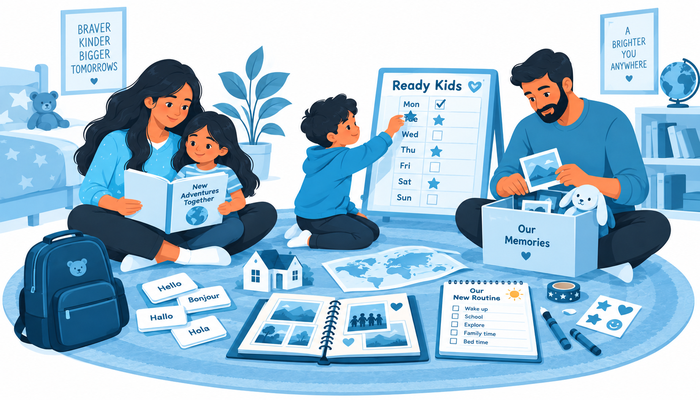
How We Prepared Our Kids for Relocation: What Helped Before Moving Abroad
When we started planning our move abroad, most of our energy went into the practical side.
Visas. Housing. Flights. Schools. Documents. Money.
But the closer the move became, the more we realized that our children were preparing for something completely different.
We were thinking about opportunity.
They were thinking about leaving.
They wanted to know what their new bedroom would look like, whether they would understand their teacher, whether they could still talk to their grandparents, and whether their friends would forget them.
That changed the way we approached the move.
We stopped treating the children as passengers in the relocation plan and started preparing them as people experiencing their own version of migration.
The most useful lesson was simple:
Children cope better with relocation when the unknown becomes more understandable.
We could not remove every difficult emotion, but we could reduce surprise, give them some control, and make the transition feel less like their entire life was disappearing at once.
We Told Them Early Enough to Process It
One of the first decisions we made was not to hide the move until everything was finalized.
It was tempting.
We wanted to avoid creating anxiety before visas, contracts, and timing were certain.
But telling children at the last possible moment creates a different problem: they have almost no time to process what is happening.
So once the relocation became genuinely likely, we began explaining it gradually.
We kept the language appropriate to their age.
We did not overwhelm them with immigration details or financial reasons.
We simply explained that we were planning to live in another country, what would change, and what would stay the same.
The first conversations were not about convincing them that the move would be amazing.
They were about giving them time to ask questions.
Some questions were practical.
Some were emotional.
And some appeared weeks later, after they had enough time to understand what moving really meant.
We Did Not Force Them to Be Excited
This was one of the most important choices we made.
Adults often present international relocation to children as an adventure.
New country.
New school.
New language.
New experiences.
That can be positive, but it can also make children feel as though sadness is the wrong reaction.
We tried not to do that.
If they were excited, we shared the excitement.
If they were upset, we allowed that too.
A child can look forward to a new home and still be angry about leaving friends.
They can be curious about a new school and still wish the move were not happening.
We learned not to interpret those mixed emotions as resistance.
They were part of the transition.
The goal was not to make the children love the move before it happened.
It was to make sure they felt safe talking about how they actually felt.
We Made the New Place More Concrete
A new country is an abstract idea for a child.
So we tried to make it visible.
We looked at the neighborhood online.
We showed them pictures of parks, schools, public transport, supermarkets, and places we might visit together.
We looked at the route between the future home and school.
We talked about what the weather would be like.
If there was a playground nearby, we showed them.
If the city had a familiar activity they already enjoyed, that became part of the conversation.
This mattered because children often fear what they cannot picture.
Once the destination became a real place instead of “somewhere abroad,” the questions became more specific and manageable.
Instead of asking:
“What will happen to us?”
they began asking:
“Can we go to that park after school?”
That felt like progress.
School Was the Biggest Source of Anxiety
For us, school preparation mattered more than almost anything else.
Children spend a huge part of their life at school.
A move can change the language, teachers, curriculum, classmates, schedule, and classroom culture all at the same time.
We therefore tried to learn as much as possible before arrival.
What language would lessons use?
How were newly arrived children placed?
Was language support available?
What did a normal school day look like?
Would they need uniforms?
What time did school start?
For families moving to countries such as Germany, these questions are particularly important because education is organized at state level and local procedures can vary. Germany's official guidance advises international families to ask about support such as German as a second language when children are not yet fluent.
The practical details helped because children worry about things adults sometimes consider small.
Where will I eat lunch?
What if I do not understand the teacher?
What happens during break?
Answering those questions made school feel less unpredictable.
We Started Language Exposure Before the Move
We did not expect the children to become fluent before relocation.
That would have been unrealistic.
But we wanted the new language to sound less unfamiliar when they arrived.
So we started with basic everyday language.
Greetings.
Numbers.
Simple classroom phrases.
How to say they did not understand.
How to ask for help.
Words related to food, toilets, transport, and play.
For younger children, songs, videos, games, and cartoons were more useful than formal lessons.
The objective was not academic achievement.
It was recognition.
Hearing a few familiar words during the first week can make a completely new environment feel slightly less foreign.
We Prepared Them for Not Understanding Everything
This was just as important as learning vocabulary.
We told them clearly that there would be moments when they would not understand what someone was saying.
That did not mean they were doing badly.
It did not mean everyone else was smarter.
They were learning.
Children who were confident students before moving can find this particularly difficult.
Suddenly, they may know the answer but not know how to express it.
We wanted them to understand that this temporary gap between what they knew and what they could communicate was normal.
That conversation helped protect their confidence.
We Let Them Have Some Control
Children do not choose most parts of an international move.
They do not choose the country.
They may not choose the city.
They usually do not choose the timing.
Giving them small areas of control became important.
We let them make decisions about their room.
Which favorite objects should travel with us?
What should go in their hand luggage?
Which toys mattered enough to keep nearby during the first weeks?
Which activities would they like to continue after moving?
These choices did not change the relocation itself.
But they changed how powerless the process felt.
Children do not need control over everything.
They need evidence that their preferences still matter.
We Did Not Treat Goodbyes as a Small Detail
At first, we thought the practical move would be the hardest part.
For the children, saying goodbye was often harder.
Friends, teachers, grandparents, cousins, neighbors, and familiar routines all carried emotional weight.
We therefore tried not to rush the goodbye period.
The children had time with important friends.
They could exchange contact details.
We took photos.
We planned how they would stay connected.
We also avoided saying things such as:
“You'll make new friends.”
That may be true, but it does not replace the existing friendships.
New relationships and old relationships can both matter.
Children do not need to erase the previous life to build a new one.
We Created a Plan for Staying Connected
Video calls sound obvious, but we found it useful to make them part of the routine rather than leaving them to happen randomly.
Regular contact with grandparents and close friends gave the children continuity.
They knew that moving did not mean disappearing from people's lives.
At the same time, we tried not to make every evening about home.
The goal was connection, not constant comparison.
We wanted the children to maintain meaningful relationships while still having enough emotional space to become curious about the new environment.
That balance took time.
We Protected Familiar Routines
Relocation changes almost everything at once.
So we tried to keep some ordinary parts of family life familiar.
Bedtime routines.
Favorite meals.
Weekend movie nights.
Certain toys.
Family traditions.
Even small things became useful anchors.
Children often experience stability through repetition.
When the language outside is different, the school is different, and the neighborhood is unfamiliar, a normal breakfast or familiar bedtime routine can create a surprising amount of security.
The home did not need to look exactly like the old one.
It needed to feel recognizably ours.
Practical Example: Two Children Need Two Different Preparations
Imagine a family relocating with an eight-year-old and a fourteen-year-old.
The younger child is mostly worried about making friends and understanding the teacher.
The teenager is thinking about much more.
Friendship groups.
Identity.
Exams.
University.
Social media.
Whether they will feel behind academically.
Giving both children the same preparation would miss the point.
The younger child might benefit most from seeing the school, learning basic language, and finding a familiar activity such as football or swimming.
The teenager may need more detailed conversations about curriculum, graduation requirements, language expectations, and how to stay connected with close friends.
Both children are relocating.
But they are not experiencing the same move.
That was something we tried to keep in mind throughout the process.
We Researched Activities, Not Just Schools
School is important, but children also build belonging outside the classroom.
We looked for activities they already enjoyed.
Sports.
Music.
Art.
Dance.
Clubs.
These offered two benefits.
First, they gave children something familiar in an unfamiliar environment.
Second, repeated activities created natural opportunities to see the same children each week.
That matters because friendships are often easier to build when children meet repeatedly around a shared interest.
We did not try to fill every afternoon.
One or two consistent activities were enough to begin creating a routine beyond school.
We Talked About What Would Stay the Same
Migration conversations naturally focus on change.
We found it just as important to identify continuity.
We would still be a family.
The same parents would still be there.
Birthdays would still be celebrated.
Favorite traditions would continue.
Grandparents would still be part of their lives.
Their interests would come with them.
The move was changing the environment, not everything about who they were.
For younger children especially, that distinction seemed reassuring.
We Prepared Ourselves for Regression
We also learned that adjustment is not linear.
A child may seem completely comfortable for several weeks and then suddenly become homesick.
The first school holiday can trigger sadness.
A birthday can make distance from relatives feel much stronger.
A difficult day at school can bring back the wish to return home.
We stopped treating these moments as evidence that all previous progress had disappeared.
Adaptation can move forward and backward.
That is normal.
The better measure was the overall direction over several months.
We Tried Not to Make Them Responsible for the Move
One sentence we deliberately avoided was:
“We are doing this for you.”
Parents often mean it lovingly.
But it can create pressure.
If a child struggles, they may feel guilty because the family supposedly made the move for their benefit.
We wanted the children to understand that relocation was an adult decision based on the family's overall situation.
They did not need to prove the move was worthwhile by being happy all the time.
That gave them more freedom to be honest.
What Nobody Tells You About Preparing Children
You cannot fully prepare a child for something they have never experienced.
No amount of conversation can perfectly simulate the first day in a new school.
You cannot explain exactly what homesickness will feel like.
Preparation does not remove difficulty.
What it does is reduce shock.
The child understands why things are happening.
They know who they can talk to.
They recognize some of the environment.
They know that struggling with language is expected.
They know they are allowed to miss home.
That is what preparation really gives them.
Not certainty.
A framework for dealing with uncertainty.
Our First 90 Days Plan
We also realized that preparation should continue after the plane lands.
During the first month, we focused mostly on routine and basic stability.
School.
Sleep.
Meals.
Transport.
Learning the neighborhood.
During the second month, we paid more attention to friendships and activities.
By the third month, we could begin judging which difficulties were fading naturally and which needed more support.
We tried not to ask:
“Do you like living here?”
every few days.
Instead, we asked more specific questions.
Who did you talk to today?
Which lesson is easiest?
Which part of school is confusing?
Who would you like to invite over?
What do you miss most?
Those answers gave us a much clearer picture of how they were really adapting.
Kids Relocation Preparation Checklist
Before moving, explain the relocation early enough for children to process it and make space for both positive and negative reactions.
Show them the future neighborhood and school wherever possible.
Research school language, curriculum, placement, and support before arrival.
Introduce basic local-language phrases without turning the preparation into academic pressure.
Give each child some control over personal belongings, bedroom choices, or activities.
Plan meaningful goodbyes and a realistic way to stay connected with important people back home.
Keep familiar routines during the first months and monitor each child separately rather than assuming siblings will adapt at the same speed.
Conclusion: We Prepared Them for Change, Not Perfection
The most important thing we learned was that preparing children for relocation does not mean convincing them that everything will be wonderful.
It means helping them understand what is changing and giving them enough stability to move through that change.
We prepared school information.
We introduced language.
We talked about friendships.
We preserved routines.
We gave them small choices.
And we made room for the fact that they could be excited and sad at the same time.
For families moving to Germany, Spain, Italy, or another country, school systems, enrollment procedures, language support, and academic pathways vary by region and should be checked through current official sources before relocation.
But the emotional preparation is just as important as the administrative preparation.
The question we eventually learned to ask was not:
“How do we make our children excited about moving?”
It was:
“How do we make sure they feel informed, included, and supported while their world changes?”
That became the most useful preparation we could give them.
FAQ
When should you tell children about an international move?
Once the move is genuinely likely, giving children enough time to process the change is usually more helpful than telling them immediately before departure.
Should children help decide whether the family moves?
Adults remain responsible for the final decision, but age-appropriate involvement and small choices can reduce feelings of powerlessness.
Should children learn the local language before relocating?
Some basic exposure can help. The goal does not need to be fluency; familiar everyday words and phrases can make the first weeks less overwhelming.
How can parents prepare children for a new school?
Research the school system, language of instruction, schedule, curriculum, and available language support, then explain what a normal school day may look like.
Should children stay connected with friends after moving?
Yes. Maintaining important relationships can provide emotional continuity while children gradually develop new friendships.
What if a child does not want to move?
Listen to the specific concerns rather than trying to immediately persuade them. Fear of school, losing friends, language, and leaving relatives may require different kinds of support.
How do you know whether a child is adapting well?
Look at progress over time in school comfort, friendships, language, routine, sleep, mood, and willingness to participate in normal activities rather than expecting constant happiness.