What Nobody Told Me About Family Migration
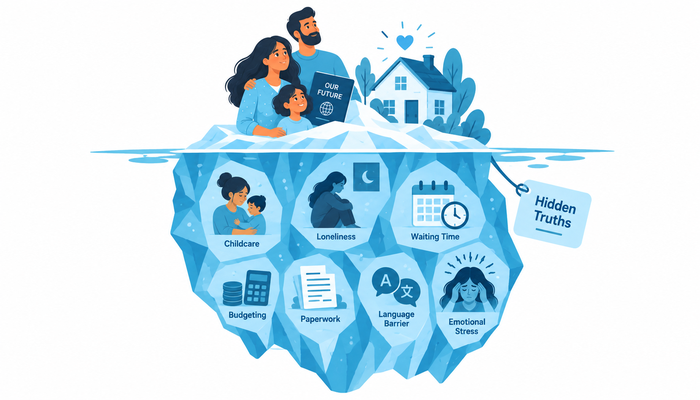
What Nobody Told Me About Family Migration Before We Moved Abroad
Before moving abroad as a family, I thought the difficult part would be getting everyone there.
Visas. Documents. Flights. Housing. School enrollment.
Those things were difficult, but they were not the whole story.
What I did not understand was that family migration changes the balance of the household.
One person's career may move forward while another person's pauses. Children may adapt faster than their parents in some areas and struggle more in others. The family can be financially stable but emotionally unsettled. Everyone can technically be living together and still feel as though they are moving at different speeds.
The biggest surprise was that family migration does not end when the family is reunited.
That is when the real rebuilding begins.
I Thought Moving Together Would Make Everything Easier
I assumed that once the family was physically together, most of the stress would disappear.
In reality, living in the same country does not automatically create stability.
One person may already have a job and daily routine.
The spouse may still be searching for work.
The children may be learning a new language.
Housing may still feel temporary.
The family may be dealing with paperwork, school communication, banking, transport, and unfamiliar healthcare systems at the same time.
Everyone is together, but everyone is solving a different problem.
That is why I stopped thinking of family migration as one transition.
It is several transitions happening inside the same household.
The Main Applicant Can Become the Center of Everything
This was one of the most uncomfortable parts.
If one person's job or visa creates the move, the family can begin revolving around that person.
Their work schedule determines the commute.
Their office location influences where the family lives.
Their immigration status may shape everyone else's residence.
Their salary may temporarily support the entire household.
That can create pressure on both sides.
The main applicant may feel responsible for everything.
The spouse may feel that their own career and preferences have become secondary.
Neither person has to do anything wrong for this imbalance to appear.
It happens because the migration route itself can place one person at the center.
The important thing is to notice it early.
Legal Dependency and Emotional Dependency Are Different
One thing I wish I had understood sooner is that legal dependency does not always mean practical helplessness.
A spouse may move through family reunification but still have broad rights to work, study, and build an independent life.
At the same time, someone with legal work rights may still feel dependent because they do not yet have income, language skills, a professional network, or confidence in the local system.
That distinction matters.
Independence is not only a residence permit.
It is the ability to earn, communicate, move around, make decisions, and understand how the country works.
A family migration plan should therefore ask more than whether the spouse can legally work.
It should ask how quickly that person can become practically independent.
The Second Career Can Be Harder Than the First
The main applicant often moves because they already have a strong reason to be there.
A job offer.
A university admission.
A skilled-worker pathway.
The spouse may arrive without the same professional entry point.
That can create a major difference in momentum.
One person's career begins immediately.
The other's may need to be rebuilt.
They may need language training, qualification recognition, local experience, a different CV, or simply time to understand the market.
This can be frustrating, especially when the spouse had a strong professional identity before moving.
The problem is not only lost income.
It can feel like losing status, routine, confidence, and purpose.
Family migration works better when the second career is treated as a real project rather than something that will “work itself out.”
Practical Example: Amir Is Settled, Maya Is Not
Imagine Amir relocates for an engineering role.
He has a contract, colleagues, salary, and a clear weekly routine from the first day.
His spouse, Maya, joins him several months later.
Maya is legally allowed to work, but her field depends heavily on the local language and professional networking.
Amir feels that the hardest part is over because the family is finally together.
Maya feels that her difficult part has only just started.
Both perspectives are understandable.
The tension comes from assuming the household is in the same stage of adaptation.
It is not.
Amir is in the integration stage.
Maya is still in the entry stage.
Recognizing that difference changes the conversation.
Children Can Adapt Fast and Still Struggle
Another thing people often say is:
“Children adapt quickly.”
Sometimes they do.
They may learn the language faster than the adults.
They may make friends sooner.
They may understand school routines within a few months.
But adaptation does not mean the absence of difficulty.
A child can speak the new language and still miss grandparents.
They can enjoy school and still feel angry about leaving old friends.
They can appear confident outside the home and become emotional at night.
Parents sometimes expect children to either be “fine” or “not fine.”
Real adjustment is much more mixed.
A child can be progressing and grieving at the same time.
Language Changes Family Roles
This was something I had not expected.
Children sometimes learn the local language faster than their parents.
The working parent may also improve quickly through daily professional use.
The spouse who spends more time at home initially may progress more slowly.
Suddenly, the family roles begin to change.
A child may understand a school message before the parent.
One spouse may handle every phone call.
One person becomes responsible for appointments, landlords, government offices, and paperwork simply because they understand more.
That can create an invisible dependency inside the family.
Language learning therefore should not be treated only as a career tool.
It is also part of family power and independence.
Housing Affects Much More Than Comfort
Before moving, I saw housing mostly as a financial decision.
How much rent can we afford?
After moving, I realized that housing determines a large part of family life.
It affects school access.
Commute times.
Whether children can meet friends easily.
Whether the spouse can reach potential employers.
Whether the family needs a car.
Whether weekends feel connected to the city or isolated from it.
A cheaper apartment can become expensive in time, transport, and stress.
A smaller home in a better-connected neighborhood can sometimes create a much easier family life.
Housing is not just where the family sleeps.
It is part of the family's integration strategy.
The Family Budget Changes After Arrival
Another surprise was how different the real budget looked from the spreadsheet we made before moving.
The major expenses were easy to predict.
Rent.
Food.
Transport.
Insurance.
But small costs appeared everywhere.
School supplies.
Deposits.
Furniture.
Document fees.
Language classes.
Children's activities.
Trips home.
Replacing things we did not bring.
Paying for convenience because we did not yet understand the cheapest local option.
These costs are manageable individually.
Together, they can change the household budget significantly.
That is why I would now keep more financial runway than the relocation calculation suggests.
Family migration almost always contains expenses you cannot see clearly from abroad.
One Income Feels Different After Migration
A family may have lived comfortably on one income before.
After relocation, relying on one salary can feel more vulnerable.
The household may have fewer relatives nearby.
There may be no informal childcare.
The family may not understand unemployment support or local social systems yet.
If the main job ends, the consequences can affect residence, housing, and the entire family at once.
This is why the spouse's eventual financial independence matters even when the main salary is sufficient.
A second income is not only about having more money.
It can reduce household risk.
Grandparents Become a Real Part of the Migration Decision
This was one of the least discussed parts.
When families talk about migration, they usually focus on the people who are moving.
But family migration also changes relationships with the people who stay behind.
Grandparents may lose regular contact with grandchildren.
Parents may worry about aging relatives from another country.
Visits become expensive and need planning.
Emergencies feel more complicated.
Children may miss people who used to be part of normal weekly life.
Video calls help, but they do not replace physical proximity.
The emotional cost of distance should not be ignored just because it does not appear in the visa application.
Every Family Member Has a Different Definition of Success
This became one of the most important lessons.
For the main applicant, success may mean career progression.
For the spouse, success may mean regaining professional independence.
For the children, success may mean feeling comfortable at school and having friends.
For the parents, success may mean financial stability.
These goals overlap, but they are not identical.
A family can therefore look successful from outside while one member is still struggling.
That is why family migration should be reviewed at the individual level.
Ask how each person is doing rather than asking only whether the move was “worth it.”
The First Year Should Not Be Judged Too Quickly
Family migration has a slow beginning.
The first months are full of setup.
You are learning systems.
The children are adjusting.
The spouse may still be building a career.
The family is creating new routines.
If you judge the move after three difficult months, you may be judging the transition rather than the destination.
At the same time, not every problem is temporary.
Some issues reveal a genuine mismatch.
Maybe the city has almost no career options for the spouse.
Maybe housing costs are unsustainable.
Maybe one child's educational needs are not being met.
The challenge is learning the difference between discomfort that comes from adaptation and problems that are structurally unlikely to improve.
What Nobody Tells You About Relationship Stress
Migration can magnify existing differences between partners.
One person may love the new country.
The other may feel homesick.
One may want to invest in staying permanently.
The other may see the move as temporary.
One may feel pressure to succeed because their job caused the relocation.
The other may feel they sacrificed more.
These conversations can become emotional because they are not really about one bad day.
They are about identity, sacrifice, security, and the future.
Couples should talk explicitly about what each person gave up and what they expect to gain.
Unspoken expectations are much harder to manage than acknowledged trade-offs.
Family Migration Can Change Your Identity
I expected the practical changes.
I did not fully expect the identity changes.
You may stop being the person who knew how everything worked.
Simple tasks become difficult.
Your children may become more culturally connected to the new country than you are.
Your spouse may build a completely different career.
Your family may eventually feel partly connected to two places and fully identical to neither.
At first, that can feel uncomfortable.
Over time, it can become one of the most valuable parts of the experience.
The family does not necessarily replace one identity with another.
It can build a wider one.
What I Would Do Differently
If I were planning family migration again, I would spend less time trying to predict whether everyone would “like” the new country.
I would focus more on systems.
How will the spouse build a career?
How will children enter school?
How will we learn the language?
What happens if the main job ends?
How often can we realistically visit family back home?
What amount of savings will remain after the move?
I would also set review points.
After three months, I would look at basic stability.
After six months, I would review careers, school adjustment, and finances.
After a year, I would ask whether each family member is becoming more independent and settled.
That gives the family something more useful than a vague judgment about whether migration is going well.
Family Migration Reality Checklist
Before moving, understand the residence and work rights of every family member and verify current requirements for your specific destination and immigration route.
Create a real career plan for the spouse rather than assuming employment will happen automatically.
Choose housing around the family's daily routine, not only the main applicant's commute.
Budget for language classes, school costs, setup expenses, visits home, and a meaningful emergency reserve.
Pay attention to each child's adjustment separately.
And most importantly, create a Plan B. The family should know what it would do if the main job, school choice, city, or financial plan does not work as expected.
Conclusion: Family Migration Begins After Arrival
What nobody told me about family migration was that the visa was not the hardest part.
The hardest part was rebuilding a functioning family life in a place where none of our old systems existed.
We had to rebuild careers.
Routines.
Friendships.
Language.
Financial confidence.
A sense of belonging.
And we did not rebuild those things at the same speed.
For Germany, Spain, Italy, or any other destination, family residence rules, partner work rights, school systems, and long-term immigration conditions vary and can change. Current legal requirements should always be verified through official sources before making major decisions.
But official rules can only tell you whether your family is allowed to move.
They cannot tell you how the family will experience that move.
That is where speaking with people who have already relocated with spouses and children can become especially useful. Their experience can reveal the problems that rarely appear on immigration websites: rebuilding the second career, helping children adapt, managing distance from grandparents, and learning how long it really takes before a new country begins to feel normal.
The biggest lesson I learned was this:
Family migration is successful when every member of the household gradually gains more stability, confidence, and independence after the move.
Not simply when everyone receives a residence card.
FAQ
What is the hardest part of family migration?
For many families, the hardest part is not the visa process but rebuilding careers, routines, friendships, finances, and family roles after arrival.
Does family reunification make the spouse dependent?
The residence route may initially be based on the family relationship, but practical independence depends on work rights, employment, language, finances, and the long-term residence pathway.
How long does it take a family to adjust after moving abroad?
There is no fixed timeline. Different family members can adapt at very different speeds, and the first year is often a major transition period.
Do children adapt more easily than adults?
Children may learn language and school routines faster, but they can still struggle with friendships, homesickness, academic changes, and separation from relatives.
What is the biggest financial risk in family migration?
A major risk is relying too heavily on one income while underestimating housing, setup, childcare, education, language, and unexpected relocation costs.
How can couples reduce stress after family migration?
Discuss career sacrifices, finances, family roles, language learning, and long-term plans openly before moving and review those decisions regularly after arrival.
How do you know whether family migration is working?
Look beyond visa approval. Ask whether each family member is gradually becoming more stable, socially connected, financially secure, and independent in the new country.