Public Schools vs International Schools
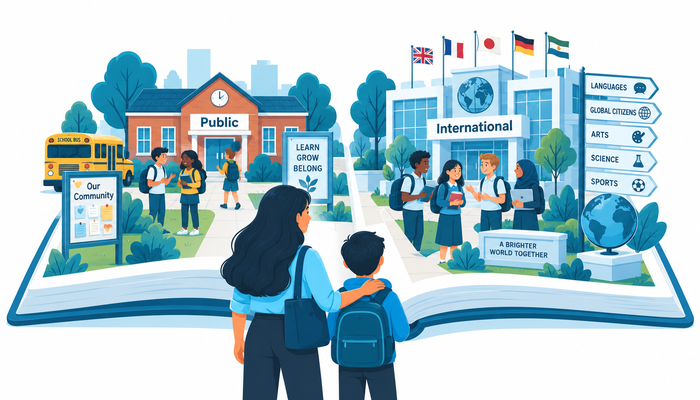
Public Schools vs International Schools: What Expat Families Should Compare
Choosing between public schools and international schools is one of the most important decisions families make after moving abroad.
At first, the comparison can look simple.
Public schools are usually cheaper and can help children integrate into the local community. International schools can provide continuity in English or another familiar language and may make future moves between countries easier.
But the real decision is more complicated.
The right school depends on the child's age, current language ability, how long the family expects to stay, whether another international move is likely, the local public system, the international curriculum available, and the household budget.
A school that is perfect for a seven-year-old family planning to remain for ten years may be a poor fit for a sixteen-year-old who expects to move again in two years.
That is why the better question is not:
“Which type of school is better?”
It is:
“Which school environment creates the strongest combination of academic continuity, social stability, language development, and future flexibility for this child?”
Public Schools Connect Children to the Local System
The main strength of public education is that children enter the same system as most local families.
That creates a direct connection to the language, community, and education structure of the country.
In Germany, the majority of schools are state-run and provide free education. School attendance is generally compulsory from around age six, while education policy is managed by the individual federal states. Germany's official guidance also recommends checking whether schools offer German-as-a-second-language support for children who are not yet fluent.
Spain similarly provides a public education pathway for children entering the national system. Primary education is compulsory, generally beginning in the calendar year when a child turns six. Children arriving from foreign education systems are placed according to factors including age, previous studies, knowledge, and individual circumstances.
For a family intending to remain long term, this local integration can be a major advantage.
The child is not only studying in the country.
They are becoming part of it.
International Schools Prioritize Educational Continuity
International schools solve a different problem.
Their biggest advantage is often continuity.
A child who has studied in English, followed the International Baccalaureate, or used another international curriculum may be able to continue with fewer academic disruptions after relocating.
That becomes particularly valuable for families that expect to move between countries.
Instead of changing from one national curriculum to another every few years, the child can remain inside a broadly familiar educational structure.
This can reduce the risk of repeating material, missing topics, or struggling with different exam systems.
It can also make the transition emotionally easier because the school community often includes many other internationally mobile families.
For a child who knows that another move may happen, that environment can feel more familiar.
Language Is Usually the Biggest Difference
For many families, the school decision is really a language decision.
A child entering public school in Germany may need to learn German quickly enough to follow lessons and participate socially.
Germany explicitly advises international parents to look for schools offering support such as German as a second language when their children are not yet fluent.
A similar issue exists in Spain, where children entering the public system may need to adapt to Spanish and, depending on the autonomous community, potentially another co-official language.
International schools may reduce that immediate language pressure if the curriculum is delivered in English or another language the child already speaks.
But there is a trade-off.
The easier the international-school environment is linguistically, the less naturally the child may acquire the local language through daily academic life.
That can affect integration outside school.
Younger Children and Teenagers May Need Different Strategies
Age changes the calculation significantly.
A young child often has more time to learn a new language and adapt academically.
For an eight-year-old family planning to remain in Germany for many years, entering a local school may offer strong long-term integration even if the first year is challenging.
A sixteen-year-old preparing for final examinations faces a different risk.
Changing language and curriculum at the same time may disrupt grades, university preparation, and confidence.
In that situation, an international school offering a familiar academic pathway may reduce educational disruption.
This is why families should avoid making one school philosophy apply automatically to all children.
Two siblings may even need different solutions.
Cost Is More Than Tuition
Public schools have a major financial advantage because state education is generally tuition-free or very low-cost.
In Germany, most state schools are free, while private and international schools charge fees.
International school tuition can therefore become one of the largest items in a family relocation budget.
But tuition is not the only cost to compare.
Families may also face registration fees, transport, meals, uniforms, extracurricular activities, technology, trips, and capital or development fees depending on the school.
Public schools can have indirect costs too.
A family may choose a more expensive neighborhood to access a particular school or pay for additional language tutoring during the transition.
The useful comparison is therefore total annual education cost, not just headline tuition.
Practical Example: Maya and Daniel Have Two Children
Imagine Maya and Daniel move abroad with children aged eight and fifteen.
The younger child knows only basic German.
The older child has already spent several years following an English-language international curriculum and expects to apply to university within three years.
Putting both children into the same school type might feel convenient.
But their needs are different.
For the eight-year-old, public school may provide enough time to become fluent in German and build strong local friendships.
The first year could be difficult, but the long-term benefit may be significant if the family plans to remain in Germany.
For the fifteen-year-old, changing both the academic curriculum and the language of instruction shortly before major exams could create more risk.
An international school may provide greater continuity.
The family therefore chooses two different paths.
That is not inconsistency.
It is child-specific planning.
Public Schools Can Accelerate Social Integration
Public schools place children directly into the local social environment.
Their classmates are likely to live nearby.
School friendships can become neighborhood friendships.
Parents may also meet local families through school events, sports, or daily routines.
This can make the entire family's integration easier.
Children sometimes become the first family members to develop strong local-language skills.
That can help them build a genuine sense of belonging.
The downside is that the early period may be uncomfortable.
A child who cannot communicate easily may initially feel isolated even when teachers are supportive.
Families should expect that integration can require time rather than assuming that immersion automatically means immediate adaptation.
International Schools Can Create a Different Kind of Community
International schools also create strong communities, but often of a different type.
Students may share the experience of having moved countries, speaking several languages, or having parents working internationally.
That can make a newly arrived child feel less unusual.
They may find classmates who understand what it is like to leave friends behind or move repeatedly.
The trade-off is that international communities can be more transient.
Friends may leave after two or three years.
Families may live across a wider geographic area instead of in the same neighborhood.
And children can sometimes remain inside an international social bubble without developing strong connections to local life.
That may matter less for a short assignment.
For a family intending to settle permanently, it deserves more thought.
Curriculum Matters More as Children Get Older
Parents sometimes compare schools mainly by reputation.
Curriculum can be more important.
Different systems prepare students for different examinations and university pathways.
A child moving into a local secondary system may eventually qualify through that country's national school-leaving credential.
An international school may instead offer the International Baccalaureate, British qualifications, an American curriculum, or another national system.
The important question is where the child is likely to study next.
If university is expected in the destination country, a local curriculum can provide a natural transition.
If the student may apply across several countries, an internationally recognized curriculum may simplify mobility.
This becomes increasingly important in the final years of secondary education.
Switching Systems Later Can Be Harder Than It Looks
Families sometimes choose a school for Year One with the assumption that changing later will be easy.
It may not be.
A child can become academically comfortable in one curriculum and socially settled with friends.
Changing systems again can introduce a second disruption.
Older students may also encounter differences in course sequencing, required subjects, or qualification structures.
This does not mean families need to predict the next ten years perfectly.
But they should think beyond the first semester.
Ask:
“If this school works, are we comfortable staying in this system for the next several years?”
That question can prevent unnecessary future transitions.
Public School Entry Can Be Simpler Than Parents Expect
Parents sometimes worry that previous foreign schooling will require a complicated recognition process before a child can join the local system.
That is not always the case.
Spain, for example, states that students arriving from foreign systems who want to enter primary or compulsory secondary education do not need formal recognition or validation of previous studies simply to enroll at those levels.
Schools instead consider factors such as the student's age, background, and academic history when placing them.
This illustrates why families should check actual enrollment rules instead of assuming that international transfer always requires a lengthy academic recognition process.
The requirements can become more complex at later educational stages.
International Schools Do Not Automatically Mean Better Education
One of the most common assumptions is that expensive international schooling must be academically superior.
Price does not prove educational quality.
International schools vary significantly.
So do public schools.
A strong public school with excellent language support may suit a child far better than an international school with impressive facilities but weak academic or pastoral support.
Families should therefore investigate the actual school.
Teacher stability matters.
Class size matters.
Language support matters.
Student turnover matters.
University counseling matters for older students.
The curriculum label alone does not tell you how well the school delivers it.
The Child's Personality Matters
Some children adapt rapidly to new environments.
Others need familiarity.
A highly social younger child may enjoy the challenge of entering a local school and learning the language through friendships.
A teenager who has already experienced several moves may value educational continuity more strongly.
A child who struggles academically may find learning complex subjects in a new language particularly demanding.
The decision should therefore include the child's own experience.
That does not mean children make the final decision.
It means parents should listen carefully to what kind of transition their child is actually facing.
What Nobody Tells You About the Decision
Parents often think they are choosing between two types of education.
In reality, they are choosing between two different integration strategies.
Public school usually pushes the child more quickly toward the local language and community.
International school usually protects more continuity with the child's existing academic and international identity.
Neither benefit is automatically more valuable.
It depends on where the family expects the child's life to be in three, five, or ten years.
This is why the family's expected length of stay matters so much.
A two-year assignment and a permanent relocation are fundamentally different school decisions.
Public vs International School Checklist
Start with the child's age, language level, current curriculum, and likely university path.
Then decide how long the family realistically expects to remain in the destination and whether another international move is likely.
Compare actual schools rather than only school categories. Look at language support, curriculum, academic outcomes, social environment, commute, student turnover, and total cost.
For younger children, give significant weight to long-term local integration.
For older students, pay closer attention to curriculum continuity and major examination years.
Finally, think several years ahead. The strongest school decision should still make sense if the family stays longer than expected.
Conclusion: Choose for the Child's Next Chapter, Not Just the First Year
Public schools and international schools solve different problems.
Public schools can provide strong local integration, language immersion, community ties, and much lower direct costs. Germany's state schools, for example, are largely free, while international and private schools charge fees. Spain also integrates children arriving from foreign systems into compulsory education according to their age, knowledge, background, and circumstances.
International schools can provide valuable curriculum and language continuity, particularly for older children or highly mobile families.
But international does not automatically mean academically stronger, just as public does not automatically mean difficult for expat children.
The most useful question is:
“Which school gives this child the best chance to remain academically confident, socially connected, and prepared for what comes next?”
For some families, that will be a local public school.
For others, it will be an international school.
And for families with children of different ages, the right answer may not even be the same for every child.
FAQ
Are public schools free for expat children?
In many European systems, public education is state-funded. Germany, for example, provides free education through most state-run schools.
Do children need to speak the local language before entering public school?
Not necessarily. Schools may offer language support, although the level of support varies. Germany recommends checking whether a school offers German as a second language for children who are not fluent.
Are international schools better for teenagers?
They can be useful when a teenager needs curriculum continuity or is close to major examinations, but the decision depends on the individual child and school.
Are international schools always expensive?
They generally charge tuition, unlike many public schools, but fees vary significantly between schools and cities.
Is public school better for learning the local language?
It usually provides much more daily immersion because students learn and socialize primarily in the local language.
Can children transfer from a foreign school into the Spanish public system?
Yes. Students entering Spanish primary or compulsory secondary education generally do not need formal recognition of previous foreign studies simply to enroll at those levels.
What should parents compare before choosing a school?
Compare language support, curriculum, age of the child, expected length of stay, university plans, social integration, commute, school quality, and total annual cost.