Moving First Alone vs Moving Together
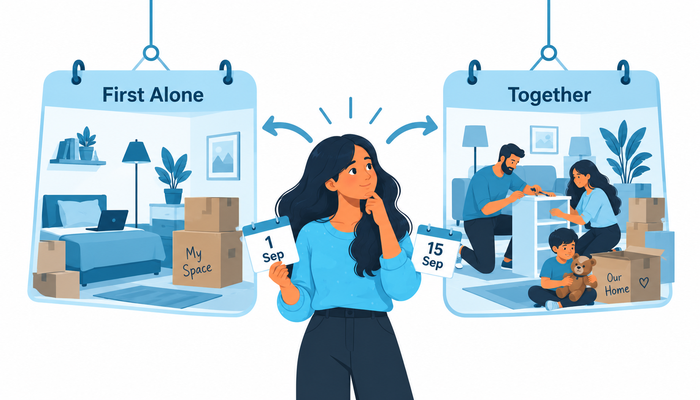
Moving First Alone vs Moving Together: Which Family Relocation Strategy Works Better?
When a family decides to move abroad, one of the earliest practical questions is whether everyone should relocate at the same time or whether one person should move first.
Both approaches can work.
Moving together keeps the family united and allows everyone to begin the new chapter at once. Moving first alone can reduce logistical pressure because one person has time to start the job, understand the city, secure housing, and prepare for the rest of the family.
The mistake is treating this as a purely emotional choice.
It is really a coordination decision involving immigration timing, finances, housing, schools, childcare, careers, and the family's ability to manage uncertainty.
The better question is not:
“Which option is easier?”
It is:
“Which option creates the most stable transition for this specific family?”
Moving Together Creates One Shared Transition
The biggest advantage of moving together is obvious: the family does not need to separate.
Everyone begins adapting at the same time.
Children enter school together with the rest of the relocation process. The spouse does not spend months waiting in another country. The main applicant does not have to manage a new job while also maintaining a second household from a distance.
Emotionally, this can make the move feel more like a family decision.
No one is “already living the new life” while someone else is still waiting behind.
That sense of moving forward together can be valuable, especially for families that find separation difficult.
But shared timing also means shared pressure.
Everything starts at once.
The First Month Is Much Harder When Everyone Arrives Together
A family arriving together may need to handle immigration formalities, permanent housing, school enrollment, childcare, banking, healthcare, transport, furniture, and a new work schedule within a very short period.
That can be exhausting.
The main applicant may begin a demanding new job only days after arrival while the rest of the family still needs help navigating the city.
The spouse may not yet speak the language confidently.
Children may be emotionally unsettled.
Even basic tasks can take longer because nobody in the household understands how the system works yet.
This does not mean moving together is a poor choice.
It means the family needs a much stronger arrival plan.
The first weeks should be treated as an intensive setup period rather than a normal routine.
Moving First Alone Reduces Operational Risk
When one person relocates first, they can solve several high-pressure problems before the rest of the family arrives.
They can start work.
They can understand the commute.
They can see neighborhoods in person.
They can identify schools, supermarkets, healthcare providers, transport connections, and realistic housing options.
Most importantly, they can discover which assumptions were wrong before the entire family has to live with those mistakes.
That can make the second stage much smoother.
A neighborhood that looked perfect online may turn out to be impractical.
A commute may be much worse than expected.
A temporary apartment may not be suitable for children.
Discovering those things alone is inconvenient.
Discovering them after moving an entire family is much more disruptive.
Practical Example: Amir Moves Three Months Before His Family
Imagine Amir receives a job offer in Germany with a start date in September.
His spouse and two children could theoretically move at the same time.
Instead, Amir moves first.
For the first month, he stays in temporary accommodation and focuses on the new job.
During evenings and weekends, he visits neighborhoods and learns how long the commute actually takes.
He realizes that one area they were considering has cheaper rent but poor transport to both his office and the schools they like.
He finds another neighborhood that costs slightly more but reduces daily travel significantly.
By the time his family arrives, the long-term apartment is ready, the school options are clearer, and basic registration and banking are already understood.
The staged move costs the family more because they temporarily maintain two households.
But it also removes much of the uncertainty from the children's arrival.
In this case, moving first alone may be worth the additional cost.
A Staged Move Can Be Much More Expensive
The financial disadvantage of moving separately should not be underestimated.
For a period, the family may have two housing costs.
There may be additional flights.
The main applicant may need temporary accommodation abroad while continuing to pay rent or a mortgage at home.
Food, transport, and utilities may also be duplicated.
If the separation lasts longer than expected, these costs can become substantial.
That is why staged relocation works best when the family has a clear purpose and a realistic timeline.
“Move first and see what happens” is not a strong plan.
“Move first for eight to twelve weeks to start work and secure family housing” is much more manageable.
The first mover should know exactly what needs to be completed before the rest of the family follows.
Family Visa Timing Can Decide the Question for You
Sometimes the choice is not entirely personal.
Immigration procedures can make a staged move necessary.
The main applicant may be able to enter under a work route before the spouse or children complete their family residence or reunification process.
In other cases, the family may already be eligible to apply together.
The exact rules depend on the destination and the main applicant's status.
Germany, Spain, Italy, and other European countries use different family residence structures, so current official rules should always be checked for the specific route.
This can affect not only whether the family can travel together, but also when a spouse receives work rights and when children can complete local registration.
Immigration timing should therefore be mapped before booking flights or ending leases.
Moving Together Can Be Better for Children
For some children, moving together can create greater emotional security.
Their parents are experiencing the transition with them.
There is no extended period where one parent is absent and the family is uncertain about when everyone will reunite.
This can be especially important for younger children or families where separation would create significant stress.
The family can also establish the new routine together.
School begins.
The new home becomes familiar.
The children see both parents adapting.
That shared adjustment can make the relocation feel more stable.
However, this benefit depends on how prepared the adults are.
If everyone arrives into temporary housing with no clear school plan and high financial stress, moving together may actually create more uncertainty for the children.
Moving First Can Be Better Around School Calendars
A staged relocation can also make sense when children are in the middle of an academic year.
The main applicant may start the new job earlier while the children finish a school term or year before joining.
This can reduce educational disruption.
It also gives the first mover time to understand school enrollment requirements and decide whether the family should use the local public system, a bilingual option, or an international school.
The child's age matters.
A six-year-old moving mid-year may adapt differently from a teenager preparing for important examinations.
This is why the school calendar should be part of the relocation timeline rather than something families deal with after choosing the flight date.
The Spouse's Career Can Push the Decision in Either Direction
The second adult's career is another major factor.
If the spouse is already working remotely and can continue after relocation, moving together may be straightforward.
If they need several months to finish a project, transfer internally, obtain qualification recognition, or prepare language skills, a staged move may protect their career.
The opposite can also be true.
If the spouse needs to start building a local network and job search quickly, delaying their move may slow down their career unnecessarily.
Families should therefore avoid assuming that the main applicant's job automatically determines everyone's schedule.
Sometimes the spouse has equally important professional timing.
A strong relocation plan looks at both careers.
Separation Creates an Emotional Cost That Is Easy to Underestimate
Moving first alone may look efficient on a spreadsheet.
Emotionally, it can be difficult.
The first mover is dealing with a new country, a new job, and administrative stress without the usual family support.
The spouse remaining behind may be handling children, work, packing, documents, and the emotional pressure of the upcoming move alone.
Both people can feel that the other person's situation is easier.
That can create resentment.
Communication therefore becomes part of the relocation strategy.
The family should agree on the expected separation period, responsibilities, budget, visit schedule if relevant, and what conditions need to be met before reunification.
A staged move works much better when everyone knows that the separation has a defined purpose.
Housing Is the Strongest Argument for Moving First
Housing is one of the areas where being physically present can make a major difference.
Photos rarely tell you everything.
You may need to understand noise, public transport, school routes, building quality, neighborhood safety, shops, and commute patterns.
In competitive rental markets, landlords may also expect local documents, proof of employment, or in-person viewing.
A first mover can solve those problems before the family arrives.
That can prevent children from spending weeks or months moving between temporary accommodations.
For families with several children or significant furniture and belongings, this advantage can be substantial.
But Moving Together Can Prevent a “Temporary” Setup From Becoming Permanent
There is also a risk with sending one person ahead.
The first mover may optimize everything around their own routine.
They choose an apartment close to their office.
They become comfortable with the city.
They develop habits that work perfectly for one adult.
Then the family arrives and discovers that the home, neighborhood, or daily schedule is not actually suitable for them.
This is why the spouse should remain actively involved in decisions even when living elsewhere.
Housing video calls, shared neighborhood research, school comparisons, and joint budgeting help prevent the first stage from becoming an individual relocation plan.
The person who moves first is preparing the family's life.
Not just their own.
Moving Together Usually Requires More Savings Up Front
When everyone relocates at once, the family often needs to pay more immediately.
Flights for several people, larger temporary accommodation, housing deposits, furniture, school costs, transport, and household setup can occur within the same few weeks.
That creates intense cash-flow pressure.
A staged move spreads some costs across time.
But it can increase the total cost because of duplicate housing and travel.
Families should therefore compare two financial questions.
How much money is needed immediately?
And how much will the entire relocation cost by the time everyone is settled?
These are not always the same.
What Nobody Tells You About Moving First Alone
The biggest risk is that there is no natural end point.
The main applicant moves first because it seems practical.
Then housing takes longer.
The job probation period feels uncertain.
The school decision is delayed.
One month becomes three.
Three becomes six.
Meanwhile, the family is living between two lives.
That is why a staged move needs a deadline and clear completion criteria.
For example:
Once long-term housing is secured, the main applicant has completed the first month at work, and the children's school arrangement is confirmed, the family moves.
Without criteria like these, temporary separation can drift.
What Nobody Tells You About Moving Together
The biggest risk is expecting the family to become functional too quickly.
Relocation can feel chaotic even when everything is going well.
The children may not like school immediately.
The spouse may not find work quickly.
The apartment may still be half empty.
The main applicant may be exhausted from the new job.
That does not necessarily mean moving together was the wrong choice.
It may simply mean everyone is adapting simultaneously.
Families choosing this route should protect the first two or three months from unrealistic expectations.
The goal is stability first.
Optimization comes later.
How to Choose Between the Two
Moving first alone tends to work better when housing is difficult to secure remotely, the main applicant's job starts before the family's immigration process is complete, children can benefit from finishing a school term, or the family has enough savings to support a temporary two-household period.
Moving together can be stronger when separation would create significant emotional strain, family visas are ready at the same time, suitable housing is already secured, school arrangements are clear, and the spouse or children need to begin their own transition immediately.
Neither approach is automatically more responsible.
The right option depends on which type of risk the family is better equipped to handle.
Moving together concentrates the difficulty into one intense transition.
Moving first alone spreads the transition over time but creates separation and duplicate logistics.
Relocation Decision Checklist
Before choosing, map the immigration timeline for every family member.
Then compare confirmed housing, school timing, both adults' careers, available savings, and how long the family could realistically manage separation.
If one person moves first, define what they need to accomplish and set a target reunion date.
If everyone moves together, prepare temporary housing, school research, healthcare, finances, and the first weeks of daily life before departure.
In both cases, keep enough emergency savings to handle a delayed job, housing problem, or change of plan.
Conclusion: Choose the Transition Your Family Can Manage
There is no universal answer to whether you should move first alone or move together.
Moving first can make the practical side of relocation much easier.
It can give one person time to start work, understand the city, secure housing, and prepare for schools before the rest of the family arrives.
Moving together avoids separation and allows the household to begin adapting as one unit.
But it also means everyone experiences the uncertainty at the same time.
For Germany, Spain, Italy, or another destination, family residence and visa timing can materially affect which option is possible, so the current official rules for the specific immigration route should always be checked before fixing the relocation schedule.
Beyond the legal requirements, ask a more practical question:
“Which version of the move gives our family enough emotional, financial, and logistical capacity to handle the first six months?”
That is usually the better guide.
FAQ
Is it better to move abroad alone first or with the whole family?
It depends on housing, immigration timing, schools, finances, careers, and how well the family can handle temporary separation.
How long should one person move ahead before the family joins?
There is no universal period, but a staged move works better when it has a clear purpose, target timeline, and specific conditions for family arrival.
What are the main advantages of moving first alone?
The first mover can start work, understand the city, secure long-term housing, research schools, and solve administrative problems before the family arrives.
What are the disadvantages of moving first alone?
The family may face separation, duplicate housing costs, extra travel, and the emotional stress of temporarily maintaining two households.
What are the advantages of moving together?
The family stays united and everyone begins adapting to the new home, school, language, and routines at the same time.
Is moving together more expensive?
It often requires more money immediately because flights, larger housing, deposits, and family setup costs happen at once. A staged move can cost more overall if two households must be supported for several months.
What should families check before deciding?
Check immigration timing, housing, children's school schedule, both adults' careers, finances, healthcare, and how long the family can comfortably manage separation.