Family Reunification vs Independent Migration
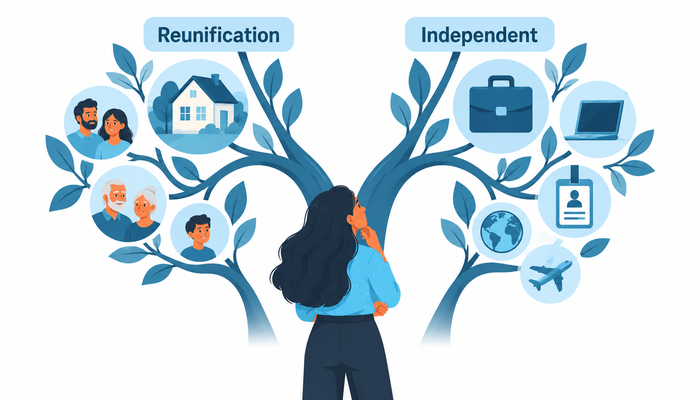
Family Reunification vs Independent Migration: Which Path Creates More Flexibility?
When one person in a family already has a legal pathway abroad, the other family member often faces a strategic choice.
Should they move through family reunification, using the spouse or partner's residence status as the basis of the application?
Or should they build an independent migration path through work, study, business, or another route of their own?
At first, independent migration can sound stronger because it appears to offer more autonomy. Family reunification can sound more dependent because one person's residence initially exists because of the family relationship.
But the real comparison is more complicated.
A family route may give a spouse broad work rights without requiring them to secure an employer before arrival. An independent work route may create more personal control over immigration status but require months of job searching, qualification recognition, or employer support before the move is even possible.
The better question is therefore not:
“Which route is more independent?”
It is:
“Which route gives this person the strongest combination of legal stability, career access, financial security, and future flexibility?”
Family Reunification Starts With an Existing Relationship
The basic advantage of family reunification is that the applicant does not need to create an entirely separate reason for migration.
The family relationship becomes the foundation of the residence route.
For example, a spouse joining a qualifying skilled worker in Germany can generally obtain a family reunification residence permit if the relevant conditions are met. Once that permit is issued, the spouse is entitled to work in Germany without restriction.
Spain's general family reunification system similarly creates a residence route for qualifying family members of a foreign resident.
This can remove one of the biggest barriers in independent migration: needing to qualify through your own job, university admission, or business before moving.
That advantage can be especially valuable when one partner already has a strong residence pathway and the second partner wants time to rebuild a career after arrival.
Independent Migration Requires Your Own Legal Basis
Independent migration works differently because your right to move does not primarily depend on the family relationship.
You might qualify through skilled employment, university admission, self-employment, entrepreneurship, or another residence category.
That can create greater immigration independence from the beginning.
If your spouse changes jobs, your own residence status may be unaffected because you are staying under your own legal route.
But the cost of that independence is usually more preparation.
A work pathway may require an employer, qualification recognition, salary conditions, or professional licensing. A study route may require admission, tuition, financial proof, and a clear academic reason for the move.
So independence should not be confused with simplicity.
The more autonomous route can also be the harder route to activate.
Family Reunification Can Be Better for Career Access Than People Expect
One of the most common assumptions is that a family permit creates weak career rights.
That is not always true.
In Germany, the spouse of a qualifying non-EU resident can receive unrestricted employment rights once the family residence permit is issued.
Spain's current framework for relatives of Spanish citizens also allows qualifying family members to work as employees or self-employed workers without needing a separate work authorization.
This creates an important strategic advantage.
A spouse may be able to move first and then search for work locally without needing an employer to create the immigration pathway.
That can sometimes provide more job-market flexibility than an independent employer-linked visa.
The legal route may be family-based, but the career search after arrival can still be highly independent.
Practical Example: Maya Has Two Ways to Move
Imagine Maya's spouse receives a strong engineering job in Germany.
Maya works in digital marketing.
She now has two possible strategies.
She could try to secure her own German job before the move and qualify independently through employment.
That would give her an individual employment-based residence structure, but she would need to convince an employer to hire her internationally before relocation.
The other option is joining her spouse through family reunification, receiving the relevant residence permit, and then entering the German labor market with unrestricted work rights.
In that situation, family reunification may actually give Maya more freedom during the job search.
She can evaluate several employers after arrival rather than making the entire move dependent on the first company willing to hire her from abroad.
That does not mean the family route is always stronger.
It means “dependent visa” can be a misleading description of the real career situation.
The Main Weakness Is Initial Residence Dependency
The major concern with family reunification is that the applicant's legal status initially exists because of a family relationship.
That can feel uncomfortable, especially for someone who has always been professionally and financially independent.
The concern becomes more important if the relationship later ends.
Countries therefore have rules that can allow family members to move toward an independent residence status after certain conditions are met.
Spain provides a clear example. A spouse or partner holding residence through family reunification can currently obtain an independent residence and work authorization after at least one year under the family reunification permit if they meet certain financial, employment, or self-employment conditions. Separate provisions can also apply after relationship breakdown in qualifying circumstances.
This shows why the word “dependent” should be treated carefully.
A family-based route may begin through the relationship but still contain pathways toward personal residence independence later.
Germany Also Provides a Route Toward Greater Independence
Germany offers another example of how family-based residence can evolve.
A spouse who joined a skilled worker can, under current rules, become eligible for their own settlement permit after meeting requirements including at least three years with a residence permit, at least 20 hours of weekly employment, B1 German, and other conditions, provided the skilled-worker spouse has the relevant settlement status.
A settlement permit then gives the holder permanent residence rights and broad freedom to work as an employee or self-employed person.
This is an important planning point.
Family reunification should not always be evaluated only by how dependent the first permit looks.
You should also ask what the route becomes after two, three, or five years.
The long-term structure may be much more independent than the first residence card suggests.
Independent Migration Can Protect Against Relationship Risk
There is still a strong argument for an independent route when it is realistically available.
If both partners have strong professional profiles, separate immigration pathways can reduce the extent to which one person's residence depends on the relationship.
That can matter in cases involving separation, divorce, or major changes in the sponsor's residence status.
It can also create psychological independence.
Someone with their own work-based residence may feel more comfortable making career or personal decisions because their immigration status is not initially linked to their spouse.
But that independence has to be weighed against the real cost of obtaining it.
If building a separate route requires delaying the family move by a year, paying tuition for an unnecessary degree, or accepting a poor job simply to get sponsorship, the theoretical independence may not justify the practical cost.
Do Not Use Education Only to Avoid a Family Route
This is one of the most important mistakes to avoid.
Some people dislike the idea of moving through a spouse and decide they need a student visa instead because it feels more independent.
That can be an extremely expensive way to solve an emotional concern.
A degree should be chosen because it improves your career, not because you want your own residence category.
If the family route already gives you the right to work, and you do not genuinely need further education, paying tuition and losing income for another degree may weaken rather than strengthen your long-term position.
Immigration independence is valuable.
But it should be created efficiently.
Sometimes the better strategy is to use family reunification first, enter the labor market, and move toward an independent status later.
Employer-Based Independence Has Its Own Dependency
An independent work visa may look completely autonomous compared with family reunification.
But that is not always true in practice.
You may simply be replacing dependence on a spouse with dependence on an employer.
If your residence depends on qualifying employment, losing the job can create immigration pressure.
This is why “independent migration” should not automatically be interpreted as “independent from everyone.”
A family-based permit with unrestricted work rights can sometimes create greater employment flexibility than a residence status tied closely to one company.
The right comparison is not relationship dependence versus total freedom.
It is the type of dependency each pathway creates.
Financial Risk Can Be Lower With Family Reunification
Family reunification can also reduce the financial risk of the second migration.
If one spouse has already secured employment and established housing, the joining partner may not need to fund a completely separate relocation strategy.
The household may already have income, health coverage, accommodation, and local knowledge.
An independent path can require separate application costs, qualification procedures, tuition, job-search savings, or business capital.
This does not mean the family route is cheap.
The household may need larger housing, more insurance coverage, and enough income to meet family-related requirements.
But the second family member may enter a system that is already partly established.
That can make the transition considerably less risky.
Family Reunification Can Be Weak if the Sponsor's Route Is Weak
The family route is only as strong as the legal structure supporting it.
If the main applicant has a highly stable residence status and a strong career, family reunification may be straightforward and secure.
If the sponsor's own position is uncertain, temporary, or financially fragile, the spouse may inherit some of that uncertainty.
For example, a household relying entirely on one job can become vulnerable if the employer relationship ends.
That is why family reunification should still include a Plan B.
The joining spouse should gradually build language, career access, savings, and local professional experience.
The goal should be increasing independence after arrival rather than remaining permanently dependent on one person's career.
Career Timing Can Decide the Better Route
The strongest route may depend on where each partner is professionally.
Suppose one spouse is already an experienced software engineer with international employer demand.
An independent work route may be relatively easy and worthwhile.
Now imagine the spouse has several years of professional experience but works in a field where local language is essential and international hiring from abroad is uncommon.
Family reunification may give that person a much better transition.
They can move first, improve the language locally, learn the job market, and apply without needing an employer to support the initial immigration process.
Neither person is more qualified.
Their labor-market situation is simply different.
That is why couples should not insist on using the same type of migration pathway for both partners.
What Nobody Tells You About Family vs Independent Migration
The most independent-looking visa is not always the route that gives you the most freedom after arrival.
A work visa can be tied to employment.
A student route can restrict how much you work.
A family permit may sometimes allow broad access to employment.
The visa label therefore tells only part of the story.
You need to compare what each residence status actually allows you to do.
Can you work freely?
Can you change employers?
Can you become self-employed?
What happens if the relationship or job ends?
When can you qualify for a more permanent status?
Those questions reveal the real level of independence.
Family Reunification vs Independent Migration Checklist
Family reunification deserves serious consideration when one partner already has a stable qualifying residence status, the family route provides useful work rights, and building a separate immigration case would add unnecessary cost or delay.
Independent migration can be stronger when the second partner already has a compelling job, study, or business pathway and wants their legal status to stand separately from the family relationship.
In both cases, compare the route after arrival rather than only at entry.
Look at work rights, employer flexibility, career access, financial risk, relationship dependency, and the route toward permanent or independent residence.
The strongest option should increase the person's freedom over time.
Conclusion: Independence Is About the Long-Term Structure
Family reunification and independent migration are not simply “dependent” versus “independent” visas.
The reality is more nuanced.
Family reunification can allow a spouse to move without first securing their own employer and, in countries such as Germany, can provide unrestricted access to employment after the residence permit is issued. Spain also provides pathways through which reunited family members can later obtain an independent residence and work authorization.
An independent migration route gives the applicant their own legal basis from the beginning, but it may require substantially more preparation and can create another form of dependency if the residence status is closely connected to one employer.
The better question is not:
“Which visa makes me look more independent?”
It is:
“Which route gives me the strongest ability to build my own career, income, residence security, and choices over the next several years?”
For Germany, Spain, Italy, or any other destination, family and independent residence rules can change and can vary depending on citizenship, residence status, and relationship type. Current official requirements should always be verified before making a final decision.
FAQ
Is family reunification less independent than a work visa?
Not necessarily. Some family residence permits provide broad work rights, while some employment permits create significant dependence on a specific job or employer.
Can I work after moving through family reunification?
Often, yes. In Germany, spouses joining qualifying non-EU residents can work without restriction once the family residence permit is issued.
Can family-based residence become independent later?
Yes, in some countries. Spain currently provides an independent residence and work authorization for qualifying family-reunified spouses or partners after certain conditions are met.
Can a spouse get permanent residence in Germany after family reunification?
Under current rules, spouses of skilled workers can qualify for their own settlement permit after meeting requirements including residence duration, employment, language, and other conditions.
Is it better to get my own work visa instead of joining my spouse?
It depends on how strong your independent job pathway is, how long it would take, and what work and residence rights the family route provides.
Should I study abroad just to avoid a family-based visa?
Usually, education should solve a real academic or career need. Choosing an unnecessary degree only to obtain a separate residence category can create substantial financial and opportunity costs.
What should couples compare before choosing between the two routes?
Compare work rights, employer dependency, financial cost, time to move, relationship dependency, career flexibility, and the pathway toward independent or permanent residence.