Planning an International Move as a Family
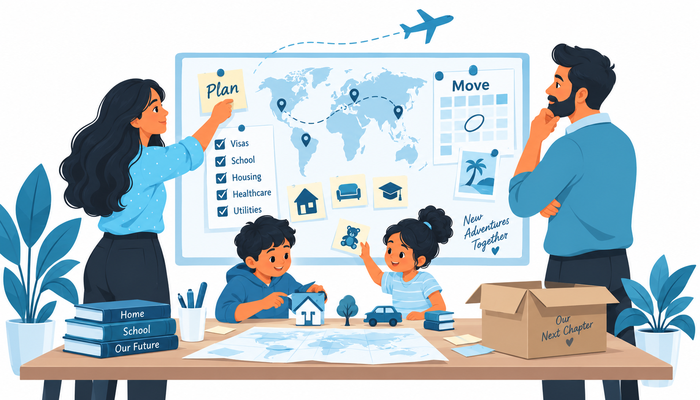
Planning an International Move as a Family: A Practical Relocation Framework
Planning an International Move as a Family
Planning an international move as a family is very different from planning one as an individual.
When one person moves alone, most decisions can be optimized around that person's job, visa, housing, budget, and preferences. A family move has more moving parts. One person's opportunity can affect another person's career, a child's education, the household budget, housing needs, language learning, healthcare access, and the family's ability to adapt emotionally.
That is why a family relocation should not be built around one question such as:
“Can the main applicant get a visa?”
The stronger question is:
“Can the whole household function well after the move?”
That shift changes the way you choose countries, compare cities, evaluate jobs, calculate savings, and decide when each family member should relocate.
Start With the Family Outcome, Not the Visa
The first step is to define what the move is supposed to improve.
Perhaps the main goal is career growth for one parent. Maybe the family wants better long-term stability, a stronger education environment for the children, or access to a specific professional market.
The problem begins when those goals are left vague.
If one person wants a major career upgrade while the other wants to protect their existing career, the family needs to acknowledge that tension early. If the children are approaching an important school stage, timing may matter more than salary. If the household depends heavily on two incomes, the spouse's work rights and realistic employability may become more important than the main applicant's job offer.
A good family migration plan therefore starts with priorities.
What matters most in Year One? What matters most after three years? Which compromises are temporary and which would be unacceptable?
Without those answers, it is easy to choose a destination that looks strong on paper but does not fit the family as a whole.
Build Two Career Plans, Not One
One of the most common mistakes is building the entire move around the main applicant's job.
That makes sense at first because the move may be possible only because one person has a work visa, skilled-worker route, or strong job offer.
But the spouse's career still matters.
Legal permission to work and realistic ability to find work are not the same thing.
A spouse may have full work rights and still face language barriers, professional recognition issues, a narrow local job market, or a need to rebuild their network from zero.
This is especially important in countries such as Germany, Spain, and Italy, where the local language can significantly affect the size of the job market even when the main applicant works in English.
The family should therefore ask two separate questions:
What does the main applicant need to succeed?
and:
What does the spouse need to remain professionally independent?
That makes the move more balanced.
Practical Example: One Strong Job Can Still Create a Weak Family Plan
Imagine Amir receives an engineering offer in Germany.
The salary is good, the company is stable, and the role is a clear professional step.
His spouse, Maya, works in communications and has six years of experience.
At first, the family focuses on Amir's offer because it solves the immigration problem.
Then they begin researching the city.
They discover that Amir's industry is strong there, but Maya's field has fewer employers. Most local communications roles also expect strong German.
The move may still make sense, but the family now sees the trade-off clearly.
They can plan for Maya to improve German before moving, target international employers, explore remote roles, or accept that her career may take longer to restart.
That is very different from arriving and discovering the problem after the move.
A good family plan does not eliminate trade-offs.
It makes them visible before they become stressful.
Build the Budget Around Confirmed Income
A family relocation budget should be conservative.
One of the most dangerous assumptions is that both adults will earn income shortly after arrival.
That may happen.
But it should not be necessary for the plan to survive.
The safer approach is to build the first several months around confirmed income only.
If the spouse finds work quickly, that becomes financial upside rather than a rescue mechanism.
This matters because family expenses rise in ways that are not always obvious before moving.
A larger home costs more. Deposits are higher. Groceries, transport, school-related expenses, insurance, and household setup add up quickly.
The family may also face temporary double costs if one parent moves first while the rest of the family remains behind.
The move should therefore be financially sustainable even if the transition takes longer than expected.
Separate Relocation Costs From Emergency Savings
Families often underestimate how much money disappears before normal life even begins.
Flights, deposits, temporary accommodation, furniture, transport passes, school supplies, documentation, and basic household setup can consume a significant amount of savings.
Those expenses should be budgeted separately from the emergency reserve.
The emergency fund is for what happens after the move if something goes wrong.
A job ends.
A spouse takes longer to find work.
The family needs to change housing.
A medical or travel expense appears unexpectedly.
If relocation costs consume the entire savings buffer, the household arrives financially fragile.
That can force the family into poor decisions later.
Financial flexibility is one of the strongest forms of relocation security.
Housing Should Be Chosen Around Daily Life
Families often compare housing mainly by price.
But the cheapest home is not always the cheapest lifestyle.
A house far from work and school can create long commutes, higher transport costs, and less family time.
A more expensive neighborhood may allow children to walk to school, reduce childcare logistics, and shorten both parents' commute.
That can be worth the difference.
The best way to test a neighborhood is to simulate a normal weekday.
Who takes the children to school?
How long does each parent travel?
Can the spouse reach potential employers?
Is childcare nearby?
How easy is it to reach healthcare, supermarkets, or public transport?
These questions reveal whether the home actually supports the family's routine.
Schooling Can Change the Entire Relocation Timeline
Children's education should be researched much earlier than many families expect.
A school system may look excellent overall but still create practical challenges.
Instruction may be in the local language. Enrollment may be linked to residence address. International schools may be expensive. Older children may struggle more with a language transition than younger children.
Timing matters as well.
Moving halfway through an academic year may be manageable for one child and deeply disruptive for another.
This is why school planning can influence when the family moves, which city they choose, and even whether the relocation happens in one stage or two.
The best school is not always the most prestigious one.
It is the one the child can realistically enter and adapt to.
Language Should Be Planned for Every Family Member
Language needs are different inside the same household.
The main applicant may work in English.
The spouse may need the local language to find work.
Children may learn quickly through school.
One parent may end up handling almost every administrative task because they become the strongest speaker.
That can create dependence inside the family.
A better approach is to treat language as a household project.
Adults should have their own learning plan rather than relying on the working spouse or eventually on the children.
In Germany, Spain, or Italy, local-language ability can affect employment, medical appointments, school communication, social integration, and everyday independence.
The family does not need to reach the same level at the same speed.
But everyone should have a realistic plan.
Healthcare Should Be Understood Before Arrival
Families also need to understand when healthcare coverage begins and what is required before that point.
The main applicant may be covered through employment, but that does not automatically mean every family member is covered from the first day under every immigration route.
There may be registration steps, waiting periods, private coverage requirements, or documents that need to be submitted after arrival.
This is especially important for families with young children, ongoing medication needs, or regular medical appointments.
Healthcare planning should therefore happen before the flight, not after someone needs a doctor.
Decide Whether the Family Should Move Together
There are two common relocation strategies.
The first is moving together.
This keeps the family united and allows everyone to begin adapting at the same time.
But it creates a high-pressure first month. Housing, school, work, healthcare, and administrative tasks all need to function quickly.
The second is a staged move.
The main applicant moves first, begins work, secures long-term housing, learns the city, and prepares for the family's arrival.
That can reduce logistical risk.
The trade-off is temporary separation and the financial cost of supporting two locations.
Neither option is automatically better.
The decision depends on the children's ages, job start date, family visa timing, budget, housing, and how quickly the main applicant expects to become stable.
Agree on Career Sacrifice Before the Move
Most family relocations involve some imbalance.
One person's career may accelerate while the other's slows down temporarily.
The problem is not necessarily the imbalance.
The problem is failing to talk about it.
If one partner agrees to pause a career for a year, the family should also discuss what support will help that person restart.
Will the budget include language classes?
Professional certification?
Childcare that creates time for job searching?
Networking?
A planned reassessment after six or twelve months?
Temporary sacrifice feels very different when there is a visible path back to independence.
Without that plan, frustration can build quickly.
Build a First 90 Days Plan
The first three months should be treated as a stabilization phase rather than a period when everything needs to become perfect.
The priority is getting the household functional.
That means completing residence formalities, stabilizing housing, establishing school and childcare routines, understanding healthcare, setting up banking and transport, and creating a realistic weekly rhythm.
Career optimization can continue during this period, but the family should not expect every part of the move to work immediately.
A family that arrives expecting instant stability can interpret normal adjustment as failure.
A family that expects a transition period is usually better prepared emotionally.
What Nobody Tells You About Family Relocation
The hardest part is often not immigration.
It is synchronization.
One family member may adapt quickly while another struggles.
The main applicant may love the new job while the spouse feels professionally isolated. One child may become comfortable at school while another misses home intensely.
That does not automatically mean the move was a mistake.
It means families do not adapt at the same speed.
The better way to judge the move is to look at direction rather than perfection.
Are people becoming more stable?
Is the spouse gaining more independence?
Are the children building routines and relationships?
Is the household becoming less financially fragile?
If the answer is gradually yes, the transition may be working even when it still feels difficult.
Create a Family Plan B
A good international move should include alternatives.
What happens if the main job ends?
What if the spouse cannot find work for a year?
What if housing becomes unaffordable?
What if a child struggles badly in the school system?
The answer does not need to be dramatic.
Plan B may mean moving to another city, changing employers, delaying a major purchase, switching schools, or returning temporarily.
The point is to know what the family would do before a stressful situation forces the decision.
A family with alternatives feels much less trapped.
Family Relocation Checklist
Before moving, confirm the residence and work rights of every family member and verify current requirements through the relevant official sources.
Build two career plans when both adults want to work.
Create a budget based on confirmed income and keep relocation costs separate from emergency savings.
Research housing and schools together because one affects the other.
Plan language learning for each family member and understand how healthcare coverage will work from the first day.
Then decide whether moving together or in stages creates the stronger transition.
Finally, set a date to review the move after six or twelve months using practical measures such as employment, finances, school adjustment, language progress, and daily quality of life.
Conclusion: Plan the Household, Not Just the Move
A successful family relocation is not simply one person receiving a visa and everyone else following.
It is a coordinated household transition.
The main applicant needs a sustainable career.
The spouse needs a path toward independence.
The children need a realistic school and social transition.
The family needs housing that supports everyday life, enough financial runway to absorb uncertainty, and a plan for language, healthcare, and unexpected problems.
For Germany, Spain, Italy, or any other destination, family residence, work rights, schooling, healthcare, and immigration conditions can vary by route and change over time. Current requirements should always be verified through official authorities before making major commitments.
But the broader planning principle does not change.
Do not ask only:
“Can we move there?”
Ask:
“Can each member of the family build a stable life there after we arrive?”
That is the question that turns an international move into a sustainable family plan.
FAQ
What should a family plan first before moving abroad?
Start with the household goals, immigration status of each family member, finances, spouse career options, schooling, and housing.
How much savings should a family have before relocating?
The amount depends on destination and family size, but savings should cover relocation costs, several months of living expenses, and a separate emergency fund.
Should families rely on two incomes after moving?
It is safer to build the initial budget around confirmed income only and treat the second income as additional security once it begins.
Should the whole family move at the same time?
Not always. Some families benefit from moving together, while others prefer a staged move so the main applicant can establish housing and stability first.
How important is the spouse's career in the relocation plan?
Very important. Legal work rights do not guarantee easy employment, so language, recognition, local job demand, and networking should be researched early.
When should families research schools?
Before committing to a city or neighborhood. School language, enrollment rules, location, and the child's age can influence the entire relocation strategy.
What is the biggest mistake families make when planning an international move?
A major mistake is designing the move around the main applicant's job while treating the spouse's career, children's needs, household finances, and long-term stability as secondary.