How Family Reunification Visas Work
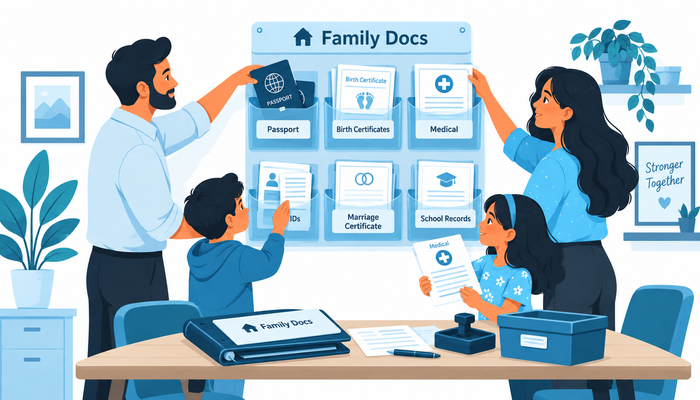
How Family Reunification Visas Work: A Practical Guide for Families Moving Abroad
Family reunification is one of the most important immigration pathways because it deals with something broader than work or study: keeping families together after one person moves abroad.
The basic idea sounds simple. One family member is already legally living in another country, and their spouse, partner, children, or in some cases other dependent relatives want to join them.
But the process is not simply, “My family member lives there, so I can move too.”
Family reunification usually depends on three things working together: the status of the person already living in the country, the legal relationship between the family members, and the financial or practical conditions required by the destination.
That is why the right starting question is not:
“Can my family join me?”
It is:
“Under my current residence status, which relatives can join me, under what conditions, and what happens after they arrive?”
The Sponsor's Residence Status Comes First
Family reunification normally begins with the person who is already living in the destination country.
Their immigration status determines which family reunification rules apply.
A skilled worker, EU Blue Card holder, long-term resident, citizen, student, or self-employed resident may not all have exactly the same family rights.
This is especially important in Europe because family reunification with an EU citizen, a national citizen, or a non-EU resident can fall under different legal frameworks.
In Germany, for example, spouses and children can generally join qualifying residents, but the exact rules depend partly on the nationality and residence status of the person already living there. Spouses of non-EU residents who require a visa generally apply for a family reunification visa and then obtain a residence permit after arrival. Once the spouse receives the residence permit, they are entitled to work in Germany without restriction.
This means family planning should begin at the same time as the main applicant's immigration planning, not after the move has already happened.
Who Counts as a Family Member?
The answer varies by country and route, but spouses and minor children are usually at the center of family reunification.
Some systems also recognize registered partners, long-term partners, dependent adult children, or dependent parents.
Spain's current general family reunification framework allows eligible foreign residents to apply for reunification with a spouse or qualifying partner, children, certain other dependent minors or persons with disabilities, and in some circumstances dependent parents. The conditions differ depending on the relationship.
Italy similarly allows reunification with categories including a non-separated spouse aged at least 18, minor children, certain dependent adult children with serious health-related dependency, and qualifying dependent parents.
The important lesson is not to assume that every person you consider “family” automatically qualifies under immigration law.
The legal definition matters.
Marriage Is Not Always the Only Recognized Relationship
Another misconception is that family reunification is available only to married couples.
Some countries recognize registered partnerships or other relationships that can be proven as equivalent to marriage.
Spain, for example, recognizes a spouse as well as certain partners in relationships equivalent to marriage, including registered partnerships and, under specified conditions, stable unregistered relationships that can be sufficiently proven.
Germany also recognizes registered civil partnerships in the context of spouse or partner reunification.
This matters because the evidence required can differ.
A marriage certificate may be straightforward. A non-marital partnership may require more evidence about the duration and reality of the relationship.
The relationship should therefore be researched from the legal perspective of the destination, not only from the couple's personal definition.
Children Often Have Their Own Rules
Children are not always processed under exactly the same conditions as spouses.
In Germany, minor children can generally join a parent who has a qualifying right of residence. Germany's official guidance states that non-EU children generally require a visa to enter for family reunification, and children under 16 can receive a residence permit to join parents who themselves hold temporary residence permits.
Age can matter significantly, particularly for older children.
Consent from another parent may also become important where only one parent is relocating.
This is why families should not assume that adding children to a reunification plan is only a matter of attaching birth certificates to the spouse's application.
Each child's legal situation should be checked separately.
Financial Requirements Can Be Central to the Application
Family reunification is often based on the idea that the household should be able to support itself after the family arrives.
That means income and financial resources can become part of the application.
Spain's general family reunification framework currently requires the resident sponsor to demonstrate sufficient resources. It also includes specific rules for households involving minors, along with requirements relating to housing and health insurance.
The practical lesson is important.
The salary that was enough for one person may not be enough once a spouse and children arrive.
Before planning reunification, build a household budget rather than an individual budget.
Rent may increase. Health costs can change. Childcare, schooling, transport, food, and larger housing may materially change the financial picture.
Family reunification is legally an immigration process, but financially it is a household expansion.
Housing Can Be Part of the Legal Test
Housing is another issue families often underestimate.
In some systems, you may need to show that the accommodation is suitable for the number of people who will live there.
Spain's current rules require adequate housing as part of ordinary family reunification.
Italy has also tightened attention to housing conditions in recent reforms. Official Italian integration guidance notes stricter checks on housing suitability and occupancy conditions for family reunification cases.
This can affect the timeline.
If one person is living in a small shared room suitable only for a single worker, family reunification may require moving into a different home first.
That means housing should not be treated as something to solve only after the visa is approved.
Practical Example: Sara Moves First, Then Brings Her Family
Imagine Sara moves to Spain for work and initially rents a small studio.
Her spouse and child remain in her home country.
Several months later, Sara decides to start family reunification.
She discovers that the process is not only about proving the marriage and parent-child relationship. She also needs to make sure her residence status allows reunification, her income satisfies the applicable requirements, her housing is considered adequate, and the household has the required health coverage.
Sara now has two possible ways to manage the transition.
She can wait until every condition is clearly satisfied before beginning the process, or she can prepare several parts in parallel by finding suitable housing, organizing civil documents, and confirming the legal requirements early.
The second approach is usually more efficient because family reunification often involves several dependencies rather than one application form.
Timing Rules Can Differ Significantly by Country
One of the biggest mistakes families make is assuming that reunification can begin immediately after the main applicant arrives.
That is not always true.
Spain's general regime currently provides that a foreign resident can normally apply for reunification after having legally resided in Spain for at least one year and having applied for authorization to remain for at least another year, although exceptions exist for specific residence categories.
Italy has also introduced a major timing change. Official Italian integration guidance states that, following reforms introduced in late 2024, many foreign residents must generally complete at least two years of continuous legal residence in Italy before applying to reunite certain family members. The same source notes exceptions for categories including EU Blue Card holders and some ICT workers.
These differences can completely change a family's relocation plan.
If staying separated for one or two years would be unacceptable, the main applicant should understand that before choosing the work or residence route.
Some Skilled Worker Routes Can Be More Family-Friendly
Not every immigration route treats family reunification the same way.
Certain highly qualified worker categories may offer easier or faster family reunification conditions.
This is one reason why a skilled worker comparing multiple work routes should look beyond salary and job eligibility.
A route with slightly more demanding entry requirements may offer better conditions for bringing a spouse or children.
For example, Italy's recent two-year residence condition does not apply in the same way to EU Blue Card holders under the cited official guidance.
That can materially affect the value of the work route for someone relocating with family.
The best work visa for a single applicant may not be the best one for a household.
The Application Often Happens in More Than One Stage
Family reunification is rarely completed through one single action.
Typically, the resident family member begins or supports the process in the destination country. The relative abroad may then need to apply for an entry visa through the relevant consulate. After arrival, a residence permit or identity card may need to be obtained locally.
Spain illustrates this multi-stage structure clearly. Under its general reunification procedure, once authorization is granted, the family member normally has two months to apply for the visa at the appropriate diplomatic mission or consular office. After entry, the person must then apply for the relevant foreigner's identity card within the required period.
Germany similarly requires many non-EU spouses to obtain a reunification visa before entry and then apply for the residence permit after arrival.
Understanding the stages prevents the common mistake of treating visa issuance as the end of the process.
Family Members May Gain Work Rights
One of the most important questions is whether the joining spouse can work.
This has major financial and career implications.
Germany's official guidance states that once the spouse joining a non-EU resident receives the family reunification residence permit, they can take up employment without restriction.
Spain's general family reunification residence authorization also allows spouses, qualifying partners, and working-age children to work either as employees or self-employed workers without needing an additional work authorization.
Italy's family residence permit similarly allows both employed and self-employed work.
This makes family reunification more than a dependent residence arrangement.
For many families, it becomes the starting point for a second international career.
Do Not Ignore the Career of the Joining Partner
Even when the spouse can legally work, that does not mean their career will transfer automatically.
They may face language barriers, professional recognition, or a local job market that values their experience differently.
This is where many families make an important planning mistake.
They research whether the spouse has permission to work but not whether the spouse can realistically find the type of work they want.
If one partner has a strong engineering offer in a smaller city while the other works in a profession concentrated in a major metropolitan area, the household may face a difficult trade-off.
Family reunification should therefore include two career plans whenever two adults want to work.
What Nobody Tells You About Family Reunification
The hardest part is often not proving that you are related.
It is coordinating the family's lives across two countries while the process happens.
One person may already be paying rent abroad while supporting the household back home. Children may be in school. A spouse may need to leave a job. Housing may need to be upgraded before the family arrives.
The timing of one immigration decision can therefore affect several non-immigration decisions.
This is why the question should not only be:
“When can the visa be approved?”
It should also be:
“When can the whole household realistically move without creating unnecessary financial and career disruption?”
That is a much more useful planning question.
Family Reunification Checklist
Before starting the process, confirm the sponsor's residence status and which family members qualify under that specific route.
Check the required evidence of the relationship and whether documents need translation, legalization, or other formal preparation.
Review income, housing, health insurance, and timing conditions before making commitments.
If the spouse intends to work, confirm both the legal work rights and the realistic career market.
Finally, map the process from initial authorization to visa, entry, local registration, and residence documentation rather than treating family reunification as one appointment.
Conclusion: Family Reunification Is a Household Migration Plan
Family reunification visas exist to allow qualifying families to live together, but the process is more structured than simply proving a family connection.
Germany, Spain, and Italy all provide family reunification routes, but the conditions differ in important ways. Germany allows qualifying spouses and children to join residents and gives spouses broad employment rights after receiving the relevant permit. Spain's general route currently includes income, housing, insurance, and residence-duration conditions. Italy has recently introduced stricter residence and housing conditions for many applicants while maintaining different treatment for certain categories such as EU Blue Card holders.
Because these rules can change and because citizenship, residence category, family relationship, and nationality can alter the process, current requirements should always be verified through the relevant official authorities before applying.
But the strategic lesson is simpler.
Do not treat family reunification as an administrative task that begins after you move.
Treat it as part of the original relocation decision.
The strongest question is:
“Can this immigration route support the life and career of the whole family, not only the main applicant?”
That is what makes family reunification work in practice.
FAQ
What is a family reunification visa?
It is a visa or residence process that allows qualifying relatives of someone legally living in a country to join that person and live there.
Who can normally qualify for family reunification?
Spouses and minor children are commonly included. Depending on the country and circumstances, registered partners, dependent adult children, or dependent parents may also qualify.
Can a spouse work after family reunification?
In Germany, Spain, and Italy, qualifying family residence permits can allow spouses to work, although the exact legal route and conditions should always be checked for the specific case.
Does the sponsor need to prove income?
Often, yes. Spain's general family reunification regime, for example, includes financial-resource requirements.
Does housing matter?
It can. Spain requires adequate housing under its general reunification rules, and Italy has strengthened housing-suitability checks in recent reforms.
Can I apply for family reunification immediately after moving?
Not always. Timing depends on the country and residence route. Spain generally requires a period of prior residence under its ordinary reunification regime, while Italy has introduced a two-year residence condition for many applicants, subject to exceptions.
Is family reunification the same for citizens and foreign residents?
No. Different rules can apply depending on whether the sponsor is a national citizen, EU citizen, or non-EU foreign resident.