Moving Abroad With Your Spouse and Children
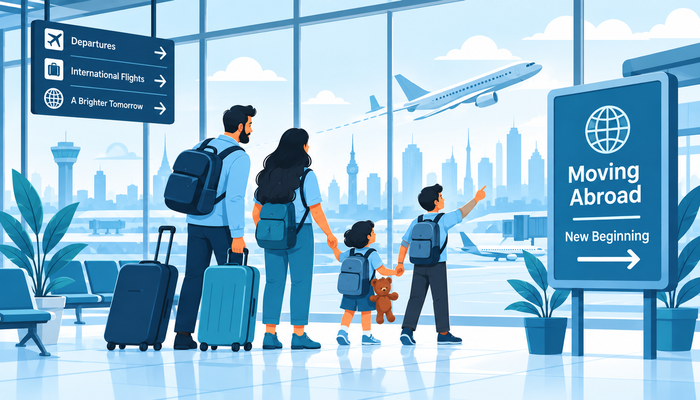
Moving Abroad With Your Spouse and Children: A Practical Family Relocation Guide
Moving abroad alone is already a major life transition.
Moving with a spouse and children changes the entire structure of the decision.
You are no longer planning only for one career, one budget, one visa, and one person's ability to adapt. You are making a household decision where immigration, work, housing, schooling, finances, healthcare, language, and emotional adjustment all interact.
This is why a destination that looks excellent for the main applicant may not be the strongest choice for the family.
A great job can be located in a city where housing is too expensive. A strong work visa may create limited options for the spouse. A good school system may still be difficult to access because of language. A financially attractive move can become stressful if the family spends the first year living almost entirely on one salary.
The most useful question is therefore not:
“Can I move my family abroad?”
It is:
“Can all of us build a stable life there after we arrive?”
That changes how the entire relocation should be planned.
Start With the Household, Not the Main Applicant
Most international moves begin with one person's opportunity.
A job offer.
A university admission.
A skilled worker route.
A business.
That makes it natural to build the plan around the person whose immigration status is strongest.
But families can run into problems when the main applicant's route is excellent and everyone else's situation is treated as a secondary issue.
Before choosing a destination, look at the household as one system.
What happens to the spouse's career? How easily can the children enter school? What kind of home will you need? How much of the household income will depend on one person? How strong is your emergency fund?
The main applicant may be ready to move while the family is not.
That distinction matters.
The Spouse's Immigration Status Can Affect the Whole Plan
One of the first things to research is what legal status the spouse will have after the move.
In some family or dependent residence arrangements, the spouse may have broad employment rights. In others, additional conditions may apply.
This should be checked before the family commits to the move, not after arrival.
The legal right to work can determine whether the household has one income or two, how quickly the spouse can restart a career, and how much financial pressure the main applicant will carry.
For families considering countries such as Germany, Spain, or Italy, the exact conditions depend on the main applicant's residence category and the family relationship, so current official requirements should always be verified.
The important planning principle is broader: the spouse's status is not a side issue.
It is part of the core relocation strategy.
Do Not Confuse Work Permission With Career Readiness
Even when a spouse is legally allowed to work, that does not mean their career will transfer easily.
This is one of the biggest mistakes families can make.
A spouse may have years of professional experience but still face local-language expectations, qualification recognition, unfamiliar hiring practices, or a weaker labor market in the destination city.
Suppose the main applicant receives an engineering offer in a smaller industrial city.
That may be perfect professionally for them.
But if the spouse works in advertising, finance, media, or another sector concentrated in major cities, the household may face a career trade-off.
This is why families should build two career plans when two adults want to work.
The move should not silently sacrifice one career unless that is a conscious family decision.
Practical Example: Amir Gets the Job, but Sara Also Has a Career
Imagine Amir receives a strong engineering offer in Germany.
The salary is good, the employer supports the relocation, and the role is a clear career step.
His spouse, Sara, works in digital marketing and has several years of experience.
At first, the decision looks easy because Amir's offer solves the immigration problem.
Then they begin looking at Sara's side of the move.
The city has many engineering employers but far fewer international marketing roles. Sara can legally work, but most local positions expect stronger German than she currently has.
The move may still make sense.
But now the family needs a plan for Sara too.
Perhaps she improves German before relocation, targets remote or international employers, or accepts that her career may take six to twelve months to rebuild.
The key is that the family knows this before moving.
That turns a surprise into a planned trade-off.
Your Budget Needs to Be Built for a Family Transition
A family budget is not simply a single-person budget multiplied by the number of people.
Some costs rise dramatically.
Housing is the clearest example.
A single professional may be comfortable in a room or studio. A family may need a two- or three-bedroom home near schools, childcare, transport, and daily services.
You may also have larger deposits, higher grocery costs, insurance, transport, school-related expenses, children's clothing, household setup, and travel.
The most important financial mistake is assuming that the second income will arrive quickly.
If the spouse needs several months to find work, the household must be able to function during that period.
The safer plan is to ask:
“Can we live on the confirmed income for several months without financial stress?”
If not, the move may depend too heavily on everything going right immediately.
Keep Relocation Money Separate From Emergency Money
Moving a family creates significant one-time expenses.
Flights, temporary accommodation, deposits, furniture, school items, transport passes, and basic household setup can consume savings quickly.
Those costs should not use the entire emergency reserve.
A stronger plan separates money into three categories.
The first covers relocation and setup.
The second covers ordinary monthly living.
The third is the emergency fund for events such as job loss, medical problems, or a longer-than-expected period before the spouse finds work.
This financial buffer is especially important when the main applicant's residence status or household income depends heavily on one job.
A family with savings has more time to solve problems without making desperate decisions.
Housing Is a Family Decision, Not Just a Rent Decision
When moving alone, choosing housing can be relatively flexible.
With children, location becomes much more strategic.
You may need to balance proximity to work with schools, childcare, parks, healthcare, supermarkets, and public transport.
A cheaper home far outside the city can create hours of commuting for both adults and children.
A more expensive neighborhood may reduce transport time and give easier access to schools.
This is why families should compare total household logistics rather than only monthly rent.
Ask what a normal weekday would look like.
Who takes the children to school?
How long is the commute?
Can both adults reach work?
What happens if one parent works late?
These questions often reveal whether a neighborhood is actually practical.
Schools Should Be Researched Before the Move
Schooling can become one of the most emotionally sensitive parts of family relocation.
Parents often focus on whether schools are “good,” but there are several other questions.
What language is instruction delivered in? Are international schools necessary, or can the children realistically enter the local system? What are the enrollment timelines? Are places linked to where you live?
The child's age matters too.
A young child may adapt to a new language much faster than a teenager preparing for important exams.
This is why school research can influence the city, neighborhood, timing, and even whether the family relocates together or in stages.
The best school option is not always the most prestigious one.
It is the one the child can realistically adapt to.
Children Experience the Move Differently From Adults
Adults usually understand why the family is moving.
Children may experience it mainly as losing familiar people, routines, language, and environment.
That difference matters.
A child may be excited before the move and still struggle after arrival.
They may miss friends, grandparents, school, or familiar activities.
Parents sometimes interpret this as evidence that the relocation was a mistake.
Often, it is simply part of adjustment.
What helps is creating continuity.
Keep familiar routines where possible. Let children stay connected with important people at home. Help them join activities where they can repeatedly meet the same peers.
Children often build belonging through routine rather than through one dramatic effort to “make friends.”
Language Becomes a Family Project
Language planning becomes more complex when different members of the family progress at different speeds.
Children may become comfortable in the local language surprisingly quickly because they use it every day at school.
The working spouse may improve through professional use.
The partner who is at home initially may have less exposure and progress more slowly.
That can create an unexpected imbalance.
One family member may suddenly become the person who handles every phone call, school message, and administrative task.
That is why language should be planned intentionally for all adults.
In Germany, Spain, or Italy, local-language ability can affect much more than employment. It can shape school communication, medical appointments, social life, and the spouse's ability to build independence.
The Main Applicant's Job Becomes More Important
When an entire family relocates around one person's employment, that job carries more weight than before.
If the role turns out badly, the consequences affect housing, schooling, income, and immigration planning.
This does not mean families should avoid employer-linked moves.
It means the employer should be researched carefully.
How stable is the company? What happens if the role ends? Are there alternative employers nearby? Does the contract include a probation period? Is the relocation package clear?
The best family relocation is not simply built around getting one job.
It is built around reducing the damage if that job changes.
The Couple Needs to Discuss Career Sacrifice Before Moving
This is a conversation families sometimes avoid.
Whose career gets priority during the first year?
If one spouse has a strong international opportunity and the other needs to restart, resentment can build if the sacrifice was never discussed openly.
The agreement does not need to be perfectly equal.
It needs to be explicit.
Maybe one career takes priority for the first 18 months, while the family invests heavily in language and networking for the second partner.
Perhaps the household agrees to reassess after a year.
The problem is not temporary imbalance.
The problem is pretending there is no imbalance.
A family move becomes stronger when both adults understand what each person is giving up and what the plan is to rebuild it.
Moving Together or Moving in Stages?
Some families relocate at the same time.
Others send the main applicant first.
Neither approach is automatically better.
Moving together reduces family separation and lets everyone begin adapting at once.
But it also creates more pressure. Housing, school, work, and immigration all need to function quickly.
A staged move can allow the main applicant to begin work, secure long-term housing, understand the city, and prepare the environment before the rest of the family arrives.
The downside is separation and the cost of maintaining two households temporarily.
The decision depends on finances, children's ages, visa timing, housing, and how quickly the main applicant expects to become stable.
What Nobody Tells You About Moving Abroad as a Family
The hardest part is often coordination.
Each person may be doing reasonably well individually while the household still feels unstable.
The main applicant may like the job.
The children may like school.
But the spouse may feel isolated or professionally stuck.
Or the adults may be comfortable while one child is struggling.
A successful family relocation therefore cannot be judged only by the salary or visa approval.
You need to ask whether each member of the family is gradually becoming more stable and independent.
That is a much more realistic definition of success.
Family Relocation Checklist
Before moving, confirm the residence and work rights of every family member and understand whether the family can relocate together or whether reunification will happen later.
Build the budget around confirmed income and assume that the second income may take time.
Research housing and schools together rather than as separate decisions.
Create a realistic career plan for both adults, including language, recognition, and job-market access.
Keep an emergency reserve after paying relocation costs.
Finally, agree on when the family will reassess the move. A six- or twelve-month review can help separate temporary adjustment problems from deeper structural issues.
Conclusion: A Family Move Is More Than One Person's Opportunity
Moving abroad with your spouse and children can create extraordinary opportunities.
But it works best when the move is designed for the household rather than built entirely around the main applicant.
The job matters.
The visa matters.
But so do the spouse's career, the children's school experience, housing, language, financial resilience, and the family's ability to build a normal daily routine.
For Germany, Spain, Italy, or any other destination, family residence, work rights, schooling, insurance, and immigration conditions can vary by route and can change over time. Current official requirements should always be checked before making major commitments.
Beyond the legal rules, speak with families who have already made a similar move.
Ask what happened to the second career.
Ask how long the children took to adjust.
Ask what costs they underestimated.
Ask whether they would move together or in stages if they could start again.
The goal is not to remove every difficulty.
No international move can do that.
The goal is to make sure the opportunity is sustainable for the entire family.
FAQ
What should families research first before moving abroad?
Start with the residence and work rights of all family members, then evaluate finances, housing, schools, healthcare, and career options for both adults.
Can my spouse work after moving with me?
It depends on the destination and your residence route. Some family permits provide broad work rights, while others can have different conditions.
Should the whole family move at the same time?
Not always. Some families benefit from moving together, while others prefer a staged relocation so the main applicant can secure housing and establish stability first.
How much savings should a family have before relocating?
The amount depends on the destination and household size, but the budget should cover relocation costs, several months of living expenses, and a separate emergency reserve.
How important is school research before moving?
Very important. School language, enrollment rules, location, and the child's age can influence where the family lives and how smoothly children adjust.
What is the biggest financial risk when moving abroad as a family?
A major risk is assuming that both adults will earn income immediately. Families should be able to function for a period on confirmed income only.
What is the biggest mistake families make when relocating?
One of the biggest mistakes is building the move around the main applicant's career while treating the spouse's career, children's adjustment, and household finances as secondary issues.