Startup Visa vs Traditional Employment
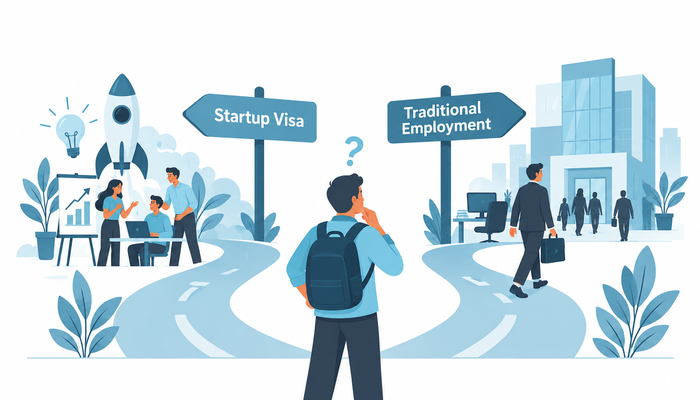
Startup Visa vs Traditional Employment: Which Path Fits Your International Career?
For professionals who want to move abroad, the choice is not always between one job offer and another.
Sometimes the bigger decision is whether to build your own company or enter the country through traditional employment.
These two paths can lead to the same destination but create very different lives.
A startup or entrepreneur route usually asks you to prove that the business itself has potential. Depending on the country, authorities may examine the business plan, financing, innovation, economic value, professional background, or whether the project can support you financially.
Traditional employment works differently. Instead of proving that your business deserves to exist, you usually prove that you have the qualifications and job offer needed for a work residence route.
Neither option is automatically more ambitious, flexible, or secure.
The better question is:
“Do I currently have a stronger business case or a stronger employment case?”
That distinction matters more than the label attached to the visa.
A Startup Route Is Not Simply a Work Visa Without a Boss
One of the biggest misconceptions about entrepreneur migration is that it gives professionals an easier way to avoid employer sponsorship.
It usually does not work that way.
A genuine entrepreneur route normally requires much more than registering a company. You may need to demonstrate why the business makes economic sense, how it will be funded, what makes the project credible, and why you are capable of executing it.
Germany illustrates this clearly. Non-EU entrepreneurs who want to establish a commercial business can apply for residence for self-employment, but the business must generally demonstrate commercial interest or regional demand, positive economic impact, and secured financing.
Spain also has a specific entrepreneur framework for projects considered innovative or of particular economic interest. The current official guidance says that ENISA evaluates factors including the founder's professional profile, the business plan and financing, and the value the project could generate for the Spanish economy. Importantly, Spain does not impose a fixed minimum investment or job-creation threshold under that entrepreneur framework.
So a startup route is not simply permission to move abroad and experiment with an idea.
The business itself becomes part of your immigration case.
Traditional Employment Starts With a Different Kind of Evidence
With traditional employment, the center of the application is usually not the business idea.
It is the employment relationship.
You normally need a real job, an employer willing to hire you, and a profile that satisfies the relevant work route.
Germany's work visa for qualified professionals, for example, is designed for people with recognized or comparable qualifications who have secured qualified employment. Its EU Blue Card also requires a specific qualifying job offer and, in 2026, applies salary thresholds depending on the role and applicant category.
Spain likewise has employment-based residence routes under which an employer applies to hire a foreign worker, alongside separate pathways for highly qualified professionals.
This makes traditional employment easier to understand conceptually.
The employer is saying:
“We need this person for this role.”
An entrepreneur route asks a different question:
“Is this business credible enough to justify allowing this person to build it here?”
The Real Difference Is Where the Risk Sits
Startup immigration shifts more risk onto you.
If you are the founder, you need to create the income source rather than simply report to one.
You may arrive with no stable salary. Revenue can be unpredictable. Customers may take longer to acquire than expected. Funding may not arrive. The product may need to change.
Traditional employment reduces some of those risks because you normally relocate with defined compensation and responsibilities.
But employment creates another kind of dependence.
Your legal status may initially be connected to the job or residence category. If the employer restructures, the role disappears, or you decide to leave, immigration questions can appear alongside the career problem.
So neither route removes uncertainty.
They simply place it in different parts of your life.
Ask Whether You Already Have a Business or Only an Idea
This is one of the most important questions before considering a startup route.
There is a huge difference between wanting to become an entrepreneur and already having evidence that a business could work.
A stronger founder profile may include early customers, existing revenue, a tested product, relevant industry experience, committed funding, or a clear understanding of the target market.
A weaker case may consist mainly of an idea that sounds attractive.
That does not mean the idea cannot become successful.
It means immigration may be a poor reason to start the company before the business itself is ready.
If you would not seriously pursue the startup without the immigration opportunity, that deserves careful attention.
The company should ideally exist because the business case is strong, not because the residence route looks attractive.
Practical Example: Maya Has a Product but No Employer
Imagine Maya has spent six years working in logistics technology.
She has developed a software product that helps small importers automate part of their documentation process. She has several paying clients in her home market and wants to expand into Europe.
For Maya, an entrepreneur route could be a logical extension of what she is already doing.
She can explain the industry problem, show evidence of customer demand, describe how the business earns money, and demonstrate why entering a European market would support growth.
Now imagine a different situation.
Maya has the same professional experience but no product, no customers, and no intention to build a company except that she heard a startup pathway might allow her to relocate.
In that scenario, traditional employment may be much more realistic.
The difference is not entrepreneurial personality.
It is evidence.
Startup Routes Usually Require a Stronger Financial Buffer
Entrepreneurship creates a different financial problem from salaried employment.
A traditional employee can usually estimate future income from the contract. The founder has to estimate expenses while accepting that revenue may be unstable.
That means personal savings and business funding need to be considered separately.
You may need money for relocation, rent, insurance, and daily life while also preserving enough capital to operate the company.
Using the same pool of money for both can create pressure quickly.
Germany's self-employment route explicitly requires secured financing for a commercial business and the ability to support yourself. Successful self-employed entrepreneurs may later qualify for a settlement permit after three years if the business remains sustainable and the relevant conditions are met.
That illustrates an important point: immigration authorities are not only interested in whether you can launch. They may also care about whether the activity looks economically sustainable.
Traditional Employment Gives You Financial Predictability Earlier
A salaried job does not remove relocation costs, but it changes how you manage them.
You normally know your gross salary before moving. You can compare it with rent, taxes, transportation, and household expenses.
You also know when the employment starts and what the expected responsibilities are.
That predictability can be especially valuable if you are relocating with a family.
It may also make career planning easier during the first year because you are not simultaneously trying to build a customer base, manage cash flow, and adapt to a new country.
The trade-off is that a stable salary can come with less control over what you build, when you work, or which projects receive your attention.
This is why the decision is not simply between risk and safety.
It is between two different kinds of professional structure.
Entrepreneur Routes Can Offer More Control but Less Certainty
For the right person, entrepreneurship can provide something traditional employment may not: control.
You choose the product, strategy, customers, and direction of the company.
Your career is less dependent on one employer's promotion system or organizational priorities.
But control does not mean freedom from constraints.
Founders answer to customers, cash flow, regulations, investors, tax systems, and the immigration conditions attached to the business.
A startup route may therefore create more autonomy over your work while simultaneously increasing financial and operational responsibility.
That distinction matters for professionals who romanticize entrepreneurship mainly because they are tired of employment.
Building a company abroad is not the absence of pressure.
It is a different form of pressure.
Italy Shows Why “Startup Visa” Is Not a Generic Term
The phrase “startup visa” can be misleading because countries structure entrepreneur immigration differently.
Italy has a specifically named Italia Startup Visa for non-EU entrepreneurs who want to establish an innovative startup in Italy. Its official program is tied to the country's innovative-startup framework rather than being a general visa for anyone who wants to become self-employed.
Germany, by contrast, mainly uses residence permits for self-employment or freelance activity rather than a single program called a startup visa.
Spain has both general self-employment authorization and a separate entrepreneur route for qualifying innovative projects.
This is why comparing “startup visas” across Europe requires caution.
You are not comparing identical programs with different country names.
You are comparing different legal structures built around entrepreneurship.
Career Growth Looks Different Under Each Route
Traditional employment can make career progression easier to measure.
You may move from specialist to senior specialist, manager, or director. You can compare salaries and switch employers as your local experience improves.
Entrepreneurship has a less predictable trajectory.
A founder could build a successful company and create far more professional independence than a salaried role would provide. The company could also remain small, fail to generate sufficient income, or require the founder to return to employment.
That is why the right question is not:
“Which route has more career upside?”
Both can have significant upside.
The better question is:
“Which route gives me the highest probability of using the skills and evidence I already have?”
A professional with strong employer demand but no tested business may be taking unnecessary risk by forcing an entrepreneur strategy.
An experienced founder with paying customers may be limiting themselves by treating employment as the only realistic immigration option.
Family Situation Can Make the Choice More Conservative
The amount of uncertainty you can realistically tolerate changes when other people depend on the move.
A founder relocating alone with significant savings may be able to absorb a year of unstable business income.
A household with children, expensive housing, and one primary income may need far more predictability.
That does not mean families should avoid entrepreneur routes.
It means the decision must include household runway rather than only business funding.
Your company may have enough cash to operate while your family does not have enough financial buffer to live comfortably.
Those are two separate problems.
What Nobody Tells You About Startup Immigration
The hardest part of a startup route may not be obtaining the residence permit.
It may be building the company after the excitement of relocation disappears.
Immigration approval does not create product-market fit.
It does not produce customers, solve pricing, build distribution, or guarantee investment.
Likewise, a traditional employment route does not guarantee a satisfying career. You can move through a legally strong work route and discover that the employer offers little progression or that the role is very different from what you expected.
The visa only creates the legal framework.
The career or company still needs to work on its own.
This is where speaking with founders and professionals already living in the target market can add context. Ask founders how difficult it was to acquire customers locally and ask employees how dependent they felt on the first employer.
Those are experiences official immigration pages cannot fully capture.
Startup Visa vs Traditional Employment Checklist
Before choosing entrepreneurship, ask whether the business has evidence behind it. Look at customers, revenue, financing, market demand, founder experience, and how much personal runway you can maintain without damaging the company.
Before choosing traditional employment, evaluate the quality of the job rather than only the visa support. Consider salary, career development, employer dependency, alternative employers in the same market, and how the position moves your career forward.
For either route, investigate language, professional regulation, family impact, long-term residence options, and the real cost of living in the target city.
Most importantly, choose the route based on what you are already capable of building rather than what sounds more exciting.
Conclusion: Choose Between Two Career Models, Not Two Visas
Startup immigration and traditional employment are not simply two administrative ways to reach the same country.
They represent two different professional models.
The entrepreneur route asks you to build the economic activity yourself. In Germany, that can mean demonstrating demand, economic benefit, and financing for a self-employed business. Spain's entrepreneur route focuses on innovative projects with economic value, while Italy operates a dedicated startup framework for qualifying innovative founders.
Traditional employment begins with a different foundation: an employer has already decided to pay for your skills.
That usually creates more immediate income stability but can also create more dependence on the job during the early stages of residence.
So the useful question is not:
“Which visa is better?”
It is:
“Which route matches the strongest evidence in my current career?”
If you already have a credible business with real market potential, an entrepreneur pathway may be worth serious investigation.
If your strongest asset is professional experience that employers are willing to pay for, traditional employment may give you a more stable starting point.
Current entrepreneur and work-residence requirements in Germany, Spain, Italy, and other destinations can change, so formal eligibility should always be verified through the relevant official sources before making a major decision.
FAQ
What is the main difference between a startup visa and a traditional work visa?
A startup or entrepreneur route is based mainly on your business activity and its viability, while a traditional work route is usually based on an eligible employment relationship.
Do all European countries have a startup visa?
No. Entrepreneur immigration is structured differently across Europe. Italy has an Italia Startup Visa, while Germany mainly uses self-employment and freelance residence permits, and Spain has entrepreneur and general self-employment routes.
Do I need investment to qualify for an entrepreneur route?
It depends on the country and program. Germany requires financing to be secured for a commercial self-employment project. Spain's entrepreneur framework does not set a fixed minimum investment or job-creation threshold but assesses the project's innovation, financing, and economic value.
Is traditional employment financially safer?
It usually provides more predictable income from the beginning, but the quality of the employer and the level of immigration dependency still matter.
Can entrepreneurship lead to permanent residence?
Potentially. For example, qualifying self-employed entrepreneurs in Germany can apply for settlement after three years if the business is successful and the applicable conditions are met.
Should I start a company mainly to obtain residency?
That is usually a weak foundation for the decision. A stronger entrepreneur case exists when the business would make sense independently of the immigration benefit.
How should I choose between entrepreneurship and employment?
Compare the evidence you already have. If you have a tested business, funding, customers, and relevant founder experience, entrepreneurship may fit. If your strongest asset is professional experience that employers actively need, traditional employment may be more realistic.