Requirements for International Students
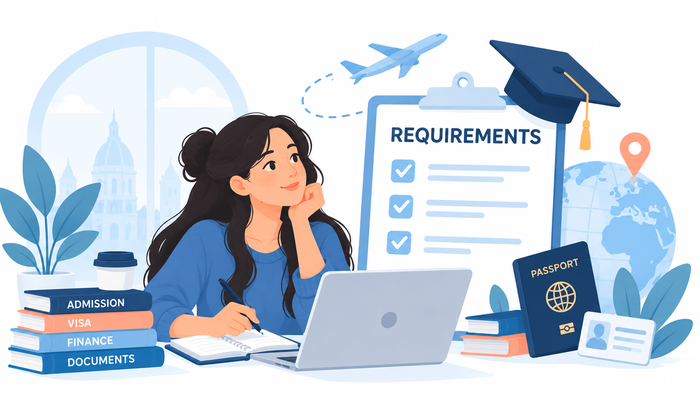
Requirements for International Students: What You Need Before Studying Abroad
When I first looked into studying abroad, I thought the process was mostly academic.
Choose a university.
Meet the entry requirements.
Get accepted.
Apply for a student visa.
Move.
That sounded straightforward.
But once I started looking at real applications, I realized that international students are usually preparing for several different systems at the same time.
You may need to satisfy:
The university.
The immigration authority.
A language requirement.
Financial requirements.
Insurance requirements.
Housing expectations.
Professional or academic recognition rules.
And sometimes a separate residence process after arrival.
The biggest mistake is assuming:
“If the university accepts me, I am fully ready to study abroad.”
Admission is only one part of the process.
A better approach is to ask:
“What must be true academically, financially, legally, and practically before I can actually start studying?”
That is the real international student checklist.
Start With the University Admission Requirements
The first layer is academic admission.
Universities may look at:
Previous education.
Grades.
Required subjects.
Language ability.
Entrance examinations.
Portfolio.
Professional experience.
Motivation.
References.
The exact combination depends on the program and country.
A bachelor's application may focus heavily on secondary-school qualifications.
A master's application may focus more on:
Your bachelor's degree.
Transcript.
Relevant coursework.
Academic fit.
Career background.
That means the first question should not be:
“Can I study in this country?”
It should be:
“Am I academically eligible for this specific program?”
Admission Requirements Are Program-Specific
A common mistake is checking the university's general admission page and assuming that is enough.
Programs can have very different prerequisites.
For example, a master's in data science may expect:
Statistics.
Mathematics.
Programming.
Quantitative coursework.
A master's in finance may require:
Economics.
Accounting.
Statistics.
Business-related subjects.
A design program may require:
Portfolio.
Creative projects.
Specific software skills.
So do not rely only on the title of your previous degree.
Check the actual prerequisite subjects.
Two applicants with the same bachelor's title may still receive different outcomes because their coursework is different.
Academic Transcripts Matter More Than People Expect
Your degree certificate proves that you completed a qualification.
Your transcript shows what you actually studied.
Universities may use it to evaluate:
Course content.
Credits.
Grades.
Subject prerequisites.
Academic progression.
That is why transcripts can become one of the most important documents in the application.
If your transcript is not already available in the required format, request it early.
Universities and previous institutions can take time to issue official records.
Qualification Recognition May Be Separate From Admission
Sometimes you may also need to verify whether your previous education is recognized or comparable in the destination.
This can involve:
Credential evaluation.
Recognition systems.
University-level assessment.
Country-specific databases.
Professional recognition.
Do not assume:
“I have a bachelor's degree, so every university will treat it as equivalent.”
The receiving institution may apply its own criteria.
This is especially important when your previous education system differs significantly from the one you are entering.
Language Requirements Are Usually More Specific Than “Good English”
A university may teach in English.
That does not mean saying:
“My English is strong”
is enough.
You may need:
An accepted language test.
A specific overall score.
Minimum scores in individual components.
A certificate within a validity period.
The same applies to programs taught in German, Spanish, Italian, or another language.
Check:
Which tests are accepted?
What minimum level is required?
Do individual skills have minimum scores?
Can prior education in that language replace the test?
How long is the result valid?
Do not book a test before checking the program-specific requirements.
Academic Language and Real-Life Language Are Different
This is especially important with English-taught programs.
You may study entirely in English and still live in a country where the local language matters for:
Housing.
Healthcare.
Administration.
Part-time work.
Internships.
Friendships.
Graduate employment.
So there are really three language questions:
Admission Language
What do I need to enter the program?
Study Language
What do I need to perform well academically?
Local-Life Language
What do I need to function and build a career?
You may meet the first and still struggle with the third.
That does not mean you should avoid the program.
It means language should be part of the relocation plan.
Financial Requirements Are Not the Same as Tuition
Another mistake is calculating only tuition.
International study can involve:
Application fees.
Tuition.
Housing.
Deposits.
Food.
Transport.
Insurance.
Books.
Technology.
Travel.
Residence fees.
Emergency savings.
The real question is:
“Can I afford the complete student life?”
not:
“Can I pay the university?”
Practical Budget Example
Imagine a one-year master's program.
Tuition: €16,000
Housing and living costs: €15,000
Travel and setup: €2,500
Insurance and other costs: €1,500
Direct total:
€35,000
Now add:
Possible lost income.
Emergency reserve.
Unexpected housing costs.
The financial commitment becomes much larger.
This is why a program should be evaluated as an investment, not only as an admission opportunity.
You May Need Formal Proof of Funds
For immigration or residence purposes, some students may need to show that they can financially support themselves.
Requirements can vary based on:
Country.
Student status.
Program duration.
Family size.
Funding source.
Scholarship.
Sponsor.
Do not assume that simply having enough money is enough.
The authority may care about:
Where the money is held.
Who owns it.
How it is documented.
Whether it is accessible.
Whether sponsorship is allowed.
How recent the evidence must be.
Always verify the current official rules for your specific country and status.
Scholarships Can Change the Strategy
Scholarships can reduce financial pressure significantly.
But they can also have their own requirements.
For example:
Minimum grades.
Specific nationality.
Academic field.
Research proposal.
Deadlines.
Return obligations in some programs.
Separate application.
Do not assume admission automatically means scholarship consideration.
Create separate trackers for:
University admission
and:
Scholarship applications
Their deadlines may be different.
Student Visa or Residence Requirements Are a Separate Process
University admission and immigration permission are not the same thing.
You can receive an admission offer and still need to satisfy separate student immigration requirements.
These may involve:
Valid passport.
Admission letter.
Financial proof.
Insurance.
Accommodation-related information.
Language evidence.
Application forms.
Biometrics.
Other country-specific documentation.
The exact process varies significantly.
Always separate:
Academic acceptance
from:
Legal permission to study and reside.
Both need to work.
Do Not Apply for Immigration Using Old Information
Student immigration policies can change.
This can affect:
Work rights.
Financial thresholds.
Post-study options.
Dependants.
Eligible institutions.
Application procedures.
That means a YouTube video from two years ago may no longer describe the current process accurately.
Whenever you research formal requirements, record:
Source.
Date checked.
Country.
Program.
Status type.
That can save you from building a plan around outdated information.
Passport Validity Matters
This seems obvious, but it can cause unnecessary problems.
Check:
Expiry date.
Condition.
Name spelling.
Whether the passport remains valid for the required period.
Whether you may need renewal before applying.
Do this early.
If you renew your passport during the process, keep records of the previous one if relevant.
Civil Documents May Be Needed
Depending on your situation, you may also need:
Birth certificate.
Marriage certificate.
Documents for dependants.
Name-change records.
Other civil-status documents.
These may become relevant for:
Immigration.
Family applications.
Insurance.
Local registration.
Do not assume the university document list covers everything you may later need.
Health Insurance Can Be Mandatory
Many countries require students to have acceptable health insurance.
The rules can depend on:
Age.
Program.
Country.
Type of residence status.
Public or private insurance eligibility.
Do not simply buy the first travel insurance policy you find.
Check what is accepted for:
Immigration.
Enrollment.
Long-term residence.
Those can sometimes be different requirements.
Housing Is Not Always an Admission Requirement—but It Can Become a Relocation Problem
Housing often becomes one of the hardest parts after acceptance.
You may have options such as:
Student residence.
Private room.
Shared apartment.
Private apartment.
Temporary accommodation.
Each has different:
Costs.
Deposits.
Availability.
Distance.
Contract conditions.
Do not wait until a few weeks before arrival to understand the housing market.
Start researching early, especially in cities with high student demand.
Practical Example: Maya Thinks She Is Ready
Imagine Maya is applying for a master's abroad.
She has:
A bachelor's degree.
Good grades.
Strong English.
€20,000 in savings.
She assumes she is almost ready.
Then she builds a full requirements map.
Academic
Degree — ready.
Transcript — needs official copy.
One prerequisite subject — unclear.
Language
English certificate — valid.
Minimum writing score — needs confirmation.
Financial
Savings — available.
Proof-of-funds format — needs checking.
Immigration
Passport — valid.
Admission letter — not yet issued.
Insurance — needs research.
Practical
Housing — not researched.
Month Zero costs — not calculated.
Emergency fund — not separated.
Maya is academically strong.
But she is not fully relocation-ready.
That difference matters.
Part-Time Work Should Not Be Your Main Financial Plan
Many international students hope to work while studying.
That can help.
But it should not be the foundation of your budget unless the rules and job market realistically support it.
Consider:
Legal work limits.
Class schedule.
Language.
Job availability.
Hourly wages.
Exam periods.
Commuting.
Do not build a fragile financial plan that only works if you immediately find part-time employment.
Treat student work as additional support where permitted—not guaranteed income.
Post-Study Plans Should Be Researched Before Enrollment
If your goal includes working after graduation, investigate that before paying tuition.
Ask:
Does the country offer post-study work options?
Does my specific program qualify?
Does institution type matter?
How long might the post-study period last?
What happens if I do not find work quickly?
Can the status transition to a work route?
What language will employers expect?
Current official information is essential here because rules can change during a multi-year degree.
Professional Programs Need Extra Care
If you are studying toward a regulated profession, you may need more than university admission.
You should check:
Professional recognition.
Licensing.
Registration.
Supervised practice.
Clinical requirements.
Language.
Professional exams.
This can be important in fields such as:
Healthcare.
Teaching.
Law.
Architecture.
Psychology.
Other regulated professions depending on the destination.
A degree can be academically valid while still not giving you full professional eligibility.
Family Requirements Can Change the Student Plan
If you are moving with a spouse or children, the plan becomes much more complex.
You may need to research:
Whether dependants are permitted.
Partner work rights.
Additional financial requirements.
Family housing.
Health insurance.
Childcare.
Schools.
Civil documentation.
A study plan that is affordable for one person may be financially unrealistic for a family.
Always calculate the household version of the plan.
Common Mistakes International Students Make
Assuming Admission Means the Process Is Finished
University acceptance is only one stage.
Checking General Requirements Instead of Program Requirements
Prerequisites can be highly specific.
Underestimating Living Costs
Tuition is only one part of the budget.
Depending Too Heavily on Part-Time Work
Work may be limited or difficult to find.
Ignoring Local Language
It can matter greatly for employment and daily life.
Researching Post-Study Options Too Late
Check them before enrolling.
Using Outdated Immigration Information
Student rules can change.
What Nobody Tells You About International Student Requirements
The hardest part is usually not meeting one requirement.
It is coordinating all of them at the right time.
Your language result has a validity period.
Your admission has a deadline.
Your immigration application needs financial evidence.
Your housing contract starts on a specific date.
Your university enrollment requires insurance.
Your previous institution takes weeks to send a transcript.
Each item may be manageable on its own.
The difficulty comes from making them all line up.
This is why I would speak with someone who recently studied in the same country or city.
Ask:
“Which requirement took longest?”
“What did you prepare too late?”
“How much did the first month really cost?”
“Was finding housing harder than admission?”
“What did you wish you had checked before choosing the program?”
That kind of lived experience can reveal practical problems that admission pages rarely explain.
Then verify the formal rules through the relevant official sources.
International Student Requirements Checklist
Academic
Program eligibility checked
Degree or school qualification ready
Transcript available
Subject prerequisites checked
Portfolio or entrance exam checked if relevant
References prepared if required
Language
Accepted test identified
Minimum score checked
Individual skill requirements checked
Certificate validity checked
Local-language plan considered
Financial
Tuition calculated
Living costs estimated
Housing deposits included
Travel and setup included
Proof-of-funds rules checked
Emergency reserve protected
Immigration
Passport checked
Admission documents ready
Student immigration requirements verified
Insurance requirements checked
Civil documents identified
Current official rules reviewed
Practical
Housing market researched
First-month budget created
Part-time work rules checked
Transport researched
Family needs included if relevant
Long-Term
Graduate outcomes researched
Post-study rules checked
Employment language understood
Qualification recognition researched
Backup plan created
Conclusion: International Student Readiness Is More Than Admission
Getting accepted to a university is important.
But it is not the same as being ready to study abroad.
Real readiness means several systems work together:
Academic eligibility.
Language.
Finances.
Immigration.
Insurance.
Housing.
Career planning.
And practical preparation for life after arrival.
That is why I would never evaluate an international study plan based only on:
“Can I get admitted?”
I would also ask:
“Can I afford the full experience?”
“Can I legally complete the move?”
“Does this program improve my career?”
“What happens after graduation?”
For formal admissions, student immigration, financial evidence, insurance, and post-study conditions, always verify current requirements through the relevant university and official authorities before making major commitments.
Then add one more layer:
Speak with someone who has actually studied there.
Official sources can tell you what is required.
Former international students can tell you what was difficult.
You need both.
Because the goal is not simply to meet the requirements.
It is to arrive prepared enough to use the opportunity well.
FAQ
What are the main requirements for international students?
Common requirements include academic eligibility, transcripts, language proof, financial evidence, passport, university admission, immigration permission, and health insurance.
Do international students always need a language test?
Not always, but many programs require formal evidence of language ability. Accepted tests and minimum scores vary by university and program.
How much money does an international student need?
There is no universal amount. You should calculate tuition, living costs, housing deposits, insurance, travel, setup expenses, and an emergency reserve.
Does university admission guarantee a student visa?
No. University admission and immigration permission are separate processes with different requirements.
Can international students work while studying?
Work rights vary by country and status. Check the current official rules and do not assume part-time work will cover your full living expenses.
Do international students need health insurance?
Many destinations require acceptable health insurance for immigration, residence, or university enrollment. Exact requirements vary.
What should I check before accepting a study offer abroad?
Check the curriculum, total cost, housing, language expectations, immigration requirements, graduate outcomes, post-study work options, and whether the program supports your long-term career goals.