Different Migration Pathways Available
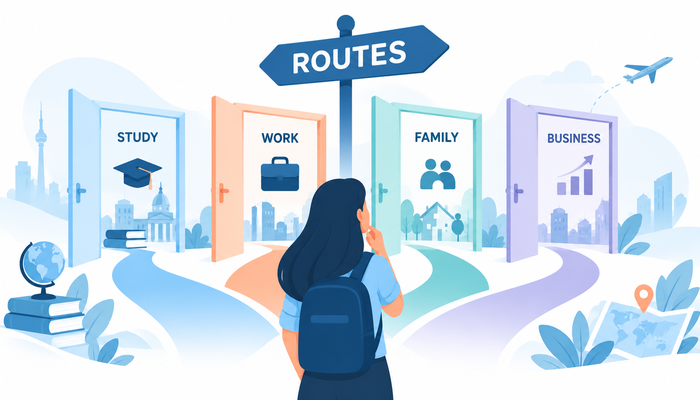
Different Migration Pathways Available: How to Choose the Right Route
When I first started researching migration, I made a simple mistake:
I thought there was one main route.
Find a country.
Find a visa.
Apply.
Move.
Then I realized migration systems are usually much more complicated.
The same country may offer completely different pathways for:
Skilled workers.
Students.
Job seekers.
Entrepreneurs.
Family members.
Researchers.
Graduates.
Employer-sponsored workers.
Highly qualified professionals.
And sometimes two people with almost identical backgrounds can end up using completely different routes.
That changed the way I approached migration planning.
Instead of asking:
“Which visa should I apply for?”
I started asking:
“Which type of migration pathway actually matches my profile, goals and timeline?”
That is a much better place to start.
Because choosing a pathway is not only about becoming eligible.
It can affect your:
Career flexibility.
Costs.
Timeline.
Dependence on an employer.
Family situation.
Long-term residence options.
And even how much freedom you have after you arrive.
Start With the Reason You Want to Move
Before comparing pathways, define the purpose of the move.
Ask yourself:
What am I actually trying to achieve?
For example:
Build an international career
Study and gain a new qualification
Change careers
Join a partner or family member
Start or expand a business
Experience another country temporarily
Move somewhere with stronger long-term opportunities
Build a path toward permanent settlement
Your answer matters because different pathways solve different problems.
Someone whose priority is career growth may need to focus on employment-based routes.
Someone who genuinely needs a new degree may consider a study pathway.
Someone with strong qualifications but no job offer may look for an independent skilled or job-search route where available.
A good pathway starts with your goal—not with whichever visa appears easiest.
1. Employer-Sponsored Work Pathways
One of the most common migration routes is moving because an employer offers you a job and supports the work-based immigration process.
The general structure is often:
Job search → Job offer → Work authorization/residence process → Relocation
This route can be attractive because employment is already connected to the move.
You may arrive with:
Income.
A role.
An employer.
Some professional structure.
Possibly relocation support.
That can reduce financial uncertainty significantly.
The Main Advantage
You are not arriving and then hoping to find employment.
The employment itself helps create the pathway.
The Main Risk
Your immigration status may be connected, directly or indirectly, to the job or employer.
Depending on the specific route, changing employers may involve additional steps.
So before choosing this pathway, ask:
How easy is it to change employers?
What happens if the job ends?
Can this status eventually lead to something more flexible?
Employer sponsorship can be an excellent entry strategy, but it should be evaluated as both an immigration decision and a career decision.
2. Independent Skilled Migration
Some countries provide migration routes that evaluate applicants primarily through their own profile rather than requiring one specific sponsoring employer.
Factors may include:
Age.
Education.
Language.
Professional experience.
Occupation.
Qualifications.
Points or ranking systems.
Other program-specific criteria.
The major attraction is independence.
You may have more flexibility in choosing employers, depending on the status granted.
The Main Advantage
Your migration plan is not necessarily built around one company.
The Main Challenge
You may need a stronger profile.
You may also face competitive selection rather than simple eligibility.
This is where people often confuse:
“I qualify”
with:
“I am likely to be selected.”
Those are different questions.
Independent migration can be powerful for someone with strong qualifications, experience and language ability, but it may require more preparation before the move.
3. Job-Seeker or Opportunity-Based Routes
Some migration systems include pathways designed for people who want to enter or remain in a country while looking for employment, subject to specific conditions.
These can appeal to professionals who:
Have strong qualifications.
Have enough savings.
Want access to the local job market.
Do not yet have an employer.
The strategy can look like:
Qualify for job-search route → Enter market → Find qualifying employment → Transition to appropriate work status
The appeal is obvious.
You can potentially search locally rather than applying entirely from abroad.
But this creates a different kind of risk.
You may be spending savings while searching.
So financial runway becomes critical.
Before choosing this type of route, I would ask:
How many realistic employers exist for me?
What language do they require?
How many months can I comfortably support myself?
What happens if I don't find suitable employment within the permitted period?
A job-search route is strongest when supported by real employability—not just optimism.
4. Study Pathways
Studying abroad can be a genuine migration pathway, but it should first make sense as education.
The general structure may look like:
Admission → Study authorization → Complete program → Possible work options → Possible longer-term pathway
The important word is:
possible.
Education should not be treated as a guaranteed shortcut to permanent residence.
When Study Makes Sense
You genuinely need the qualification.
You want to change careers.
The degree improves your professional prospects.
The program gives access to employers or industries you cannot easily reach otherwise.
You can afford the full cost.
The Main Risk
You may invest:
Tuition.
Living costs.
Years of time.
Lost income.
And still need to qualify separately for employment and long-term residence later.
My favorite question for evaluating study migration is:
“If this program gave me no immigration advantage at all, would I still consider it valuable?”
If the answer is yes, the education has independent value.
That makes the strategy much stronger.
5. Post-Study and Graduate Pathways
In some countries, certain graduates may have access to temporary post-study work options or other routes after completing eligible education.
These pathways can provide time to:
Find employment.
Gain local experience.
Build professional networks.
Strengthen future eligibility.
But they should never be assumed automatically.
The institution, qualification, program length, field and current immigration rules may matter.
If post-study work is central to your plan, research it before enrolling.
Don't choose a degree first and investigate the post-graduation route afterward.
6. Family and Partner Migration
If your spouse, partner or eligible family member already has citizenship, permanent residence or another qualifying status abroad, family migration may be relevant.
These pathways can be very different from economic migration.
Instead of being assessed mainly on:
Career.
Points.
Education.
Job offers.
The process may focus more heavily on:
Relationship eligibility.
Sponsor status.
Civil documents.
Financial or accommodation conditions where applicable.
Other country-specific rules.
But family migration still requires planning.
You should understand:
What status you receive.
Whether you can work.
How long the status lasts.
What happens in different future circumstances.
How the pathway may lead toward longer-term residence.
Never assume that family-based migration is automatically simple because the relationship itself is genuine.
The administrative process can still be detailed.
7. Entrepreneur and Business Pathways
Some countries have immigration routes designed for:
Entrepreneurs.
Startup founders.
Investors.
Self-employed professionals.
Business owners.
These pathways may evaluate things such as:
Business concept.
Funding.
Innovation.
Revenue.
Professional background.
Economic contribution.
Business viability.
Local endorsement or support.
The exact requirements vary widely.
The important question is whether you have a real business case—not just enough money to apply.
A business migration strategy should make sense commercially even without the visa.
If the business only exists because you need an immigration route, that is a warning sign.
8. Digital Nomad and Remote-Worker Routes
Remote-work migration has become another option in some destinations.
These routes can suit people who:
Already earn remotely.
Work for foreign employers or clients.
Meet income requirements.
Want temporary residence without entering the local labor market in the traditional way.
This can be attractive because you maintain existing income.
But it may be a poor choice if your real objective is:
Local career development.
Permanent settlement.
Local employer access.
A long-term family plan.
A digital nomad route can be useful for temporary relocation.
It should not automatically be treated as a permanent immigration strategy.
9. Researcher and Academic Routes
Researchers, doctoral candidates, academics and highly specialized professionals may sometimes have dedicated immigration or residence options.
These can be connected to:
Universities.
Research institutes.
Funded projects.
Academic appointments.
Scientific collaboration.
For the right person, this can be more appropriate than using a general skilled-worker route.
If your background is academic, don't assume standard employment migration is your only option.
Look at pathways related specifically to:
Research.
Higher education.
Scientific work.
Academic employment.
10. Intra-Company Transfer
If you work for a multinational company, internal transfer may sometimes provide another route.
For example, an employee might move:
From one national office to another.
Into a management role.
Into a specialist position.
For a temporary assignment.
This can be attractive because:
Your employer already knows you.
Your professional history is established.
The transition may be more structured.
But again, consider what happens after the assignment.
Is the move temporary?
Can you remain afterward?
Can you change employers?
Does the route contribute toward longer-term residence?
A good transfer opportunity can be an excellent first international step, even if it isn't the final immigration strategy.
11. Temporary Pathways
Not every migration route needs to lead directly to permanent settlement.
Temporary pathways can make sense for:
Work assignments.
Study.
Research.
Seasonal opportunities.
Career experience.
Remote work.
Testing life in another country.
The mistake is not choosing something temporary.
The mistake is choosing it while secretly assuming:
“I'll definitely find a way to stay later.”
If long-term residence matters, investigate the transition before moving.
Ask:
What happens when the temporary status ends?
12. Permanent or Long-Term Residence Pathways
Some people may qualify directly for permanent or more stable long-term residence.
Others may reach it after several years on temporary status.
Long-term pathways can offer greater security and sometimes greater employment flexibility.
But they may require:
More preparation.
Longer timelines.
Language.
Residence history.
Employment.
Financial stability.
Other integration or program-specific conditions.
Permanent residence should not automatically be treated as the ultimate goal, either.
A stable immigration status is valuable.
But it only matters if the country still fits your career, finances, relationships and lifestyle.
Practical Example: Three Routes for Amir
Imagine Amir is 31.
He has:
A master's degree.
Six years of software experience.
Strong English.
Basic German.
€18,000 in savings.
His goal is to build a strong international career and possibly settle long term.
He identifies three potential routes.
Route A: Employer-Sponsored Job
Fastest.
Lower financial risk.
But initially more employer-dependent.
Route B: Independent Skilled Pathway
Potentially more flexible.
But requires stronger eligibility and more waiting.
Route C: Study Another Master's
Possible route into the local market.
But expensive and professionally unnecessary.
At first, Amir thinks all three are simply ways to “move.”
Then he asks:
Which one solves my actual problem?
He doesn't need another degree.
His existing career is strong.
So Route C becomes less attractive.
Now the comparison is really between:
Speed and employer certainty
versus:
greater independence and potentially longer preparation.
That is a much better decision.
How to Compare Migration Pathways
I would evaluate every route using the same criteria.
Factor | Question |
Eligibility | Can I realistically qualify? |
Competitiveness | If selection is competitive, how strong is my profile? |
Time | How long will preparation and processing realistically take? |
Cost | What is the total cost, not just the application fee? |
Employment | Do I already have work or must I find it later? |
Flexibility | Can I change employers or locations? |
Family | What happens to my partner or children? |
Long-term status | What could this route lead to later? |
Career value | Does this route improve or weaken my career? |
Risk | What happens if the first plan fails? |
This helps stop one attractive feature from dominating the decision.
Common Mistakes When Choosing a Migration Pathway
Choosing the Easiest Route
Easy entry does not necessarily produce a good long-term outcome.
Choosing Study Because Work Migration Looks Difficult
Another degree should have real career value.
Ignoring Employer Dependency
Understand what your work status allows.
Looking Only at Application Fees
Tuition, lost income, housing and job-search time can matter far more.
Assuming Temporary Status Automatically Leads to Permanent Residence
Transitions usually have their own conditions.
Ignoring Partner and Family Rights
Your route affects more than one person if you're moving together.
Choosing a Pathway Before Defining Your Goal
The route should serve the plan—not become the plan.
What Nobody Tells You About Migration Pathways
The most available pathway is not always the best one.
And the most prestigious pathway is not always necessary.
Sometimes the strongest strategy is:
Accept a sponsored role.
Build local experience.
Improve language.
Save money.
Then move toward greater flexibility later.
Another person may be better off waiting a year and qualifying for an independent route.
Someone else genuinely needs education before their career can progress.
The same destination can require completely different strategies for different people.
This is where experienced expats can be useful.
Instead of asking:
“Which visa should I choose?”
ask:
“Which route did you use, and what did it make easier or harder after you arrived?”
“Did your immigration status affect your career decisions?”
“Would you choose the same route again?”
“What alternatives did you consider?”
Lived experience can reveal trade-offs.
But formal requirements, eligibility and legal conditions should always be confirmed through current official sources.
Migration Pathway Checklist
Before committing to a route:
Define your main reason for moving
Identify your three-to-five-year goal
List all realistic pathway categories
Check current official eligibility
Separate eligibility from competitiveness
Calculate total cost
Estimate realistic preparation time
Evaluate career impact
Understand employer dependency
Check partner and family implications
Understand temporary vs long-term status
Identify possible next status
Build a financial runway
Create one backup pathway
Compare the route with doing nothing for another year
Conclusion: Choose a Migration Strategy, Not Just a Visa
The biggest shift in my thinking was realizing that migration pathways are tools.
They are not goals.
A work route may be best for someone who already has a strong career.
A study route may make sense for someone who genuinely needs new qualifications.
An independent skilled pathway may suit someone with a competitive profile.
A family route may be the natural option for someone joining a partner.
A temporary route may be perfect for someone who wants international experience without committing permanently.
There is no universally best pathway.
The right route is the one that connects:
Your current profile
to:
The life you actually want to build.
So before choosing, ask:
What does this pathway give me on Day One?
Then:
What does it allow me to build by Year Three?
And finally:
What happens if the first plan doesn't work?
Those questions reveal much more than simply asking which visa is fastest or easiest.
Immigration programs, eligibility conditions and residence rules can change, so always verify current formal requirements through the relevant official authorities before making major financial or career decisions.
But once you know what is legally possible, the strategic choice is still yours.
Don't ask only:
“Which pathway can get me abroad?”
Ask:
“Which pathway puts me in the strongest position after I arrive?”
That is the comparison that matters.
FAQ
What are the main migration pathways?
Common categories include employer-sponsored work, independent skilled migration, job-search routes, study, family migration, business or entrepreneurship, research, intra-company transfers and temporary residence pathways.
Which migration pathway is easiest?
There is no universally easiest route. The answer depends on your nationality, education, career, language, finances, family situation and destination.
Is studying abroad a good immigration pathway?
It can be if the education has real academic and career value. Study should not be treated as a guaranteed route to permanent residence.
Is employer sponsorship better than independent migration?
Employer sponsorship may offer faster entry and income certainty, while independent migration may provide greater flexibility. The better option depends on your goals and risk tolerance.
Can a temporary visa lead to permanent residence?
Some temporary pathways may later support longer-term residence, but this is not automatic. The transition usually has separate requirements.
Should I choose a migration pathway before choosing a country?
Usually it is better to define your goals and shortlist suitable destinations first, then compare the realistic pathways available in those places.
How do I choose between different migration pathways?
Compare eligibility, total cost, timeline, career value, employer dependency, family implications, long-term residence potential and what happens if the route does not work as expected.