The Eligibility Requirement I Completely Missed
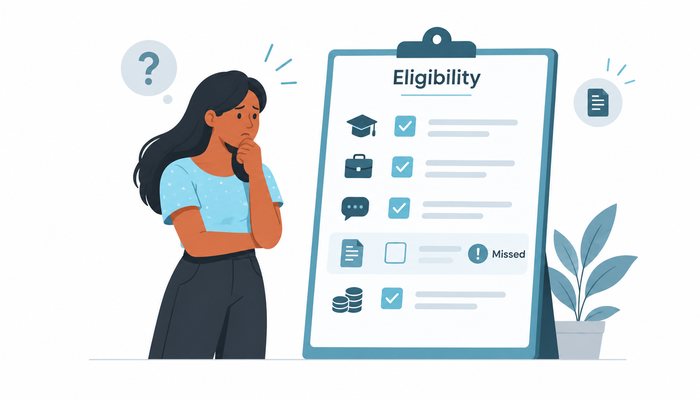
The Eligibility Requirem9ent I Completely Missed Before Applying Abroad
I thought I had checked everything.
Age.
Degree.
Work experience.
Language.
Savings.
Passport.
Job market.
I had spreadsheets, saved links and a folder full of documents.
On paper, I looked eligible.
Then I found one requirement I had completely missed.
It wasn't dramatic.
It wasn't something obvious like “you need a degree” or “you need a language test.”
It was a smaller condition buried deeper in the process.
And suddenly, the plan I had been building for months needed to change.
That experience taught me something I wish I had understood much earlier:
Immigration eligibility is rarely one big yes-or-no question.
It is usually a chain of conditions.
You can satisfy nine of them and still fail because of the tenth.
That doesn't always mean the entire relocation dream is over.
Sometimes it means you need another document.
Sometimes more work experience.
Sometimes a different pathway.
Sometimes a different timeline.
And sometimes it reveals that the route you were planning around was never the right one in the first place.
I Confused “I Look Eligible” With “I Have Verified Every Requirement”
This was my first mistake.
I had done what many people do.
I searched for phrases like:
9
“Requirements for skilled immigration.”
“Am I eligible?”
Then I compared the obvious criteria with my profile.
Degree?
Yes.
Experience?
Yes.
Language?
Probably.
Money?
Enough.
Age?
Fine.
That gave me confidence.
But confidence based on a summary page is not the same as a complete eligibility check.
Most immigration pathways contain layers.
There may be:
Basic eligibility conditions.
Document requirements.
Occupation-specific rules.
Recognition requirements.
Language thresholds.
Minimum work-experience definitions.
Financial conditions.
Job-offer conditions.
Professional licensing rules.
Status-specific requirements.
Deadlines.
Definitions that sound simple but aren't.
My mistake wasn't failing to research.
It was stopping the research too early.
The Requirement I Missed Was Hidden Inside a Definition
The problem was not necessarily a completely separate rule.
It was the way one familiar requirement was defined.
For example, a program may say:
“You need qualifying work experience.”
That sounds simple.
But then you need to ask:
What counts as qualifying?
Does it need to be paid?
Does it need to be continuous?
Does self-employment count?
Does part-time work count?
Does work completed while studying count?
Does the occupation need to match a certain classification?
How recent must the experience be?
What documents prove it?
Suddenly, one line becomes ten questions.
The same happens with education.
“Degree required” can turn into:
Is the institution accepted?
Does the foreign qualification need an assessment?
Is the degree equivalent to the required level?
Does your profession require separate recognition?
Does recognition need to happen before immigration or before employment?
Eligibility often breaks at the definition level.
The Most Dangerous Words Are the Ones That Sound Obvious
Words like:
Qualified.
Recognized.
Skilled.
Relevant.
Valid.
Sufficient.
Eligible.
Approved.
Equivalent.
They sound clear until an immigration authority defines them in a very specific way.
I learned to stop reading requirements casually.
Now, if I see:
“Relevant professional experience required,”
I want to know exactly how “relevant” and “professional experience” are defined for that process.
If I see:
“Proof of sufficient funds,”
I want to know:
How much?
For how many people?
In what form?
At what stage?
For how long must the money be available?
Are borrowed funds acceptable?
Does the balance need to be maintained?
The details matter more than the headline.
My First Reaction Was Panic
When I realized I had missed a requirement, my first thought was:
“I've wasted months.”
That wasn't entirely true.
Most of the work I had done was still useful.
My language preparation still mattered.
My savings still mattered.
My documents were still organized.
My career research was still useful.
What had changed was the pathway.
This distinction helped a lot.
Sometimes you don't have a relocation problem.
You have a pathway problem.
Those are very different things.
If one route becomes unrealistic, the next question is not:
“Should I give up?”
It is:
“What exactly failed, and what alternatives still fit my profile?”
I Built an Eligibility Matrix Instead of Reading More Articles
Reading another twenty blog posts wasn't going to solve the problem.
I needed a structured check.
So I created a simple eligibility matrix.
Requirement | What It Actually Means | My Status | Evidence | Risk |
Age | Within required range if applicable | Met | Passport | Low |
Education | Required qualification/assessment | Unclear | Degree | Medium |
Work experience | Must meet exact definition | Partial | References | High |
Language | Minimum accepted score | Not yet tested | None | High |
Finances | Required amount/evidence | Met | Bank records | Low |
Job offer | Required for this route? | No | — | High |
The important column was:
What It Actually Means
Before, I had written:
Work experience — Yes
Afterward, I wrote:
Minimum X years of qualifying experience meeting the program's exact definition — needs verification
That small change made my research much more accurate.
Step 1: Separate Mandatory Requirements From Competitive Factors
This is one of the most important distinctions.
Some conditions determine whether you can enter the process at all.
Others determine how competitive you are after becoming eligible.
Those are not the same.
Mandatory Requirement
If you don't meet it, you may not qualify for the pathway.
Examples might include:
A required qualification.
A minimum language level.
A specific amount of relevant experience.
A qualifying job offer for certain routes.
Professional recognition.
Financial requirements.
Competitive Factor
You may still qualify without maximizing it, but improving it could make selection more likely.
This distinction is particularly important in points-based systems.
You can have a good score and still fail a basic eligibility condition.
Or you can satisfy every basic condition but still be insufficiently competitive.
Always ask both:
Am I eligible?
and:
If I am eligible, am I realistically competitive?
Step 2: Check the “Before You Apply” Requirements
Some requirements must exist before you submit anything.
Others can be completed later.
This timing matters.
Suppose recognition of a qualification is needed before application.
You cannot say:
“I'll sort that out after I arrive.”
Similarly, if you need a valid language result at application, planning to take the exam three months afterward doesn't help.
Create a timeline for each requirement:
Needed before profile creation
Needed before application
Needed during processing
Needed before travel
Needed after arrival
Needed before working in profession
This prevents you from treating every task as interchangeable.
Step 3: Check Whether Your Profession Has Separate Rules
This is where many relocation plans become complicated.
Immigration eligibility and professional eligibility can be separate.
You may qualify to live in a country.
But can you actually work in the exact profession you want?
For some regulated occupations, you may need:
Recognition.
Registration.
Licensing.
Exams.
Supervised practice.
Language proof.
Additional training.
This can apply to professions such as healthcare, education, law, architecture and other regulated fields depending on the country.
So I learned to ask two questions:
Can I immigrate with my profile?
and:
Can I practice my profession with my qualifications?
Never assume the first answer automatically gives you the second.
Step 4: Verify Work Experience More Carefully
Work experience is one of the easiest areas to misunderstand.
I used to count experience the way I would on a CV:
Company A — 2 years.
Company B — 3 years.
Total — 5 years.
Immigration systems may look at it differently.
You may need to verify:
Exact dates.
Hours.
Employment type.
Whether the work was paid.
Occupation or duties.
Whether the experience falls within a particular period.
Whether freelance work is treated differently.
Whether overlapping jobs can both be counted.
Whether student employment qualifies.
And even if the experience qualifies, you need evidence.
A CV is not always evidence.
Practical Example: Amir Thinks He Has Five Years of Experience
Imagine Amir has this history:
2019–2021: Full-time engineer.
2021–2022: Full-time master's student with part-time freelance engineering work.
2022–2025: Full-time engineer.
He tells himself:
“I have six years of experience.”
But a specific immigration pathway may not count every period in the same way.
His freelance period could need stronger proof.
Work during study might be treated differently.
The duties might need to align with a specific occupational definition.
So instead of writing:
Experience: 6 years
Amir builds a table:
Period | Role | Hours | Paid? | Evidence | Clearly Qualifying? |
2019–2021 | Engineer | Full-time | Yes | Strong | Likely |
2021–2022 | Freelance | Part-time | Yes | Incomplete | Unclear |
2022–2025 | Engineer | Full-time | Yes | Strong | Likely |
Now he knows where the risk is.
That's much better than assuming.
Step 5: Don't Assume Your Degree Means What You Think It Means
A bachelor's degree from one country may not automatically be treated exactly like a bachelor's degree in another system.
Depending on the pathway, you may need:
Credential assessment.
Recognition.
Comparability.
Official transcripts.
Verification from the institution.
Professional recognition.
The terminology varies.
But the principle is simple:
Your own description of your qualification is not always the deciding factor.
The receiving institution or authority may apply its own standards.
So check early.
Qualification issues can take time to resolve.
Step 6: Language Requirements Can Be More Specific Than Expected
I once thought “good English” was enough.
That is not how formal immigration eligibility works.
A program may require:
A specific approved exam.
An overall result.
Minimum scores in each skill.
A particular language level.
Results within a certain validity period.
You can be fluent in everyday life and still not have the required formal evidence.
You can also achieve a strong overall score but miss the minimum in one component.
So I stopped asking:
“Is my English good enough?”
and started asking:
“What exact evidence does this pathway accept?”
Step 7: Financial Requirements Need Their Own Audit
This is another area where I almost relied on assumptions.
Having €20,000 in total assets doesn't necessarily mean you meet a particular financial requirement.
The authority may care about:
Liquid funds.
Ownership.
Accessibility.
Currency.
Source.
Account history.
Family size.
Timing.
Whether the money is genuinely available.
The specifics vary by route.
So create two separate numbers:
Official financial requirement
and:
Actual relocation readiness
You need both.
Step 8: Look for Requirements That Depend on Your Family Situation
A pathway may look straightforward for one person and very different for a couple or family.
Relevant questions might include:
Does family size affect required funds?
Does your spouse need documents?
Can your partner work?
Do children need additional records?
Does relationship status affect the application?
Are civil documents required?
Do any dependants have separate eligibility conditions?
Don't complete the immigration analysis as if you were moving alone when you're not.
Step 9: Check the Pathway Version and Date
This is where old information becomes dangerous.
Immigration systems change.
A blog post written two years ago may accurately describe a system that no longer exists in the same form.
A YouTube video may show a score calculation that has since changed.
A forum answer may describe rules from a different program year.
Whenever I research eligibility now, I record:
Source
Date checked
Program version if relevant
Last official update
This doesn't guarantee rules won't change later.
But it reduces the risk of building a plan around outdated information.
Why Online Eligibility Calculators Aren't Enough
Eligibility tools can be useful.
But they should be treated as screening tools, not unquestionable verdicts.
A calculator may ask:
“How many years of work experience do you have?”
You enter five.
But the calculator doesn't know whether those five years meet the formal definition.
It may ask:
“Do you have a recognized qualification?”
You click yes.
But have you actually verified recognition?
The calculator can only be as accurate as your answers.
If your interpretation is wrong, the result may be wrong too.
The Requirement You Miss Can Become Your Next Milestone
This was the biggest mindset shift for me.
Instead of saying:
“I'm not eligible.”
I started asking:
“Is this a permanent barrier or a fixable gap?”
For example:
Gap: Language Score
Potential milestone:
Prepare for six months and retest.
Gap: Experience
Potential milestone:
Continue working for another year.
Gap: Qualification Recognition
Potential milestone:
Complete the recognition process.
Gap: Savings
Potential milestone:
Save €800 per month for ten months.
Gap: Job Offer
Potential milestone:
Build targeted employer pipeline.
Gap: Occupation Doesn't Fit Route
This may require a bigger strategy change.
Not every gap is fixable.
But you need to identify the type before reacting.
Practical Example: Sara's Missed Requirement Changes Her Timeline
Imagine Sara is 29.
She has:
A master's degree.
Four years of professional experience.
Strong English.
€18,000 in savings.
She expects to apply within three months.
Then she discovers that her intended route requires a specific qualification or professional condition she hasn't yet completed.
Old reaction:
“My immigration plan is ruined.”
Better reaction:
She checks alternatives.
Option A
Complete the missing requirement.
Timeline: 9–12 additional months.
Option B
Use another pathway that fits her existing qualifications.
Timeline: potentially different.
Option C
Target a different destination with stronger alignment.
Now the missed requirement becomes decision information.
It may delay the move.
Or it may save her from pursuing the wrong pathway for years.
Don't Fall in Love With a Pathway
This is another lesson I learned.
People often become emotionally attached to a visa category.
They say:
“I'm going through Program X.”
Then new information appears.
Their profile isn't strong enough.
The occupation doesn't qualify.
The language requirement is higher.
The route changes.
Instead of adjusting, they keep trying to force themselves into the original pathway.
Your real goal is probably not:
“Obtain Program X.”
It's something like:
“Build a sustainable life and career in another country.”
A pathway is a tool.
If another tool works better, use it.
Common Mistakes When Checking Immigration Eligibility
Reading Only Summary Requirements
The detail often matters more than the headline.
Assuming Familiar Words Have Everyday Meanings
“Skilled,” “recognized” and “qualifying” may have formal definitions.
Confusing Eligibility With Competitiveness
Meeting minimum conditions does not guarantee selection.
Ignoring Professional Licensing
Immigration permission and professional permission may be separate.
Counting Work Experience Too Casually
Exact definitions and evidence matter.
Assuming a Degree Automatically Qualifies
Assessment or recognition may be required.
Treating Language Ability as the Same as Language Evidence
Formal proof may be needed.
Trusting an Old Article or Video
Always check current official information.
Giving Up After Finding One Problem
First determine whether the issue is fixable or whether another route fits better.
What Nobody Tells You About Immigration Eligibility
The hardest part isn't always meeting requirements.
Sometimes it's discovering which requirement matters before you've already spent money.
Before finding the issue, I had been thinking about:
Flights.
Housing.
Moving dates.
What city I wanted.
What my first apartment might look like.
Afterward, I realized I had mentally skipped several stages.
That was useful.
Because eligibility research is not supposed to confirm the plan you already want.
It is supposed to test it.
And sometimes the most valuable result is:
“This plan isn't ready yet.”
That can save you from:
Unnecessary applications.
Wrong degrees.
Expensive translations.
Poor job decisions.
Premature resignation.
Moving money too early.
Building your entire life around a route that doesn't fit.
This is also a great point to speak with someone who has gone through a similar process.
Not because another expat can determine your legal eligibility.
They can't.
But they can help you identify questions you may not know to ask.
Try:
“Which requirement surprised you?”
“What did you misunderstand at first?”
“Which document took much longer than expected?”
“Did you discover any career or qualification issue after arriving?”
Then take those questions back to the current official sources.
That's the useful combination:
Lived experience helps reveal blind spots.
Official information confirms the rules.
My Eligibility Audit Checklist
Program Basics
Confirm exact immigration pathway
Confirm purpose of pathway
Check current official source
Record date checked
Personal Profile
Age requirement checked
Nationality conditions checked
Education checked
Work experience checked
Language checked
Financial requirements checked
Job-offer conditions checked
Family situation checked
Qualifications
Degree comparability checked
Recognition requirements checked
Professional regulation checked
Licensing requirements checked
Required assessments identified
Work Experience
Exact qualifying definition checked
Dates verified
Hours verified
Duties verified
Evidence available
Self-employment treatment checked if relevant
Student work treatment checked if relevant
Documents
Passport valid
Academic records ready
Employment references ready
Language evidence ready
Financial evidence ready
Translation requirements checked
Authentication requirements checked
Strategy
Mandatory requirements separated from ranking factors
Fixable gaps identified
Alternative pathway identified
Timeline updated
Plan reviewed before spending major money
Conclusion: Eligibility Is a Chain, Not a Checkbox
The requirement I missed changed how I approach immigration research.
I stopped asking:
“Do I qualify?”
as if there were one answer.
Now I ask:
“What exactly must be true for this pathway to work, and have I verified every part?”
Break the program into individual requirements.
Read the definitions.
Check your profession.
Verify your experience.
Confirm your education.
Understand the language evidence.
Check the financial conditions.
Look for timing requirements.
Separate eligibility from competitiveness.
And record what you still don't know.
Where formal immigration rules are involved, verify current information directly with the relevant official authorities before submitting applications or making major financial and career decisions.
Finding a missing requirement can be frustrating.
But discovering it before you resign, pay tuition, book flights or submit the wrong application is far better than discovering it afterward.
Sometimes the requirement you completely missed is exactly the information that saves your relocation plan.
FAQ
What are immigration eligibility requirements?
They are the conditions an applicant must meet to qualify for a specific immigration pathway. These can include education, work experience, language, finances, employment, professional qualifications and other program-specific factors.
Why do people miss immigration requirements?
Many requirements contain detailed definitions that are easy to overlook. Applicants may also rely on summaries, outdated information or assumptions about terms such as qualifying experience or recognized qualifications.
Does meeting the minimum requirements guarantee immigration approval?
No. Some systems separate basic eligibility from competitive selection, and applications can also involve document verification and other assessment stages.
What should I do if I discover I'm not eligible?
Identify the exact gap first. Some gaps may be improved through additional experience, language preparation, savings or qualification processes. If not, investigate other pathways or destinations.
Can my work experience be rejected even if I've worked for several years?
Potentially. A program may define qualifying work experience according to occupation, duties, timing, hours, employment type or other factors. Evidence also matters.
Does having a university degree automatically satisfy education requirements?
Not always. Depending on the pathway or profession, a foreign qualification may require assessment, comparability or formal recognition.
How can I avoid missing an immigration requirement?
Create a requirement-by-requirement eligibility matrix using current official sources, record how each condition is defined, identify the evidence required and flag anything that remains uncertain before making major commitments.